
RADIO CONTROL GIANTS - 2005/01
Sal Calvagna, 1335 Broadway Ave., Holbrook NY 11741; E-mail: ncalvagn@suffolk.lib.ny.us
HAPPY NEW YEAR to all readers and their families.
September 11–12, 2004, I attended the 38th annual Rhinebeck Jamboree sponsored by the Mid Hudson R/C Society. The Jamboree is held at the world-famous Old Rhinebeck Aerodrome in Rhinebeck, New York.
In the past, the Jamboree was a competitive event. For a number of reasons, it has changed to a simpler, popular, noncompetitive get-together that is similar to today’s typical International Miniature Aircraft Association (IMAA) event. Participation is limited to scale models of aircraft built and flown before December 31, 1939, and no aircraft that flew in combat during World War II are allowed.
Modeling early aircraft is a popular theme that makes the Rhinebeck Jamboree a favorite to attend. Since the Old Rhinebeck Aerodrome is a mecca of full-scale early aviation, this just compounds the attraction.
The Jamboree weekend is one of the best-attended at the Aerodrome. Each day, spectators are treated to a model show for the first half of the day, followed by the full-scale show in the afternoon. At least a couple hundred models were present this year, including everything from Blackburn monoplanes to Golden Age racers.
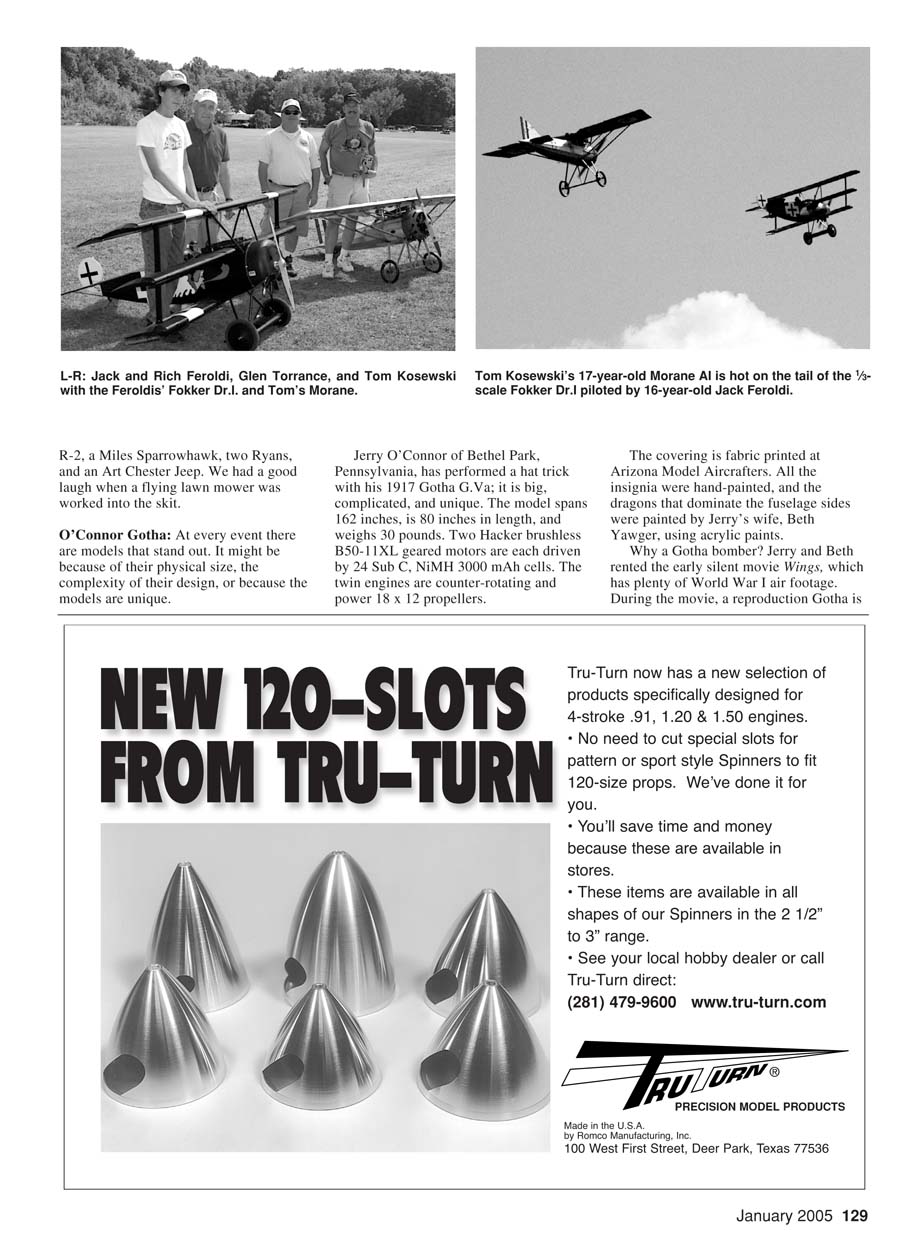
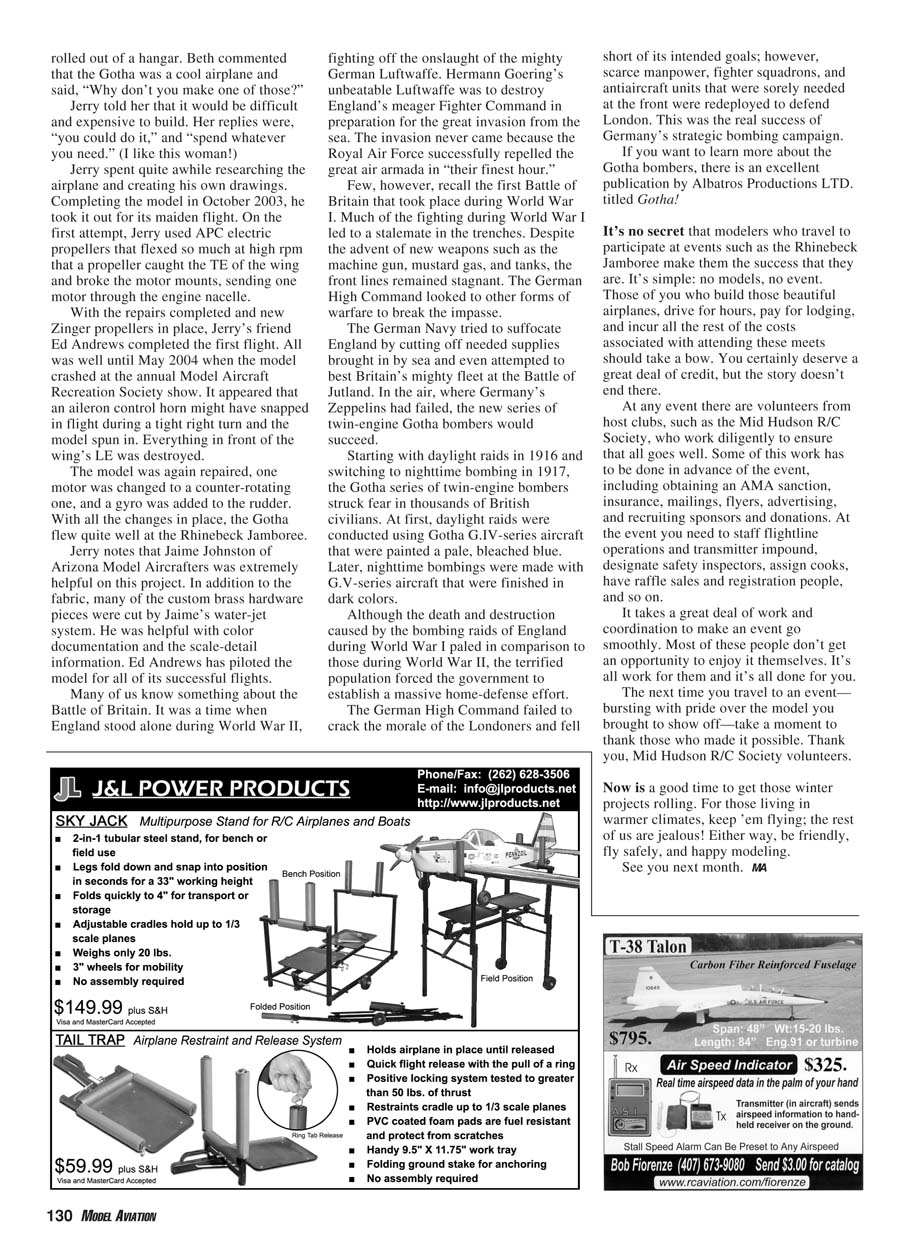
At approximately 1 p.m. each day, open flying ceases and a choreographed model show takes place. Several 1/3-scale Balsa USA Sopwith Pups were in the air, and there was a mock dogfight between Tom Kosewski’s Morane-Saulnier Type AI and Rich and Jack Feroldi’s 1/3-scale Fokker Dr.I triplane.
Another treat was the Golden Age pylon race between a Gee Bee R-2, a Miles Sparrowhawk, two Ryans, and an Art Chester Jeep. We had a good laugh when a flying lawn mower was worked into the skit.
O'Connor Gotha
At every event there are models that stand out. It might be because of their physical size, the complexity of their design, or because the models are unique.
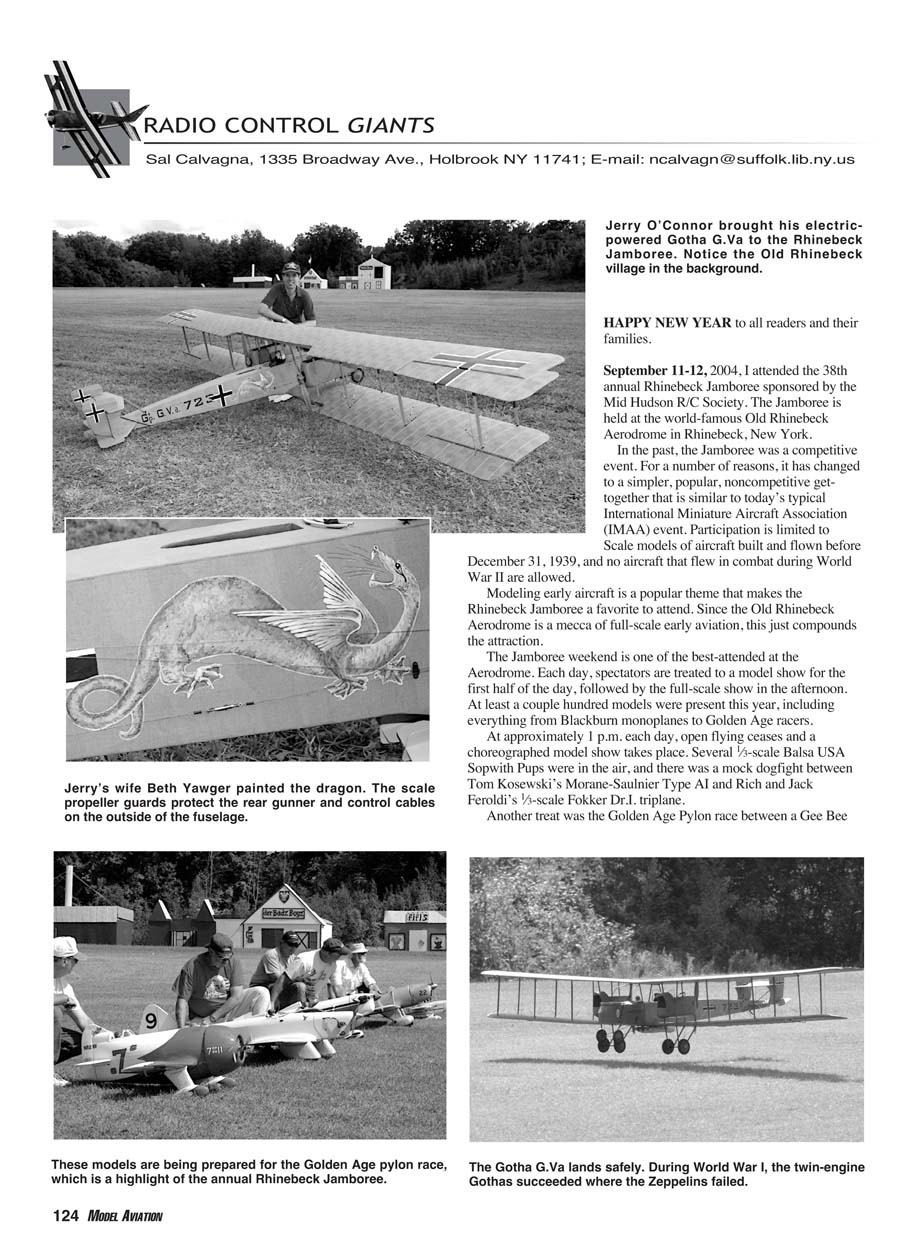
Jerry O’Connor of Bethel Park, Pennsylvania, has performed a hat trick with his 1917 Gotha G.Va; it is big, complicated, and unique. The model spans 162 inches, is 80 inches in length, and weighs 30 pounds. Two Hacker brushless B50-11XL geared motors are each powered by 24 Sub-C NiMH cells (3000 mAh). The twin engines are counter-rotating and turn 18 x 12 propellers.
The covering is fabric printed at Arizona Model Aircrafters. All the insignia were hand-painted, and the dragons that dominate the fuselage sides were painted by Jerry’s wife, Beth Yawger, using acrylic paints.
Why a Gotha bomber? Jerry and Beth rented the early silent movie Wings, which has plenty of World War I air footage. During the movie, a reproduction Gotha is rolled out of a hangar. Beth commented that the Gotha was a cool airplane and said, “Why don’t you make one of those?” Jerry told her that it would be difficult and expensive to build. Her replies were, “you could do it,” and “spend whatever you need.” Jerry spent quite a while researching the airplane and creating his own drawings. Completing the model in October 2003, he took it out for its maiden flight.
On the first attempt, Jerry used APC electric propellers that flexed so much at high rpm that a propeller caught the trailing edge (TE) of the wing and broke the motor mounts, sending one motor through the engine nacelle. With the repairs completed and new Zinger propellers in place, Jerry’s friend Ed Andrews completed the first successful flight.
All was well until May 2004 when the model crashed at the annual Model Aircraft Recreation Society show. It appeared that an aileron control horn might have snapped in flight during a tight right turn and the model spun in. Everything in front of the wing’s leading edge was destroyed.
The model was again repaired, one motor was changed to a counter-rotating unit, and a gyro was added to the rudder. With all the changes in place, the Gotha flew quite well at the Rhinebeck Jamboree.
Jerry notes that Jaime Johnston of Arizona Model Aircrafters was extremely helpful on this project. In addition to the fabric, many of the custom brass hardware pieces were cut by Jaime’s water-jet system. He was helpful with color documentation and the scale-detail information. Ed Andrews has piloted the model for all of its successful flights.
Gotha bombers and the First Battle of Britain
Many of us know something about the Battle of Britain. It was a time when England stood alone during World War II, fighting off the onslaught of the mighty German Luftwaffe. Hermann Goering’s unbeatable Luftwaffe was to destroy England’s meager Fighter Command in preparation for the great invasion from the sea. The invasion never came because the Royal Air Force successfully repelled the great air armada in “their finest hour.”
Few, however, recall the first Battle of Britain that took place during World War I. Much of the fighting during World War I led to a stalemate in the trenches. Despite the advent of new weapons such as the machine gun, mustard gas, and tanks, the front lines remained stagnant. The German High Command looked to other forms of warfare to break the impasse.
The German Navy tried to suffocate England by cutting off needed supplies brought in by sea and even attempted to best Britain’s mighty fleet at the Battle of Jutland. In the air, where Germany’s Zeppelins had failed, the new series of twin-engine Gotha bombers would succeed.
Starting with daylight raids in 1916 and switching to nighttime bombing in 1917, the Gotha series of twin-engine bombers struck fear in thousands of British civilians. At first, daylight raids were conducted using Gotha G.IV-series aircraft that were painted a pale, bleached blue. Later, nighttime bombings were made with G.V-series aircraft that were finished in dark colors.
Although the death and destruction caused by the bombing raids of England during World War I paled in comparison to those during World War II, the terrified population forced the government to establish a massive home-defense effort.
The German High Command failed to crack the morale of the Londoners and fell short of its intended goals; however, scarce manpower, fighter squadrons, and antiaircraft units that were sorely needed at the front were redeployed to defend London. This was the real success of Germany’s strategic bombing campaign.
If you want to learn more about the Gotha bombers, there is an excellent publication by Albatros Productions Ltd. titled Gotha!
Volunteers and thanks
It’s no secret that modelers who travel to participate at events such as the Rhinebeck Jamboree make them the success that they are. It’s simple: no models, no event. Those of you who build those beautiful airplanes, drive for hours, pay for lodging, and incur all the rest of the costs associated with attending these meets should take a bow. You certainly deserve a great deal of credit, but the story doesn’t end there.
At any event there are volunteers from host clubs, such as the Mid Hudson R/C Society, who work diligently to ensure that all goes well. Some of this work has to be done in advance of the event, including obtaining an AMA sanction, insurance, mailings, flyers, advertising, and recruiting sponsors and donations. At the event you need to staff flightline operations and transmitter impound, designate safety inspectors, assign cooks, have raffle sales and registration people, and so on.
It takes a great deal of work and coordination to make an event go smoothly. Most of these people don’t get an opportunity to enjoy it themselves. It’s all work for them and it’s all done for you.
The next time you travel to an event—bursting with pride over the model you brought to show off—take a moment to thank those who made it possible. Thank you, Mid Hudson R/C Society volunteers.
Now is a good time to get those winter projects rolling. For those living in warmer climates, keep ’em flying; the rest of us are jealous! Either way, be friendly, fly safely, and happy modeling.
See you next month.
MA
Transcribed from original scans by AI. Minor OCR errors may remain.

