
Radio Control Giants
Sal Calvagna [ncalvagn@suffolk.lib.ny.us]
Views from an East Coast Scale Masters qualifying event
I want to take this opportunity to wish all of you and your families a happy and healthy new year.
In this issue I will share some photos that I took on a trip to Virginia and others from a local Scale Masters Qualifier that I attended in August 2006.
Stinson SR-9C
Dick Smith of Waynesboro, Virginia, built a beautifully finished Stinson SR-9C from a Top Flite kit. The model spans 100 inches and weighs 22.5 pounds. The Stinson is powered by a Quadra Q-35 gas engine and is finished with Nelson Hobby covering material and paint system. Following instructions, Dick brushed the paint on. He is extremely satisfied with the results and recommends Nelson Hobby paint. If you look closely at the photos you can see some of the detail Dick added, including rivets, pitot tube, rib stitching, and much more.
- Span: 100 inches
- Weight: 22.5 pounds
- Engine: Quadra Q-35 gas
- Covering/finish: Nelson Hobby covering material and paint (brushed)
- Added details: rivets, pitot tube, rib stitching
- Kit modifications: replaced ABS cowling and wheel pants with fiberglass parts purchased from Stan's Fiber Tech
Background on the Stinson Detroiter: In 1920 Eddie Stinson formed the Stinson Airplane Company in Dayton, Ohio. A few years later he relocated to Detroit, Michigan, where some local businessmen supported his plan to establish the Stinson Aircraft Syndicate and provided $25,000 to develop a new monoplane. The six-seat Stinson Detroiter made its first flight in January 1926. The aircraft was heated and had a soundproof cabin, electric starter, and wheel brakes. The Detroiter was stable in flight and became an instant success, which enabled Stinson to obtain $150,000 in public capital to incorporate the Stinson Aircraft Corporation in May 1926. Shortly afterward Stinson started to refine his design and business steadily increased.
As fate would have it, Stinson never enjoyed the success of his company. While on a sales trip in January 1932, he died in an aircraft accident at the age of 38. His newest designs, the 1931 Model W and the Model R-2/3, were the predecessors to the most famous of the Stinson line: the Reliant, which was first introduced in 1933.
Between 1933 and 1941 the Stinson Aircraft Corporation built more than 1,300 Reliants, from the SR-1 to the SR-10. The later variant had leather upholstery, walnut instrument panels, and automobile-type roll-down windows. In 1936 the classic Gull Wing was introduced with the SR-7 model.
The airplane was known for its ease of handling and its state-of-the-art navigation and communication radios. During World War II many privately owned aircraft were requisitioned by the military for various transport and liaison duties. The SR series did not escape this process and 45 aircraft were initially requisitioned for military service. They were rugged airplanes built from fabric-covered, welded-steel tubing with a single strut-braced, double-tapered wing. They could fly at speeds of nearly 165 mph. The SR was one of the most beautiful aircraft built during the Golden Age of Aviation.
For more information on the Top Flite model: www.top-flite.com/airplanes/topa0310.html For more information about the Nelson Hobby paint system: www.nelsonhobby.com/paint.html Nelson Hobby Direct: Box 1327, Keller TX 76244
Yak-54
Kit components include stabilizer, control horns, hinges, wheel pants, and SAE bolts and nuts.
For more information about the Yak-54 model, please visit the Troybuilt Web site: www.troybuiltmodels.com/AMY54.htm
Dauntless SBD
Tony Kirchenko of East Setauket, New York, built the Dauntless in the picture from Ziroli plans. It has a wingspan of 100 inches. The model has 1,750 square inches of wing area and was designed to be powered by a 3.7–5.2 cu. in. gas engine.
In the photo the model is performing a dirty pass (gear down, flaps down, and tailhook extended) at the Scale Masters Qualifier. For more information about the Dauntless SBD model, please visit the Ziroli Plans Web site: www.ziroliplans.com/cat_frameset.html
Historical note: The Dauntless flew into history on June 4, 1942, when the 36 aircraft of Scouting Squadron 6 and Bombing Squadron 6 from the USS Enterprise arrived over the main Japanese fleet. Previous attempts to attack the Japanese carriers had failed because of the air cover provided by the nimble Zeros.
Japanese aircraft returning from successful attacks on Midway Island were taken aboard the four carriers and reloaded with antishipping weapons to attack American carriers thought to be in the area. The aircraft were rearmed to strike Midway Island for a second time, and when the first aircraft sped forward on the flight decks for takeoff, Bombing Squadron 6 was entering its dives to attack.
There were no Zeros at altitude to protect the fleet from this U.S. attack, and in slightly less than 10 minutes three of the large Japanese carriers were in flames. The last Japanese carrier sank soon after. The Dauntless did more than any other aircraft to turn the tide of the war in the Pacific.
When the more modern and powerful Curtiss Helldiver went into action as the Dauntless replacement, it was soon realized that the Helldiver was inferior to the aircraft it was to replace.
Since color film and photography was not widely available during the war, most photographic documentation of these aircraft remains in black-and-white. Historians quibble over old photos, looking at the subtle differences in the shades of gray to attempt to discern the true colors.
Period writings and eyewitness accounts tell us how colorful many of the aircraft were. Even swatches of fabric remain that show us that bold colors were often used; however, since the ability to reproduce color on any medium except oils on canvas back in those days wasn't possible, we tend to see this conflict in the drab photographic colors of black, white, and gray.
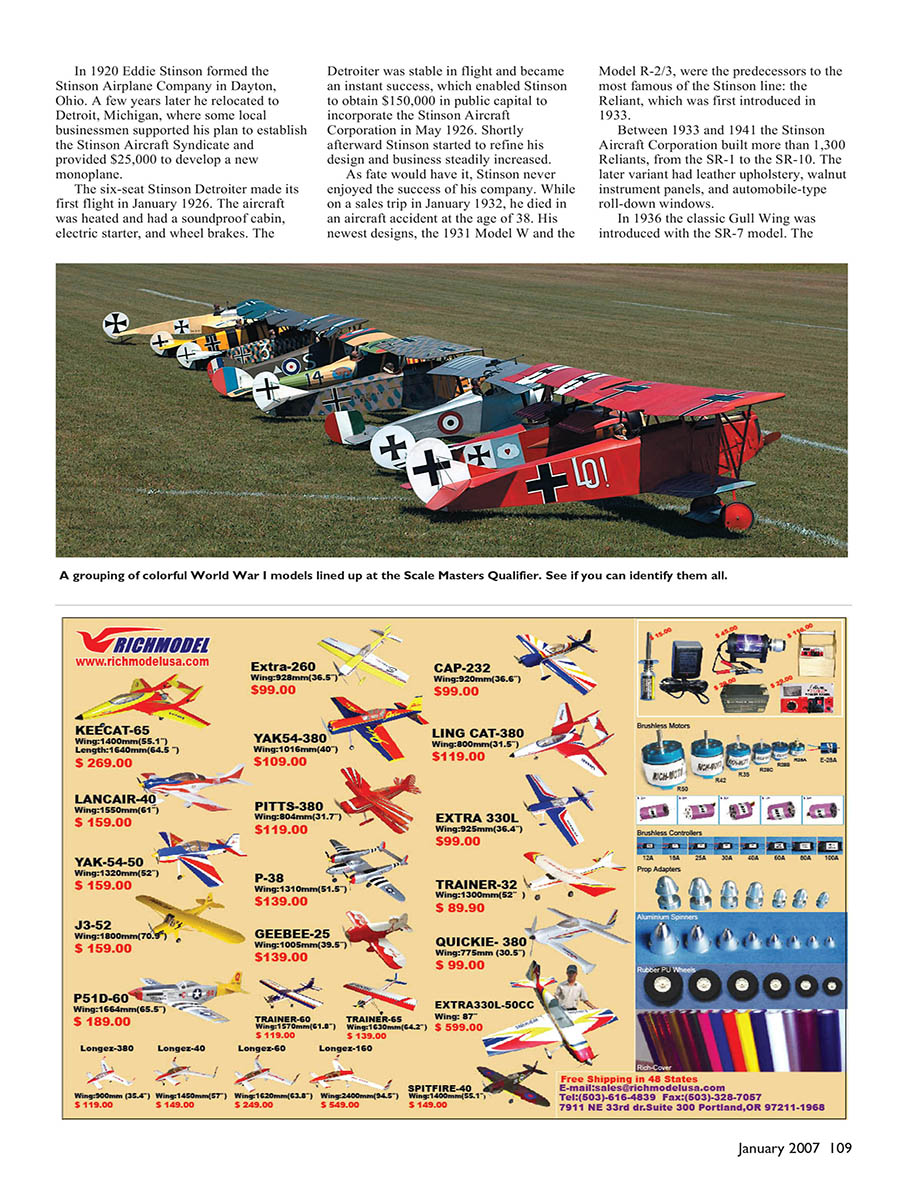
Take a good look at the lineup of models. Although the colors may not be completely accurate, this photo gives you an idea of how these aircraft could have looked back in the teens of 1900s.
That's all for now. If you're working on an RC Giant for the winter, take a couple of photos and send them to me. I would like to share what's on your workbench.
MA
Transcribed from original scans by AI. Minor OCR errors may remain.

