
Radio Control: Giants
John A. de Vries
4610 Moffat Lane, Colorado Springs, CO 80915
Back in 1950 the Air Force decided to move yours truly. It was a major displacement—from Moses Lake, Washington, to Panama City, Florida. Like other Air Force moves, professional packers showed up at the house to box up the family's belongings and furniture for shipment. It turned out to be a traumatic experience, as far as I was concerned.
At the time, I had a beautiful U-Control model of the Laird Solution, winner of the 1930 Thompson Trophy Race. It was crafted using Cleveland Dwarf (1/2-inch-to-the-foot) drawings, and was powered by a Cox Infant .020 engine.
When it came time to box my models, the packers didn't have one that really fit the Laird. In order to tuck it away for the trip to Florida, the packers literally ripped off the upper wing and collapsed the wire landing gear back to the fuselage. So much for the Solution—it never flew again!
Four years later, when I left Panama City for Albuquerque, New Mexico, I recalled the unfortunate moving experience and decided to pack my models myself rather than leaving them to the tender ministrations of the packers.
First, I found heavy-duty cardboard boxes that would hold the one-piece U-Control planes. Then, I almost filled the boxes with crumpled newspapers.
Next, I pushed the models into the nest and crumpled a lot more paper to cover them before taping the boxes shut. They easily survived the move.
The free flights in the shop had their wings removed and packaged together in long, thin, heavy-duty cardboard boxes. I found space in the car for the fuselages—not willing to trust them to truck shipment.
Leaving Albuquerque for Fairbanks, Alaska, I knew that all of my currently flightworthy models would have to be put in storage. By this time, the models were RC (single-channel) and were essentially fragile free fighters, rudder-only. Thus was born the coffin, and a career as a cabinet maker.
After measuring all the models I wanted to keep, I constructed two sturdy storage boxes using 1/4-inch plywood with one-inch-square pine at the corners for reinforcement. The wings were strapped to the sides of the box, with foam rubber spacers between them, and the fuselages, with tail feathers attached, were strapped to the bottom and top. The straps were suede leather that I'd acquired at a Tandy's leathercraft store.
I added one-inch square skids under the coffins to make them easy to pick up. They worked well, with one exception. When they were reopened, in Washington, D.C., the foam rubber had adhered to the wings, and I had to recover and repaint some panels where things had stuck together. Then, too, the straps had spread the wire landing gear, and they had to be reformed to provide prop clearance. Good try, but no cigar!
The move to Colorado Springs found the coffins filled with RC wings, separated this time with thin polystyrene foam blocks. The fuselages traveled west in the back of the Olds station wagon. A perfect move—no damage, and no repairs were necessary. The next move was to Mons, Belgium!
Calling once again on my cabinet-making skills, I constructed the ultimate coffin, using 1/4-inch plywood and a complete frame of pine molding. The new box contained three RC scale planes—a Great Lakes Trainer, a Sterling Spitfire, and a three-channel Mighty Mambo.
The wings were spaced again with foam blocks and attached to the sides of the box. The fuselages were held in place by suede straps, but I'd hot-wired some white foam wedges that fit under the fuselages and held them off the top and bottom of the box. Heretofore, the straps had been tacked in place, but they tended to come adrift from the hard plywood.
For the European move, the straps were held in place with pop rivets that had large, thin washers under their heads. It required drilling a lot of 1/8-inch holes in the box, but they positioned the pop rivets perfectly. I included a taped-down cardboard box containing a supply of suede strips, pop rivets, and washers, in anticipation of the move back home.
Both the Great Lakes and Spitfire survived the European tour, so it was relatively easy to repack the coffin for the return trip to the States. With all this ricocheting around the world, I've come to some conclusions concerning packing models of all sizes.
- The box
- Unless you can hand-carry a model or models in your car or van from the old house to the new house, they should be enclosed in a crush-proof and puncture-proof box. The box should be made of wood and should be screwed and glued together. You have to assume that your model, box or boxes will end up under some other boxes or pieces of furniture at some time during their travels. Transmitters and other radio components not installed within models should be packed in foam-lined hard cases.
- Immobilize the models
- The models should be immobilized within their box or boxes. Moving involves shifting things around. An unrestrained scale plane will bonk into the sides of its container if it isn't strapped down. A minimum of three straps are required to hold a fuselage in position, and foam blocks that are glued to the interior of the box should be used at the nose and along their sides.
- A foam block should be used beneath a fuselage to prevent the hold-down straps from collapsing the landing gear. For tail-draggers, a wedge-shaped block of foam should be used to hold fuselages away from the floor or roof of the wooden box. For a tricycle-gear model, the foam block should be square in cross section. Make sure that no model component can touch another within the coffin.
- Straps
- Straps used to hold models in position within a box should be soft—not tightened to the point where they crush a model's structure. Thin suede strips, with the rough side toward the model, are ideal since they keep things from shifting. The suede straps should be about two inches wide. Tacks, screws or pop rivets can be used to fix the suede straps—pop rivets are preferred, using large, thin washers. Tacks and screws pose the problem of hammering or wielding a screwdriver next to a fragile model within a box—not a particularly good idea.
- Handling and access
- Adding skid strips to the bottom of a model coffin makes it easier to pick up the relatively large, but light, plywood box. For the European coffin, I added hand holds to the ends of the box (leftover quarter-round molding) that made it even easier to shift around. It's a good idea to screw the top or lid to the coffin, particularly if you intend to use it for a subsequent move.
- Final rule
- Unless you know that a packer is a member of your AMA model club, and can display a current AMA license, don't let him (or her) anywhere near your models! When it comes time to move, pack your own planes. Although "packed-by-owner" relieves your mover from liability for the condition of your models when they arrive at your new house, the chances of having flyable models is a lot better if you box them yourself.
Some modelers are inclined to wrap wings in foam, with big blocks of foam over wingtips, and stick them in wardrobe boxes along with clothes. It works if the clothes are tightly packed and soft, to boot, but cardboard wardrobes are subject to puncture wounds. So if you use them, make sure you stick the wings in the middle of the box.
Never pack model fuel or other flammables for a major move. It isn't allowed by most moving companies and you can replenish your supply of fuel, paint, or other flammables when you settle down in your new house.
NASA (National Association of Scale Aeromodelers)
A plug for our friends at NASA: they're the outfit to join if you have an interest in scale model flight in all of its aspects. They've published the Scale Masters Judging Guide—24 pages of great information. It costs two bucks, and may be obtained by writing to NASA secretary/treasurer Bert Dugan at 1090 Phyllis Drive, Clio, MI 48420. Bert is also the contact to join NASA—it's only eight dollars a year, and puts you on the list for the great NASA newsletter.
A parable
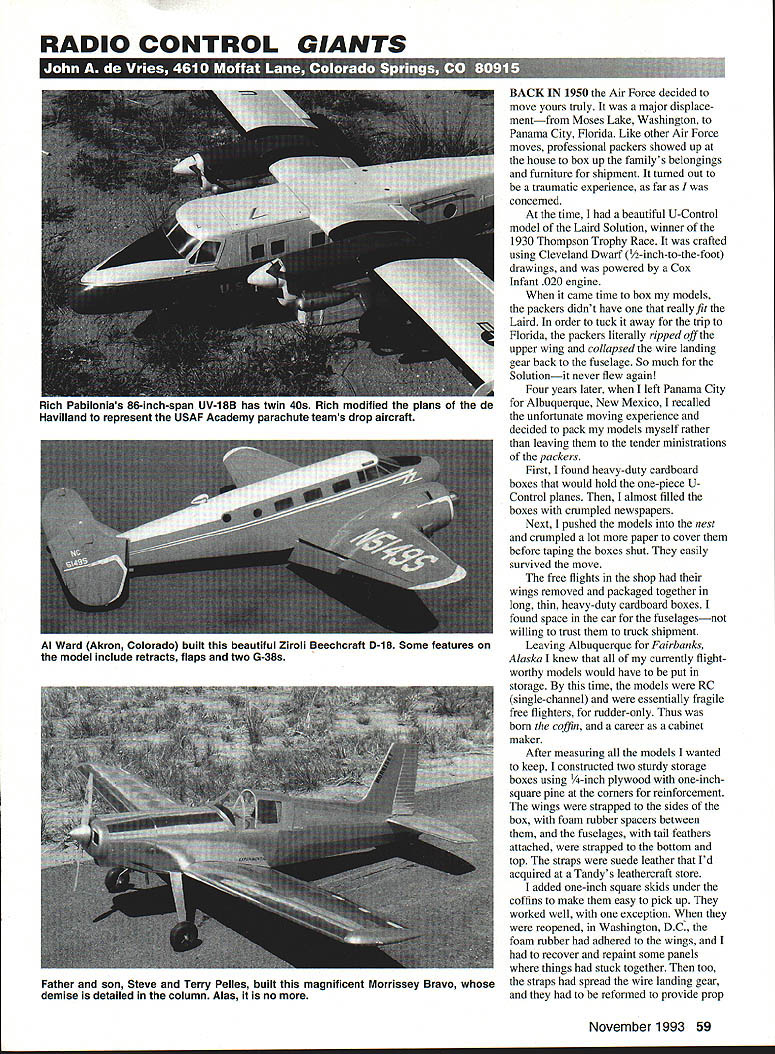
The moral of the story is that you can't be too sure of anything when it comes to flying your giant-scale model. A couple of years ago the Pelles, dad Steve and son Terry, acquired a Sig Morrissey Bravo kit. They went all out and contacted the designer of the real aircraft for documentation information. With the good data in hand, they proceeded to modify the model to an early single-seat version of the aircraft.
They acquired a new engine and a new radio, specifically for the outstanding scale model they were building. Their documentation and building efforts were blessed by a truly beautiful model. It glinted silver and blue in the sunlight of the club field.
Steve and Terry called on the talents of one of the best fliers in the club for the first flight of their beauty. All went well as the test flight began—the model responded precisely as it should have. But, a turn and a different aspect of the airborne giant, and both engine and elevator control were lost! The Morrissey went straight in, with the usual results: a complete re-kitting job.
As most modelers do after the trauma of a crash, the Pelles examined the wreckage. There, underneath the receiver, was the reason for the splatter. Neatly wound in a coil was the receiver antenna, just like it came from the factory!
Despite the years of construction effort and all the normal checks, they'd never unwound the antenna, to say nothing of leading it out of the fuselage of the metallic-coated model. Even the ground range check hadn't revealed the potential lack of control because the transmitter/receiver relationship remained relatively constant.
Steve was amenable to including the report of the loss of his beautiful model in this column. If it happened once, it could happen again. The magic phrase around his household is: "Make sure the receiver antenna is outside of the bird for assured radio control."
We won't be with you next month because the issue will be devoted to the Nationals. In the meantime, keep those giants flying!
Transcribed from original scans by AI. Minor OCR errors may remain.

