
RADIO CONTROL GIANTS
John A. de Vries
4610 Moffat Lane, Colorado Springs, CO 80915
Avro Lancaster BIII Special — "The Dambuster"
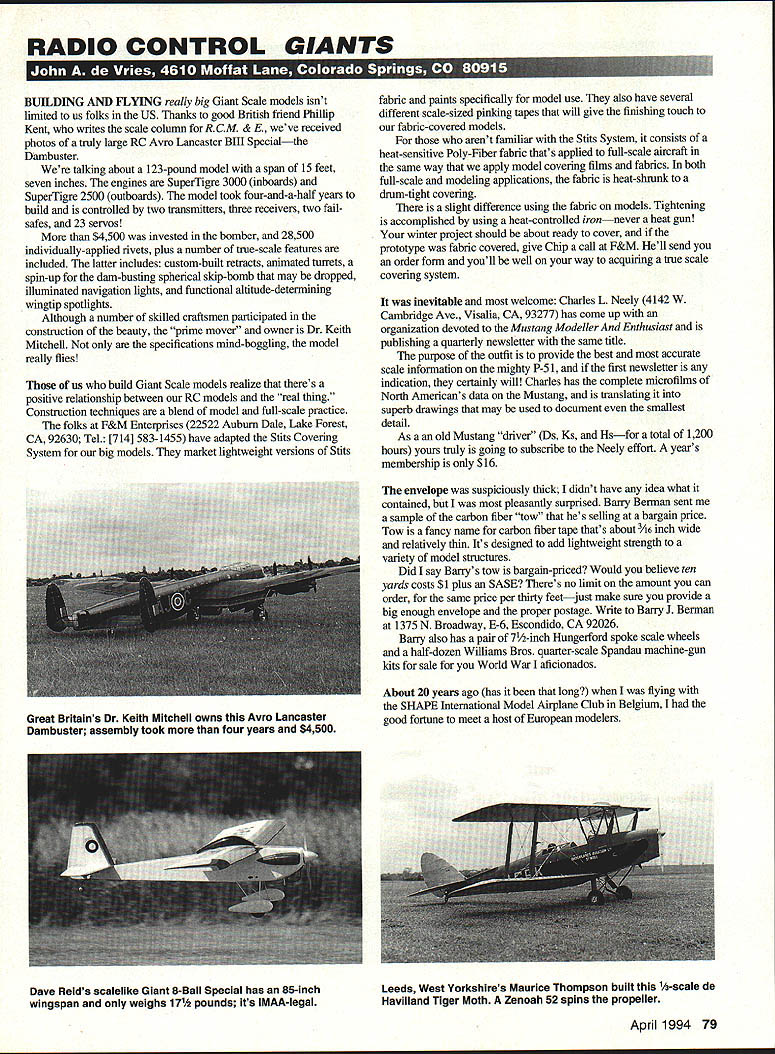
Building and flying really big Giant Scale models isn't limited to folks in the U.S. Thanks to British friend Phillip Kent, who writes the scale column for R.C.M. & E., we've received photos of a truly large RC Avro Lancaster BIII Special — the Dambuster.
Key facts:
- Weight: 123 pounds
- Wingspan: 15 ft 7 in
- Engines: SuperTigre 3000 (inboards) and SuperTigre 2500 (outboards)
- Construction time: four-and-a-half years
- Control: two transmitters, three receivers, two failsafes, 23 servos
- Cost: more than $4,500 invested
- Details: 28,500 individually applied rivets and numerous true-scale features
Scale features include custom-built retracts, animated turrets, a spin-up for the dam-busting spherical skip-bomb that may be dropped, illuminated navigation lights, and functional altitude-determining wingtip spotlights. Although a number of skilled craftsmen participated in the construction, the prime mover and owner is Dr. Keith Mitchell. Not only are the specifications mind-boggling, the model really flies!
Those of us who build Giant Scale models realize there's a positive relationship between our RC models and the "real thing." Construction techniques are a blend of model and full-scale practice.
Stits Covering System (F&M Enterprises)
F&M Enterprises (22522 Auburn Dale, Lake Forest, CA 92630; Tel: [714] 583-1455) have adapted the Stits Covering System for big models. They market lightweight versions of Stits fabric and paints specifically for model use, and offer several scale-sized pinking tapes to finish fabric-covered models.
For those unfamiliar with the Stits System: it consists of a heat-sensitive Poly-Fiber fabric applied to full-scale aircraft in much the same way we apply model covering films and fabrics. In both full-scale and modeling applications, the fabric is heat-shrunk to a drum-tight covering.
There is a slight difference using the fabric on models: tightening is accomplished with a heat-controlled iron — never a heat gun. If your winter project is about ready to cover and the prototype was fabric-covered, contact Chip at F&M. He'll send an order form and you'll be on your way to acquiring a true scale covering system.
Mustang Modeller and Enthusiast (Charles L. Neely)
Charles L. Neely (4142 W. Cambridge Ave., Visalia, CA 93277) has formed an organization devoted to the Mustang modeller and enthusiast and is publishing a quarterly newsletter of the same name. The group's purpose is to provide the best and most accurate scale information on the P-51. Neely has complete microfilm of North American's data on the Mustang and is translating it into superb drawings that document even the smallest detail.
A year's membership is only $16.
Carbon Fiber Tow (Barry Berman)
Barry Berman sent a sample of carbon fiber "tow" he's selling. Tow is a narrow carbon fiber tape (about 3/16 in wide) designed to add lightweight strength to model structures.
Pricing and items:
- Ten yards costs $1 plus an SASE (no limit on quantity for the same price per thirty feet — just provide a large enough envelope and proper postage)
- Contact: Barry J. Berman, 1375 N. Broadway, E-6, Escondido, CA 92026
Barry also offers:
- 7-1/2 in Hungerford spoke scale wheels
- Williams Bros. quarter-scale Spandau machine-gun kits for WWI modelers
Transmitter Trays and Safety
About 20 years ago, while flying with the SHAPE International Model Airplane Club in Belgium, I noticed most European RC fliers were addicted to transmitter trays. The trays allowed more precise control because fliers didn't have to grip both sticks and the transmitter box.
Today in the U.S., the neck strap is common. Most transmitters include a bracket for a neck strap, but there's a dangerous aspect: if you forget you're wearing one and crank up a Giant Scale engine, the strap can become entangled in a spinning prop. Bill Law of Pacific Northwest Industries suffered such an accident and sought a safer system.
He developed the PNI Transmitter Tray — a European-style tray improved with palm rests so the user only moves the fingers. Features:
- Aluminum construction, fully adjustable
- Soft plastic foam padding on shoulder straps
- Compatible with transmitter mounts
- Detachable suspension strap assembly
- Extra trays available to slip in/out of several transmitters using the same suspension assembly
Request a brochure and current price from Pacific Northwest Industries, 9658 Ronald Drive, Blaine, WA 98230 (SASE).
Seidel Radial Engines and Hansen Video
The ultra engines for Giant Scale are the Seidel radials from Germany. Expensive, but they are true scale four-stroke radials. Vic Hansen's latest video gives a good appreciation of why Seidels are worth the cost. The tape includes:
- 22 minutes touring the Seidel factory with jigs and fixtures used to produce smooth-running radials
- 32 minutes covering Toledo 1993
Contact Vic at Hansen Scale Aviation Video, 10807 S.E. E. Stacy Ct., Portland, OR 97266.
Reid's 8-Ball Special Kit (Dave Reid)
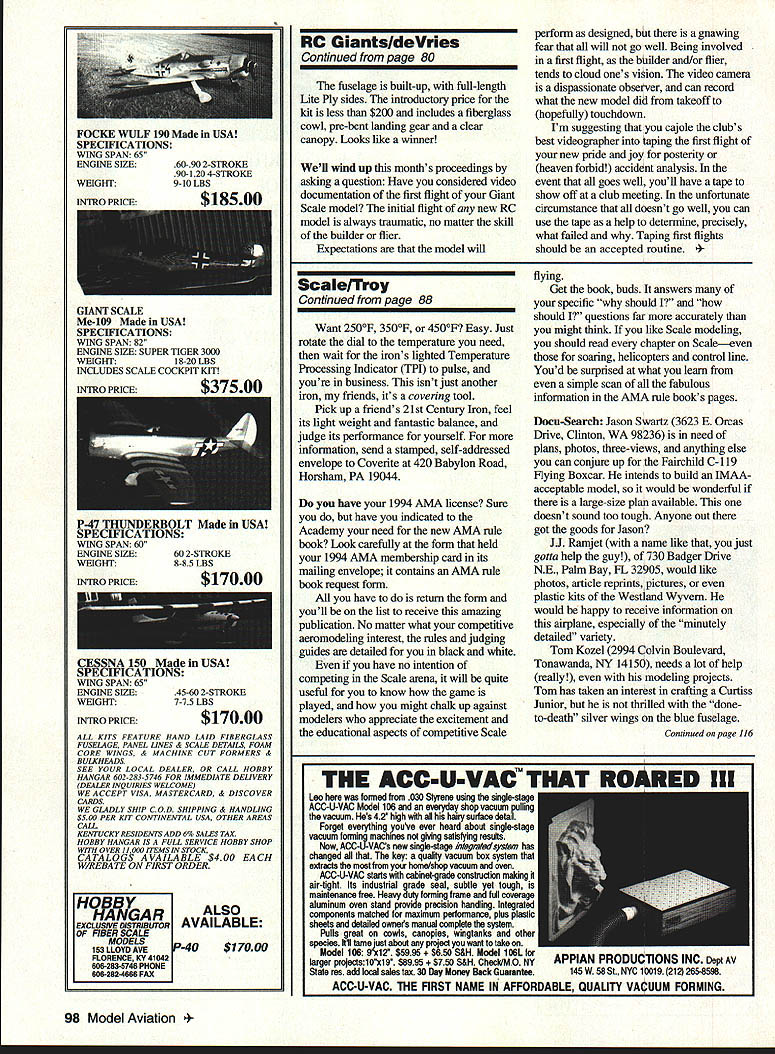
Dave Reid (Reid's Quality Model Products, 16 Main St., Phelps, NY 14532-0144) has a new Giant kit: the 8-Ball Special. Features:
- 85-inch wing (foam) with ready-cut spar grooves
- Built-up fuselage with full-length Lite Ply sides
- Includes fiberglass cowl, pre-bent landing gear, and clear canopy
- Designed for G-38 to G-42 engines
- Introductory price: less than $200
RC Giants / de Vries — Continued from page 80
We'll wind up this month's proceedings by asking a question: have you considered video documentation of the first flight of your Giant Scale model? The initial flight of any new RC model is always traumatic, no matter the skill of the builder or flier. Expectations are that the model will perform as designed, but there's a gnawing fear that all will not go well. Being involved as the builder and/or flier tends to cloud one's vision.
The video camera is a dispassionate observer and can record what the new model did from takeoff to (hopefully) touchdown. I suggest cajoling your club's best videographer into taping the first flight of your new pride and joy for posterity or — heaven forbid — accident analysis. If all goes well, you'll have a tape to show at a club meeting. If not, the tape will help determine precisely what failed and why. Taping first flights should be an accepted routine.
Transcribed from original scans by AI. Minor OCR errors may remain.

