
Radio Control: Giants
John A. de Vries 4610 Moffat Lane, Colorado Springs, CO 80915
Although there never was any doubt, it's nice when the statistics show it: Giant Scale remains a dominant force in both sport and competition Scale RC flying.
Forty-four contestants entered the 1993 Scale Masters Championship, conducted by the Scale Squadron of Southern California and the Orange Coast Radio Control Club. Thirty-five of them (80%) flew Giants. Five of the nine non-Giant models in the contest were jets (ducted fans), which usually are relatively small. Eight of the top ten scorers, including Dennis Crooks, the ultimate winner, flew Giants. Any questions?
Bob McLeod and Giant Scale enthusiasm
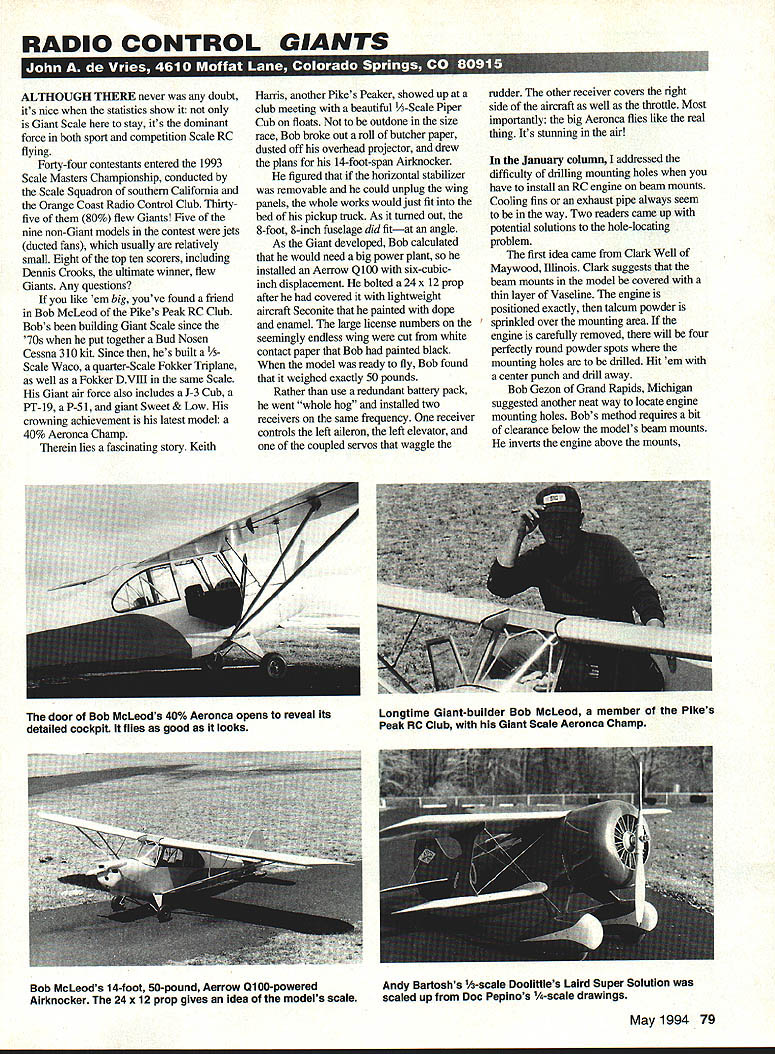
If you like 'em big, you've found a friend in Bob McLeod of the Pike's Peak RC Club. Bob's been building Giant Scale since the '70s when he put together a Bud Nosen Cessna 310 kit. Since he's built a 5/8-scale Waco and a quarter-scale Fokker Triplane, as well as a Fokker D.VIII in the same scale, his Giant air force also includes a J-3 Cub, a PT-19, a P-51, and a giant Sweet & Low. His crowning achievement is his latest model: a 40% Aeronca Champ.
Therein lies a fascinating story. Keith Harris, another Pike's Peaker, showed up at a club meeting with a beautiful 1/5-scale Piper Cub on floats. Not to be outdone in the size race, Bob broke out a roll of butcher paper, dusted off his overhead projector, and drew the plans for his 14-foot-span Airknocker.
He figured that if the horizontal stabilizer was removable and he could unplug the wing panels, the whole works would just fit into the bed of his pickup truck. As it turned out, the 8-foot, 8-inch fuselage did fit — at an angle.
As the Giant developed, Bob calculated that he would need a big power plant, so he installed an Aerrow Q100 (six-cubic-inch displacement) and bolted a 24 x 12 prop. After he had covered it with lightweight aircraft Seconite that he painted with dope and enamel, the large license numbers on the seemingly endless wing were cut from white contact paper that Bob had painted black. When the model was ready to fly, Bob found that it weighed exactly 50 pounds.
Rather than use a redundant battery pack, he went "whole hog" and installed two receivers on the same frequency. One receiver controls the left aileron, the left elevator, and one of the coupled servos that waggle the rudder. The other receiver covers the right side of the aircraft as well as the throttle. Most importantly, the big Aeronca flies like the real thing. It's stunning in the air!
Engine-mount hole-location tips
In the January column, I addressed the difficulty of drilling mounting holes when you have to install an RC engine on beam mounts. Cooling fins or an exhaust pipe always seem to be in the way. Two readers came up with potential solutions to the hole-locating problem.
- Clark Well (Maywood, Illinois) suggests covering the beam mounts with a thin layer of Vaseline. Position the engine exactly, then sprinkle talcum powder over the mounting area. If the engine is carefully removed, there will be four perfectly round powder spots where the mounting holes are to be drilled. Hit them with a center punch and drill away.
- Bob Gezon (Grand Rapids, Michigan) recommends another method that requires a bit of clearance below the model's beam mounts. Invert the engine above the mounts and, with the bolts removed, align and drill four holes partially through the beams. Finally remove the engine and complete the drilling process.
Both Clark's and Bob's methods seem to work well. Sincere thanks go out to both model builders.
Materials and suppliers
If you need particularly flexible plywood for your Giant Scale project, contact Riteco Supply, Inc. at 12999 F.M. 529, Houston, TX 77041. They supply 1.5 mm (1/16") and 3.0 mm (1/8") "plantation hoop pine" construction plywood in sheets up to 4 x 8 feet. Their exterior grade can be boiled for 12 hours without delaminating. Tough stuff. The sample they sent me was sanded as smooth as a table top.
I have noted the excellence of the great kits that Chuck Gill produces from Nick Zirolis's, Rich Uravitch's, and Leading Edge Models' plans at The Aeroplane Works (2134 Gilbride Road, Martinsville, NJ 08836). Chuck's precise workmanship turns scratch-building big models into practically pure pleasure.
This latest masterpiece is the kit that goes with Zirolis's plans for a 1/4-scale Northrop P-61 Black Widow. We're talking about a model that spans 114 inches and uses two 35 to 50 cc gas engines. With Chuck's kit and Nick's plans, transparent canopies, fiberglass cowls, and radar housings, you'll have the makings of a truly outstanding Giant Scale twin.
Plans, catalogs, and new designs
Old friend Doc Pepino of Scale Plans and Photo Service (3209 Madison Ave., Greensboro, NC 27403) has just published his latest pair of catalogs. The Scale Documentation volume lists a host of photo packs, and the SuperScale Plans tome includes the tally of all the construction drawings that the Doc sells. Many of them are for IMAA-legal Giants. Each catalog costs five bucks and is well worth it.
Doc's newest offering is a design by Dick Katz for the (Howard) Hughes H-1 Racer that will knock your socks off. It's the long-wing version of the sleek bird and the model spans 80 inches. A built model will weigh between 14 and 16 pounds and takes a healthy 1.8-cubic-inch engine to propel it; a Moki is recommended.
We've seen the drawings and they're absolutely beautiful. Doc has a stunning set of color documentation photos for the H-1 for sale as well. Get a set of the Paul Matt drawings for the prototype, and your research will be pretty well complete.
Parting thought
We're going to finish this month's column with what is probably a rhetorical question: Why are all the available Curtis P-40 kits and plans for the relatively short-coupled B, D, E, or F versions, when the most numerous production Warhawks were the N version? It would seem that the P-40N would be a better prototype for a model, with its longer tail moment that promotes stability.
There is one lonely set of P-40 Giant Scale drawings that shows the N as a modification, but that's about it. Is the dearth of RC model Ns because so few of them were decorated with the "traditional" shark-mouth markings? Hmmm.
Transcribed from original scans by AI. Minor OCR errors may remain.

