
RADIO CONTROL GIANTS
John A. de Vries, 4610 Moffat Lane, Colorado Springs, CO 80915
The Lockheed Vega — history and design
The Lockheed Vega first flew in July 1927. At that time it was powered by a 220 hp J-5 engine, carried five passengers, cruised at 118 mph, and topped out at 138 mph. Later versions were equipped with more powerful engines (up to 450 hp) and cruised at 180 mph. In its day, it was the fastest transport aircraft available.
The Vega was designed by Jack Northrop. Its fuselage was molded in a concrete tub in two halves. The monocoque structure was joined over spruce formers and longerons. The pilot sat up front in his own compartment, just forward of the wing's leading edge.
Passengers were treated to leather seats in a pigskin-lined interior. Early versions did not have engine cowlings; later versions did.
Several Vegas were modified by their owners for a host of record-setting flights. It could be said that there was no such thing as a standard Vega. Vegas could be equipped with:
- high-pressure tires or low-pressure tires,
- wheel pants or no wheel pants,
- tail skids or tail wheels,
- floats (several were mounted on floats, particularly by world explorers whose only assured landing areas were rivers or lakes).
The Vega fuselage was adapted by the factory into the parasol Lockheed Air Express, the low-wing Altair, the Sirius (with and without retractable landing gear), and the Orion. While these aircraft sported their own varieties of tail surfaces, they were basically the same.
Arguably the most famous Vega was the Winnie Mae, flown by Wiley Post. Wiley flew it around the world twice, and it is now enshrined in the National Air and Space Museum.
Giant-scale model of the Winnie Mae
Of greatest interest to Giant Scale model builders is the fact that Doc Pepino (Scale Plans & Photo Service, 3209 Madison Ave., Greensboro, NC 27403) has produced a detailed set of drawings for the Winnie Mae in 1/5 scale.
Doc's drawings result in a model with a 100-inch wingspan that is 67 inches long. The recommended engine is the Zenoah G-38. The model features an aluminum-tube wing joiner that eases the transportation problem.
Since there is no model-sized concrete tub in which to mold the Vega fuselage, Doc designed the model to be built over plywood formers, then planked. The plans feature scale three-views and a clever fuselage jig. The plan set includes a modest construction manual; both come in a sturdy mailing tube for $37 plus shipping and handling. Fiberglass cowls and wheel pants are available.
Doc offers this advice: "Decide exactly which Vega you're going to build before you cut balsa." Documentation is readily available from Doc in the form of photo packs.
William Wylam did an extensive series on the Vega and its descendants; it is available from Model Airplane News (Air Age, 251 Danbury Rd., Wilton, CT 06897). Those articles can be used to document specific Vegas or suggest how the basic model might be modified to duplicate one of its descendants.
Now that Doc Pepino has pioneered an accurate Giant Scale drawing set for the Lockheed Vega, the possibilities are endless.
Exemplary Giant Scale craftsmanship
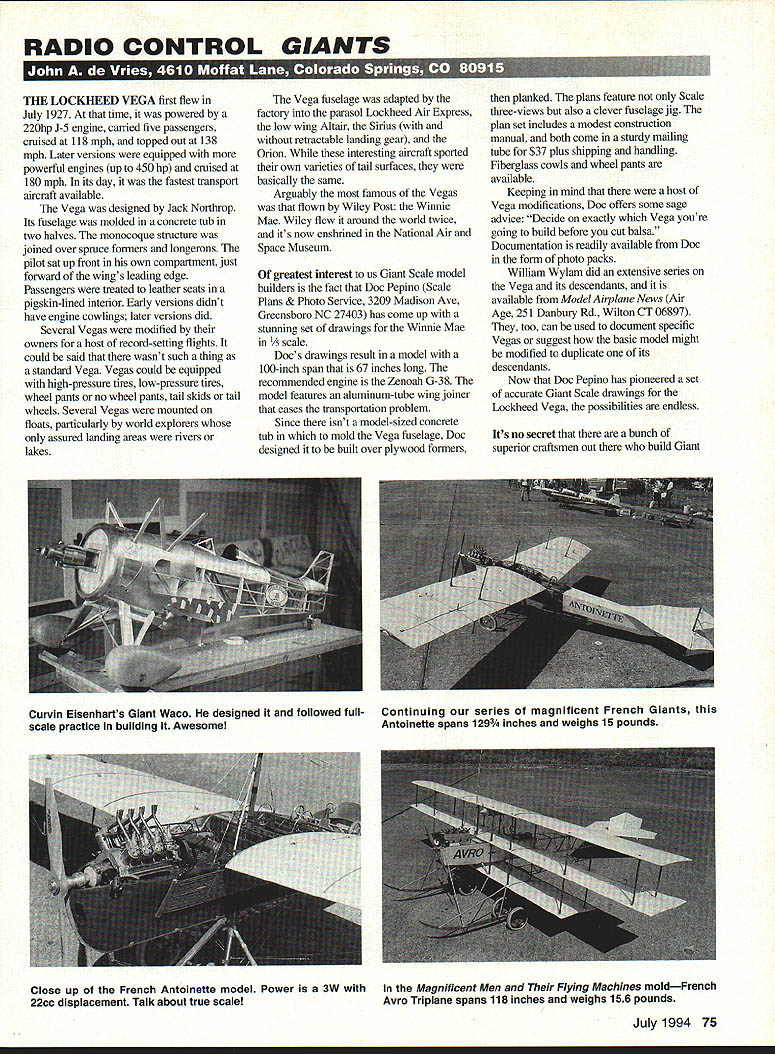
There are a bunch of superior craftsmen who build Giant Scale models. One of the best is Curvin Eisenhart of York, Pennsylvania. Photos of his modified Waco Tapewing model illustrate his workmanship. To give an idea of the model's size: the aft cowl ring is 12 inches in diameter.
Details of Curvin's work include:
- everything that is aluminum on the prototype is aluminum sheeting on the model,
- fiberglass molds for the wheel pants,
- landing gear struts with oleos,
- tail wheel shock-mounted on a telescoping spring,
- scale-sized piano hinges used on cowling access hatches.
Much of Curvin's expertise comes from the fact that, before he "lost his medical," he was a home-builder in the EAA sense of the word: he flew the big ones.
Scale engines for quarter-scale models
The ultimate in the hobby is a quarter-scale model equipped with a quarter-scale replica of the engine that powered the prototype. Unfortunately, most real airplanes had multicylinder engines, and there is a dearth of commercially available engines of this type. Although many homebuilt engines are jewels of the machinist's art, they often lack true scale appearance.
My notes indicate that there are only four truly scale quarter-scale aircraft engines on the market, and one of them has never been flown. Available scale engines are very expensive.
There is an alternative for Giant Scale modelers with metal fabricating skills: build your own scale engine. If you decide to take the plunge, the immediate problem is acquiring the necessary detailed data to machine a scale engine.
A good source of dimensional data and detailed plans is Strictly I.C., published by Robert A. Washburn (24920 43rd Avenue South, Kent, WA 98032-4160). Strictly I.C. is devoted to miniature internal combustion engines, is published every two months, and costs $4.75 a copy.
A recent issue includes detailed drawings and instructions for machining a Kinner K-5 engine in 1/4 scale. Previous issues have included data and drawings for the Wright J-5 Whirlwind and the de Havilland Cirrus four-cylinder inline engine (which powered both British and U.S. aircraft).
Although not scale, several engines suitable for Giants have been detailed in Strictly I.C., including twins and five-cylinder radials. One that is particularly interesting is the Cam Axial: a .60 with the cylinder parallel to the drive shaft.
I received a phone call from an earnest modeler who intends to build a quarter-scale Curtiss Jenny. He is collecting information on the Curtiss OX-5 V-8 engine and intends to machine a quarter-scale OX-5 for the aircraft — true devotion to scale!
Coming next month
Next month I will help you reduce the propensity to warp in your next Giant. I will discuss the art of laminating the curved parts of fins, rudders, stabilizers, elevators, and wingtips.
See you then.
Transcribed from original scans by AI. Minor OCR errors may remain.

