
RADIO CONTROL GIANTS
John A. de Vries
4610 Moffat Lane, Colorado Springs, CO 80915
"RESEARCH" is the magic word for this month's column.
Practically every Giant Scale modeler has a "dream model" that he or she wants to build and fly. Modelers are often frustrated by a lack of appropriate drawings. After an exhaustive search for plans in model magazines and writing to the experts who might know of appropriate drawings, modelers end up against a wall.
Given a burning desire to produce a scale model of an obscure prototype, the only alternative is to design it yourself. That decision will lead you into the wilds of research where nothing is as it seems!
Research and reference gathering
First, you will become a collector of three-views and photographs. If you're doing a conscientious job, you will acquire stacks of magazines and shelves loaded with books. You'll assemble a rapidly thickening scrapbook of photographs of the subject in its various views and color schemes. Early on, you'll become aware of the conflicts between the various "experts" on the aircraft you've chosen to duplicate. Taken to the extreme, you'll have to decide who's right and who's wrong.
Second, you'll have to take a T-square and drawing board in hand (or a suitable computer and CAD program) and produce a practical set of full-size drawings. This task may be eased in a number of ways. You might have your most accurate set of three-views enlarged photographically by photocopier or by the old standby: the opaque projector and butcher-paper-on-the-wall technique. Whichever way you go, you'll end up with a set of Giant Scale size outline drawings that you'll have to fill with a supporting structure.
There is another way to arrive at the same point in producing building plans. Back in the dim days of model building, several competent draftsmen produced some great rubber-powered scale models. John Pond (John Pond Old Time Plan Service, P.O. Box 90310, San Jose, CA 95109-3310) offers thick catalogs full of these drawings that are appropriate for enlargement.
When they're sized to Giant dimensions by the techniques mentioned earlier, you get not only scale outlines but also an easily modified interior structure to build on. You may have to improve on the "scaleness" of the enlarged drawings, using your research data, but that's much easier than starting with just a set of scale outlines.
You'll certainly use your research data to add external detail, and I recommend that you use photos of the prototype rather than three-views for this task. Pictures don't lie, and line drawings often prove to be fanciful.
If you're really lucky, you might find a set of old Free Flight Gas Scale drawings of your subject. They'll produce relatively large models, perhaps ones requiring only a 2X enlargement to generate a Giant Scale model.
A word of caution: both rubber and gas scale models were designed to be stable. This usually means that stabilizers were increased in area and non-scale airfoils were used to ensure good flying characteristics. Landing gear were frequently extended to accommodate longer-than-scale propellers. But again, it's easier to rescale existing drawings than doing them from scratch. And sometimes the older designers would dash in scale outlines on their drawings for the more adventuresome.
However you arrive at a set of building plans for your dream Giant Scale model, it will be only as good as the depth of your research. It's truly a case of "more is better."
Don't overlook the humble plastic model as a source of accurate scale research information. With minimum effort, the probability of locating a plastic kit of your dream model is relatively high. Researched by professionals, plastic kit instruction sheets are a fertile source of truly accurate color and markings information, as well as obscure three-views. This point was recently brought home for me.
I built a five-model series for a book to be published by ViP Publishers, Inc. It was a true surprise and delight when I found photographs of the prototypes of all five models in the illustration package that the author provided along with his manuscript.
If your dream model is so obscure that you can't find a plastic kit of it in a local hobby shop, a prime source may be found in the Kit Collector's Clearinghouse magazine (John W. Burns, 3213 Hardy Drive, Edmond, OK 73013). Your $15 a year subscription/membership will open up a host of potential Giant Scale subjects that have already been produced in plastic model form.
Practical tips for producing plans
- Use photocopy enlargement or opaque projector methods to create full-size outlines.
- Consider enlarging well-drawn rubber- or gas-scale plans rather than starting from scratch.
- Rely on photographs for external detail; three-views can be misleading.
- Expect to modify stabilizers, airfoils, and landing gear to suit Giant Scale flying characteristics.
News and notes
- The designer of the Cutting Edge aerobatic Giant-sized biplane pictured in the June '94 column has moved. If you wish to contact Brian Reed, his new address is RD 3, Box 56, Franklin, PA 16323.
- Lewis Pancoast of Spokane, Washington, is designing a Giant Scale version of the Keith-Rider R-4, the Schoenfeldt Firecracker racer. Lew found that the real warbird is neatly ensconced in the National Air Race Museum and Hall of Fame in Sparks, Nevada, which will make his job easier.
- Although I promised last month to share Curvin Eisenhart's method of producing cowl flanges, the press of other business didn't give me enough time to duplicate his instructions. Curvin did phone and suggest that I make friends with a machinist who has a milling machine. The steel template for the hinge-making process requires a precise hunk of metal that is best produced by milling. The template can be made with less exotic machine work, but it would take a lot of hand labor.
- Bob Holman reports he has drawings for a 76-inch-span B-17. He also has plans for a quarter-scale model of Benny Howard's DGA-4 "Mike" pylon racer; the model is light enough to require only a .60 four-stroke. Finally, Bob has construction drawings for a Bristol Brownie—built-up construction, 104-inch span, and takes a .90 four-stroke. The Brownie was a between-the-wars British two-cockpit low-wing light monoplane.
Featured scale drawings and kits
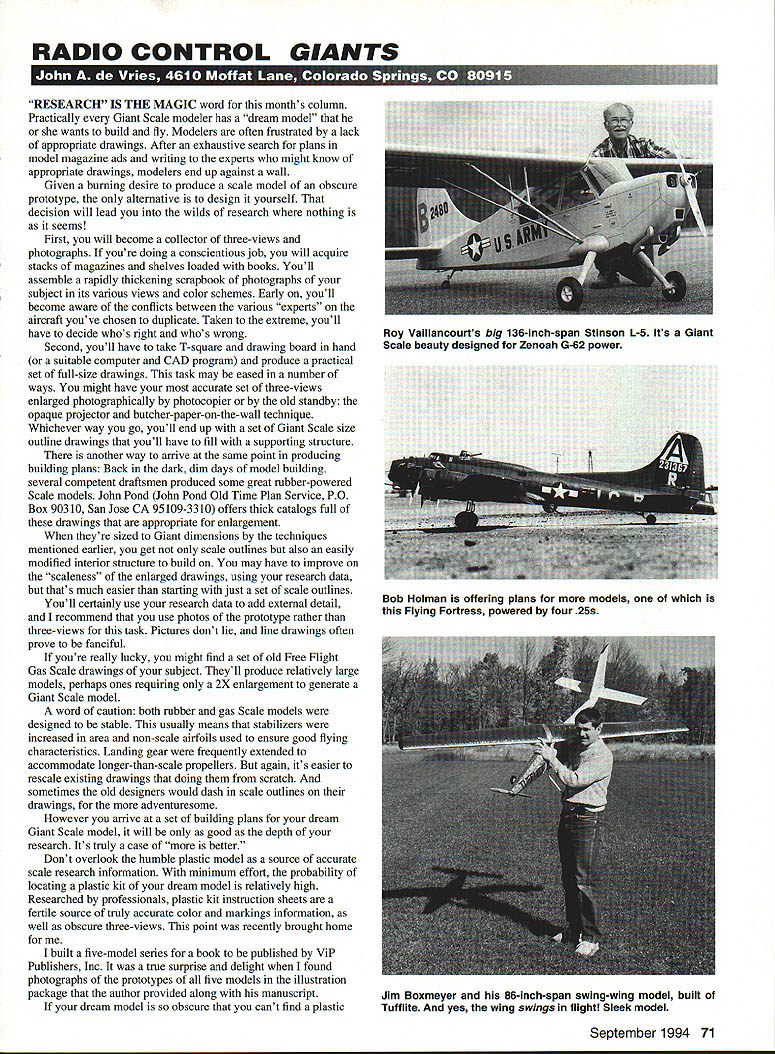
When I took up occupation duty in Japan right after WWII, the first airplane I checked out was the Stinson L-5. I soloed it after three landings and immediately took off to fly over Mt. Fuji.
The L-5's benign appearance belied an aircraft with surprising STOL performance. With flaps and ailerons drooped, we regularly operated out of an 800-foot strip smack dab in the middle of Yokohama!
Roy Vaillancourt has added a 1/4-scale version of the Sentinel (L-5) to his line of great scale drawings. The L-5 spans 136 inches and takes a Zenoah G-62 for power. Roy offers not only the drawings but a bunch of accessories including a fiberglass cowl, formed landing gear, and a kit of strut covers, blisters, and dummy exhaust stacks. Contact him at:
- Vaillancourt Aviation
- 18 Oakdale Ave., Farmingville, NY 11738-2828
Roy also has epoxy/glass surface material for models, backed up with foam, available in 1/8-, 3/32-, and 1/4-inch thicknesses.
New materials: Tufflite
There's a new construction material aimed squarely at the Giant Scale hobby. It's called Tufflite and it's sold by Boxmeyer Composites (P.O. Box 6165, Philadelphia, PA 19115). Key points:
- Can be formed into extremely smooth wings; wings can be hollow or fully ribbed.
- Can be used with foam cores in one piece.
- Comes in sheets as large as 4 x 8 feet.
- Fully compatible with CA glues; quick-setting glues are recommended.
- Can be used to build silky smooth fuselages with the right skill.
Company president Jim Boxmeyer has written a particularly lucid instructional manual, "Getting Tufflite Into Flight," that details how to use his product. For $20, Jim will send you a copy of his manual and a large sample of Tufflite so you can try it yourself.
Closing
Hope you're having a great and successful Giant Scale flying season.
Transcribed from original scans by AI. Minor OCR errors may remain.

