
RADIO CONTROL GIANTS
By John A. de Vries
4610 Moffat Lane, Colorado Springs, CO 80915
The proliferation of subjects that are being reproduced in Giant Scale form is a continual source of amazement. Modelers throughout the world are adapting some pretty exotic prototypes to R/C flight. It would take a monster computer database to keep track of them. When a fascinating subject is being designed and built in your own backyard, the interest level is at a fever pitch.
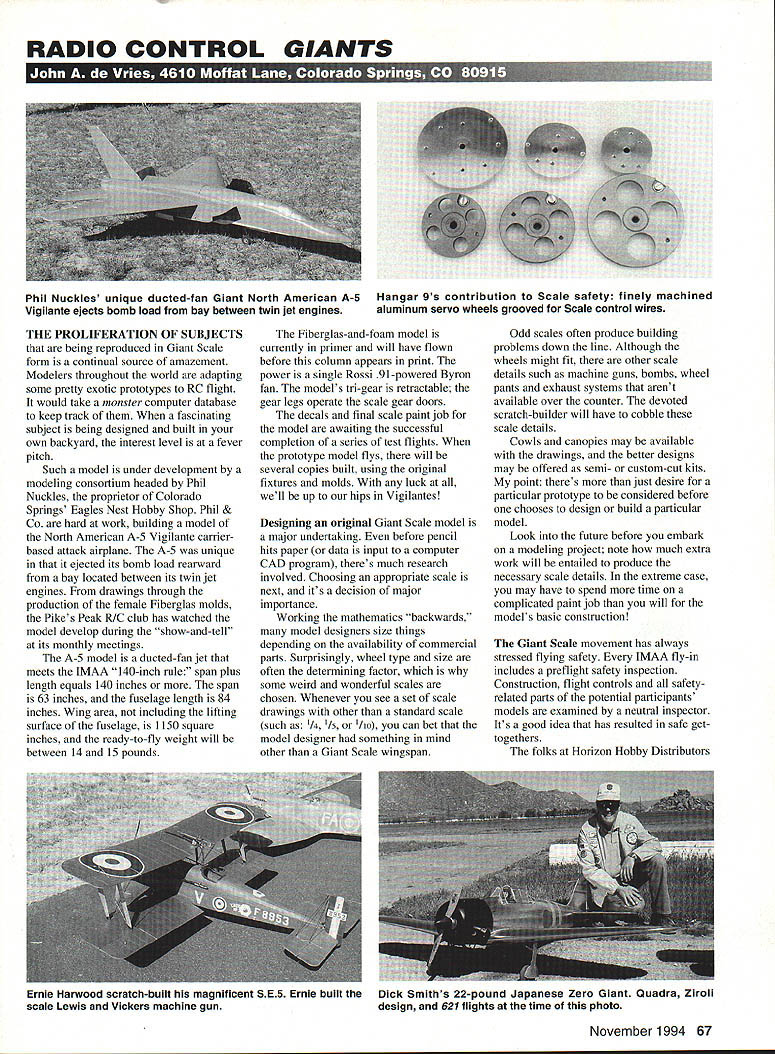
Such a model is under development by a modeling consortium headed by Phil Nuckles, proprietor of Colorado Springs' Eagles Nest Hobby Shop. Phil & Co. are hard at work building a model of the North American A-5 Vigilante carrier-based attack airplane. The A-5 was unique in that it ejected its bomb load rearward from a bay located between its twin jet engines. From drawings through the production of the female fiberglass molds, the Pikes Peak R/C Club has watched the model develop during the "show-and-tell" at its monthly meetings.
The A-5 Vigilante project
The A-5 model is a ducted-fan jet that meets the IMAA "140-inch rule": span plus length equals 140 inches or more.
- Span: 63 inches
- Fuselage length: 84 inches
- Wing area (not including lifting surface of fuselage): 1,150 square inches
- Ready-to-fly weight: 14–15 pounds
The fiberglass-and-foam model is currently in primer and will have flown before this column appears in print. Power is a single Rossi .91–powered Byron fan. The model's tricycle gear is retractable; the gear legs operate the scale gear doors.
The decals and final scale paint job for the model are awaiting the successful completion of a series of test flights. When the prototype model flies, several copies will be built using the original fixtures and molds. With any luck at all, we'll be up to our hips in Vigilantes!
Choosing a scale
Designing an original Giant Scale model is a major undertaking. Even before pencil hits paper (or data is input to a computer CAD program), there's much research involved. Choosing an appropriate scale is next, and it's a decision of major importance.
Working the mathematics "backwards," many model designers size things depending on the availability of commercial parts. Surprisingly, wheel type and size are often the determining factor, which is why some weird and wonderful scales are chosen. Whenever you see a set of scale drawings with anything other than a standard scale (such as 1/4, 1/5, or 1/10), you can bet that the model designer had something in mind other than a Giant Scale wingspan.
Odd scales often produce building problems down the line. Although the wheels might fit, there are other scale details such as machine guns, bombs, wheel pants, and exhaust systems that aren't available over the counter. The devoted scratch-builder will have to cobble scale details.
Cowls and canopies may be available with the drawings, and the better designs may be offered as semi- or custom-cut kits. My point: there's more than just desire for a particular prototype to be considered before one chooses to design or build a particular model.
Look into the future before you embark on a modeling project; note how much extra work will be entailed to produce the necessary scale details. In the extreme case, you may have to spend more time on a complicated paint job than you will for the model's basic construction!
Safety and accessories
The Giant Scale movement has always stressed flying safety. Every IMAA fly-in includes a preflight safety inspection. Construction, flight controls, and all safety-related parts of the potential participants' models are examined by a neutral inspector. It's a good idea that has resulted in safe get-togethers.
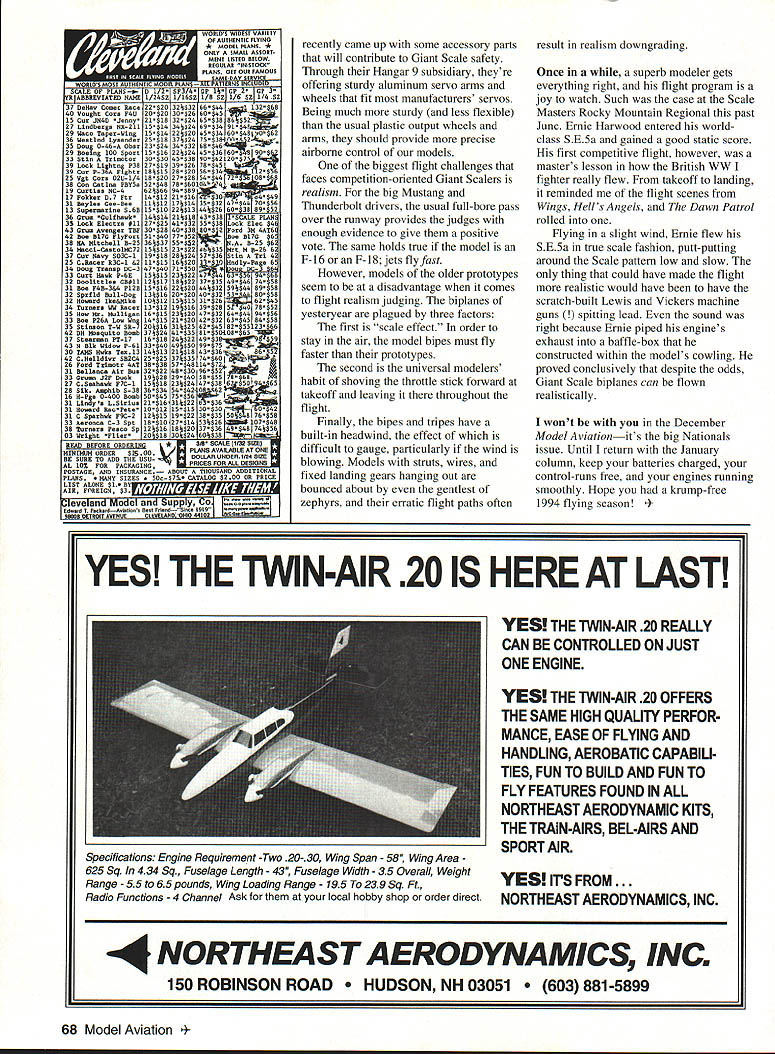
The folks at Horizon Hobby Distributors recently came up with some accessory parts that will contribute to Giant Scale safety. Through their Hangar 9 subsidiary, they're offering sturdy aluminum servo arms and wheels that fit most manufacturers' servos. Being much more sturdy (and less flexible) than the usual plastic output wheels and arms, they should provide more precise airborne control of our models.
Realism challenges in competition
One of the biggest flight challenges that faces competition-oriented Giant Scalers is realism. For the big Mustang and Thunderbolt drivers, the usual full-bore power on the runway provides the judges with enough evidence to give a positive vote. The same holds true if the model is an F-16 or an F-18; jets fly fast.
However, models of the older prototypes seem to be at a disadvantage when it comes to flight realism judging. The biplanes of yesteryear are plagued by three factors:
- Scale effect: In order to stay in the air, the model biplanes must fly faster than their prototypes.
- The universal modelers' habit of shoving the throttle stick forward at takeoff and leaving it there throughout the flight.
- Aerodynamic "headwind" caused by struts, wires, and fixed landing gear: models with these features are bounced about even by the gentlest zephyrs, and their erratic flight paths often result in realism downgrading.
A demonstration of realistic flight
Once in a while, a superb modeler gets everything right, and his flight program is a joy to watch. Such was the case at the Scale Masters Rocky Mountain Regional this past June. Ernie Harwood entered his World War I–class S.E.5a and gained a good static score. His first competitive flight, however, was a master's lesson in how the British WW I fighter really flew. From takeoff to landing, it reminded me of the flight scenes from Wings, Hell's Angels, and The Dawn Patrol rolled into one.
Flying in a slight wind, Ernie flew his S.E.5a in true scale fashion, put-putting around the scale pattern low and slow. The only thing that could have made the flight more realistic would have been to have the scratch-built Lewis and Vickers machine guns spitting lead. Even the sound was right because Ernie piped his engine's exhaust into a baffle box that he constructed within the model's cowling. He proved conclusively that despite the odds, Giant Scale biplanes can be flown realistically.
Closing
I won't be with you in the December Model Aviation — it's the big Nationals issue. Until I return with the January column, keep your batteries charged, your control runs free, and your engines running smoothly. Hope you had a crash-free 1994 flying season!
Transcribed from original scans by AI. Minor OCR errors may remain.

