
RADIO CONTROL GIANTS
John A. de Vries 4610 Moffat Lane, Colorado Springs, CO 80915
What a quandary!
If you've ever attended a gathering of Giant Scale enthusiasts, you must have noticed that most of the RC pilots are—to be candid about it—mature. To be more specific, Giant Scalers are, for the most part, rather old compared to the usual run of RC'ers.
They're usually rather well-to-do, because their beautiful scale models represent a substantial investment of both time and money. If you consider the cost of the engine, the radio with its dual airborne batteries and hefty servos, the expensive kit and accessories, a $1,000-plus Giant Scale model airplane is at the low end of the investment scale. So, how can I recommend that the beginning modeler start out with a big aircraft?
Assuming that the neophyte wants to build and fly RC models and has disabused himself or herself of the "Flying Fortress Syndrome" (you'd be surprised at how many folks envision a Boeing B-17 four-engined bomber as their first RC model!), there are valid reasons to begin with a larger-than-usual model airplane.
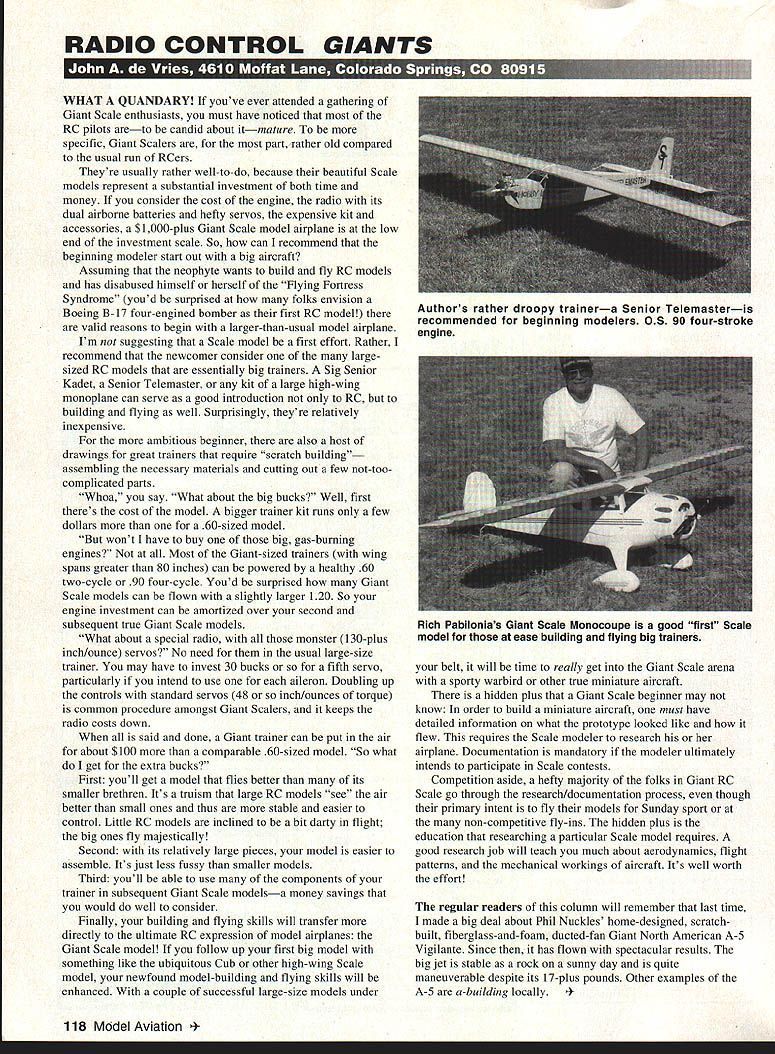
I'm not suggesting that a scale model be a first effort. Rather, I recommend that the newcomer consider one of the many large-sized RC models that are essentially big trainers. A Sig Senior Kadet, a Senior Telemaster, or any kit of a large high-wing monoplane can serve as a good introduction not only to RC, but to building and flying as well. Surprisingly, they're relatively inexpensive.
For the more ambitious beginner, there are also a host of drawings for great trainers that require scratch building—assembling the necessary materials and cutting out a few not-too-complicated parts.
Costs and equipment
"Whoa," you say. "What about the big bucks?" Well, first there's the cost of the model. A bigger trainer kit runs only a few dollars more than one for a .60-sized model.
"But won't I have to buy one of those big, gas-burning engines?" Not at all. Most of the giant-sized trainers (with wingspans greater than 80 inches) can be powered by a healthy .60 two-cycle or .90 four-cycle. You'd be surprised how many Giant Scale models can be flown with a slightly larger .120. So your engine investment can be amortized over your second and subsequent true Giant Scale models.
"What about a special radio, with all those monster servos?" No need for them in the usual large-size trainer. You may have to invest $30 or so for a fifth servo, particularly if you intend to use one for each aileron. Doubling up the controls with standard servos (48 oz-in of torque) is common procedure among Giant Scalers, and it keeps the radio costs down.
When all is said and done, a giant trainer can be put in the air for about $100 more than a comparable .60-sized model.
Benefits of starting with a large trainer
So what do I get for the extra bucks?
- Better flight characteristics: Large RC models "see" the air better than small ones and thus tend to be more stable and easier to control. Little RC models are inclined to be a bit darty in flight; the big ones fly majestically.
- Easier assembly: With relatively large pieces, your model is easier to assemble. It's just less fussy than smaller models.
- Reusable components: You'll be able to use many of the components of your trainer in subsequent Giant Scale models—a money savings that you would do well to consider.
- Transferable skills: Your building and flying skills will transfer more directly to the ultimate RC expression of model airplanes: the Giant Scale model. If you follow up your first big model with something like the ubiquitous Cub or other high-wing scale model, your newfound skills will be enhanced. With a couple of successful larger-size models under your belt, it will be time to really get into the Giant Scale arena with a sporty warbird or other true miniature aircraft.
Hidden plus: research and education
There is a hidden plus that a Giant Scale beginner may not know: to build a miniature aircraft you must have detailed information on what the prototype looked like and how it flew. This requires the scale modeler to research his or her airplane. Documentation is mandatory if the modeler ultimately intends to participate in scale contests.
Competition aside, a hefty majority of the folks in Giant RC scale go through the research/documentation process, even though their primary intent is to fly their models for Sunday sport or at the many non-competitive fly-ins. The hidden plus is the education that researching a particular scale model requires. A good research job will teach you much about aerodynamics, flight patterns, and the mechanical workings of aircraft. It's well worth the effort!
Recent example
Regular readers of this column will remember that last time I made a big deal about Phil Nuckles' home-designed, scratch-built, fiberglass-and-foam, ducted-fan Giant North American A-5 Vigilante. Since then, it has flown with spectacular results. The big jet is stable as a rock on a sunny day and is quite maneuverable despite its 17-plus pounds. Other examples of the A-5 are being built locally.
Transcribed from original scans by AI. Minor OCR errors may remain.

