
RADIO CONTROL GIANTS
John A. de Vries, 4610 Moffat Lane, Colorado Springs CO 80915
A Cold Solo
FEBRUARY 12, 1944 was a bitterly cold day in Douglas, Georgia. We'd had a light dusting of snow overnight but it didn't stick to the wings of the silver‑painted Stearman PT‑17s out on the flight line. I really didn't look forward to the day's flight in the open cockpit of the primary trainer. I had about nine hours in the PT and knew that I'd soon have to make my first solo flight.
In anticipation of the biting cold, I bundled up in the Air Corps' winter flying gear. That included fleece‑lined pants held up with broad suspenders. Over that I wrestled into the thick fleece‑lined jacket and pulled on the fleece‑lined flying boots. When I put on the leather flying helmet, with its Gosport tube "ear muffs," I resembled a brown leather snowman.
My instructor, Evan A. Fernald, met me at our Stearman. He, too, was bundled against the severe morning chill. After the ground crewman flipped our prop, the propwash added to our discomfort. I taxied the PT out onto the field, aligned us with the windsock, and shoved the throttle forward. The 220 hp Continental radial answered immediately, and we were airborne.
We headed for the auxiliary field to practice landings. I made three relatively respectable "bumps and jumps" when Mr. Fernald told me to make a full‑stop. We pulled off to the side of the field, and he got out. It was solo time! Two "bumps" and then a full‑stop landing, and I picked up my instructor for the flight back to home base.
What he didn't realize was that I was so surrounded with fleece‑lined leather that all of my movements were restricted. I could only move the Stearman's controls in a smooth manner. It took all my strength to bend the leather and get the stick fully back for a three‑pointer! It was the first and last time I ever wore the complete Air Corps winter flying suit.
Cold‑weather flying gear was substantially improved before I flew in Alaska in 1958. Multiple layers of clothing kept us warm; lightweight mukluks substituted for unwieldy fleece‑lined boots. Lightweight parkas kept us warm and mobile; their hoods were trimmed in coyote fur.
Dress the Pilot to the Mission
Why the war stories? To make a point: airplane drivers and other aircrewmen have always dressed to counter the environment in which they flew. So when we add the pilots to our Giant Scale models, we should consider researching how they would be dressed. It's important that a miniature pilot's clothing match the mission, location, and era of the aircraft.
Examples:
- P‑40 in the North African desert or Southeast Asian jungle: a leather helmet and A‑2 jacket would be inappropriate. A desert pilot might wear a khaki shirt and shorts and a light tan cloth flying helmet.
- Hurricane pilot in North Africa vs. Battle of Britain: a desert Hurricane driver would fly in lightweight khaki; the same pilot in the Battle of Britain would wear a turtleneck sweater, a fleece‑lined leather jacket, and British fleece‑lined almost‑knee‑high flying boots.
- From 1939 on, most pilots wore thin leather gloves as protection against cockpit fires — a common detail even today.
- Japanese pilots: not all wore kamikaze or "rising sun" headbands. In colder climates a Japanese pilot would wear a heavy cloth flying suit with a real fur collar and a fur‑rimmed helmet.
- Messerschmitt pilots often left their smooth black flying jackets back in the barracks when not needed.
- Medium bomber (B‑25 or B‑26) pilot and copilot: typically wore their "25‑mission crush" uniform hats plastered down with earphones and throat mikes, and A‑2 light leather jackets for low‑level missions.
- B‑17 and B‑24 crews (high altitudes): wore fleece‑lined gear, flak vests, and leather helmets to which oxygen masks could be attached. Gunners often used fleece‑lined caps with fuzzy earflaps.
- WWII enclosed cockpits and cockpit heaters seldom worked satisfactorily; high‑altitude cold still demanded heavy flying gear.
- Modern military jet aircrew: hard‑shell crash helmets and cloth jackets of varying thickness over tan (summer) or dark wool (winter) flying suits in pressurized, warmed cockpits.
Civilian pilots:
- "Early bird" civilian pilots (1920s–1930s) often wore padded leather hard‑shell crash helmets, goggles, and long coats similar to motorists' coats. Flying helmets frequently had goggles with thick white rubber rims (Williams Bros. pilot busts capture this scale detail well).
- They might also sport leather jackets over shirts and ties.
- Today's civilian pilots wear whatever is available, including military surplus flying suits and jackets. Like military pilots of old, they may have a knee pad to hold cross‑country maps and let‑down plates.
Moral: when clothing the pilot in your RC scale model, consider how he would have been dressed for the mission, location, and facilities associated with his aircraft.
A Notable Giant Scale Example: Alexander Eaglerock
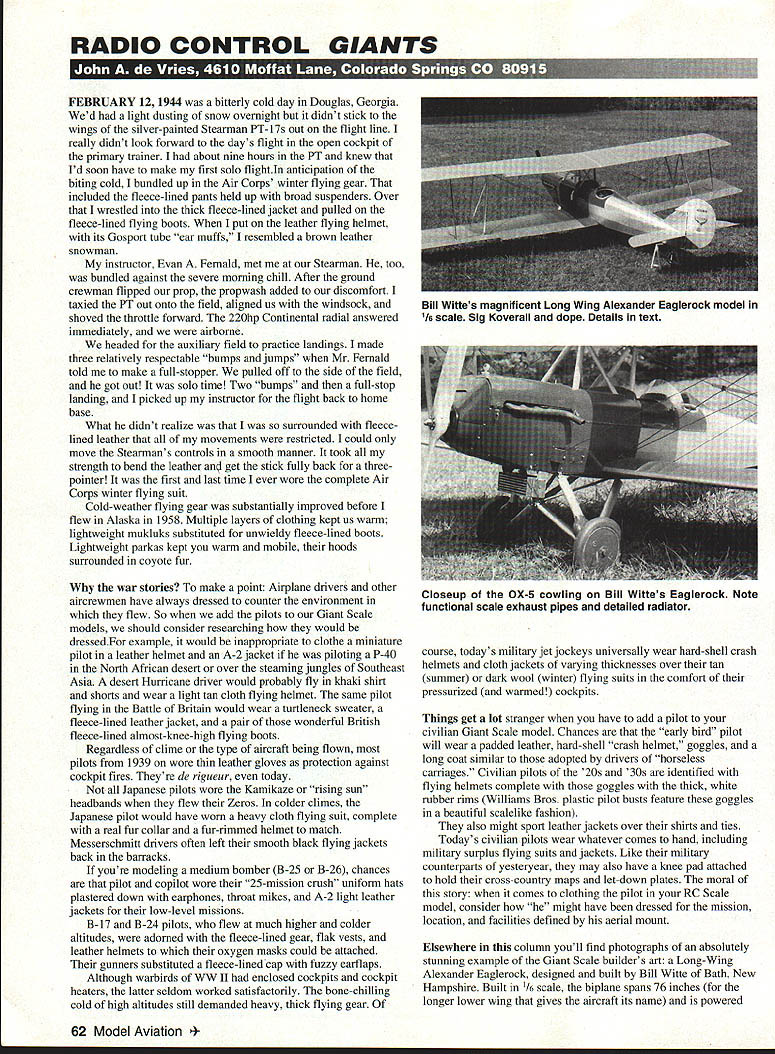
Elsewhere in this column you'll find photographs of an outstanding Giant Scale example: a Long‑Wing Alexander Eaglerock, designed and built by Bill Witte of Bath, New Hampshire. Built in 1/6 scale, the biplane spans 76 inches (the longer lower wing gives the aircraft its name) and is powered with a Saito 50.
Of particular interest are the scale exhaust pipes Bill constructed. They're functional and carry the Saito's fumes out of the cowling. The flying wires are also functional, to brace the long, floppy wing structure. Wing loading is a light 14 ounces per square foot.
Bill says it flies beautifully, but he has to remove the cowl front for engine cooling when the model is airborne. The original OX‑5 power plant was a liquid‑cooled V‑8, and Bill has duplicated the scale radiator, although it is not functional.
I am particularly interested in the Eaglerock model for a couple of reasons. Mr. Witte's basic research source was my book, Alexander Eaglerock, A History of the Alexander Airplane Co. He used the scale drawings in the book and supplemented them with photographs of George Epp's restored (and flyable) OX‑5‑powered Eaglerock, now in the Southern Museum of Aviation in Birmingham, Alabama.
A new edition of the book has just been printed. It has 22 more pages than the original volume, devoted to a tabulation of all Alexander aircraft. It's available for $24.95 plus $2.50 shipping and handling from Wolfgang Publishers, 4610 Moffat Lane, Colorado Springs CO 80915.
Publications and Resources
- Bob Banka has recently published his 1995 Scale Aircraft Documentation & Resource Guide. In addition to serving as Bob's Foto‑Paak and three‑view catalog, the handsome 167‑page tome includes articles by several well‑known scale writers. Given that Bob lists 5,500 different Foto‑Paaks and a complementary inventory of line drawings, this Guide is a necessary foundation for any scale modeler's documentation library.
- Price: $8 in the US, $9 in Canada, $14 overseas (includes Air Post).
- Order from: Scale Model Research, 3114 Yukon Ave., Costa Mesa CA 92626; Tel.: (714) 979‑8058. Visa and MasterCard accepted for orders over $20.
Transcribed from original scans by AI. Minor OCR errors may remain.

