
Radio Control: Giants
John A. de Vries, 4610 Moffat Lane, Colorado Springs, CO 80915
It works both ways!
While most Giant Scalers are interested in going from large to small, many aircraft manufacturers swear by going from small to large. Take Lockheed, for instance. About 20 years ago they wanted to investigate whether their C-130 Hercules could be redesigned as a flying boat. They produced a large-sized RC model. Where computers and wind tunnels couldn't provide the necessary operational data, the big model could and did. The model information thus generated helped dissuade them from building a large, wet Hercules.
There have been a couple of recent instances where Giant Scale RC models have been used to confirm "real aircraft" flight parameters.
Recent examples
- A one-design aerobatic monoplane: the quarter-scale prototype justified construction of the full-sized aircraft. The coloring and markings on the model were so striking they were adopted for the full-size version.
- The Genesis: a graceful, swept-forward-wing sailplane. The Genesis Group intends to provide a home-building kit for the full-sized soarer using composite technique. Their test model spanned 16 feet at 1/3 RC scale, was built by Charlie Fox, and it "proved" the design— it thermaled almost out of sight. The full-scale sailplane has been prototyped.
There were two man-carrying "models" that received much publicity during World War II. In the U.S., a 1/5-scale flying boat was built as a single-place test model; in England, a four-engined bomber was prototyped as a flying test bed that also provided for a pilot aboard. Today, both test models would probably be a bit smaller and controlled by radio.
The Hughes XF-11 model
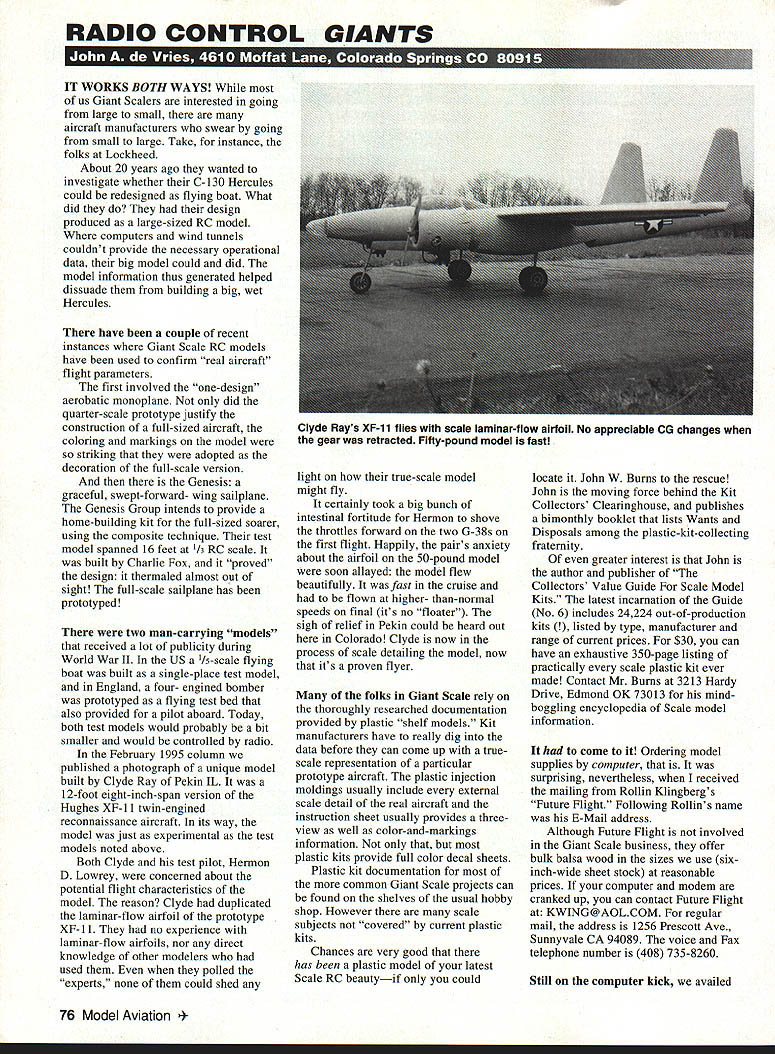
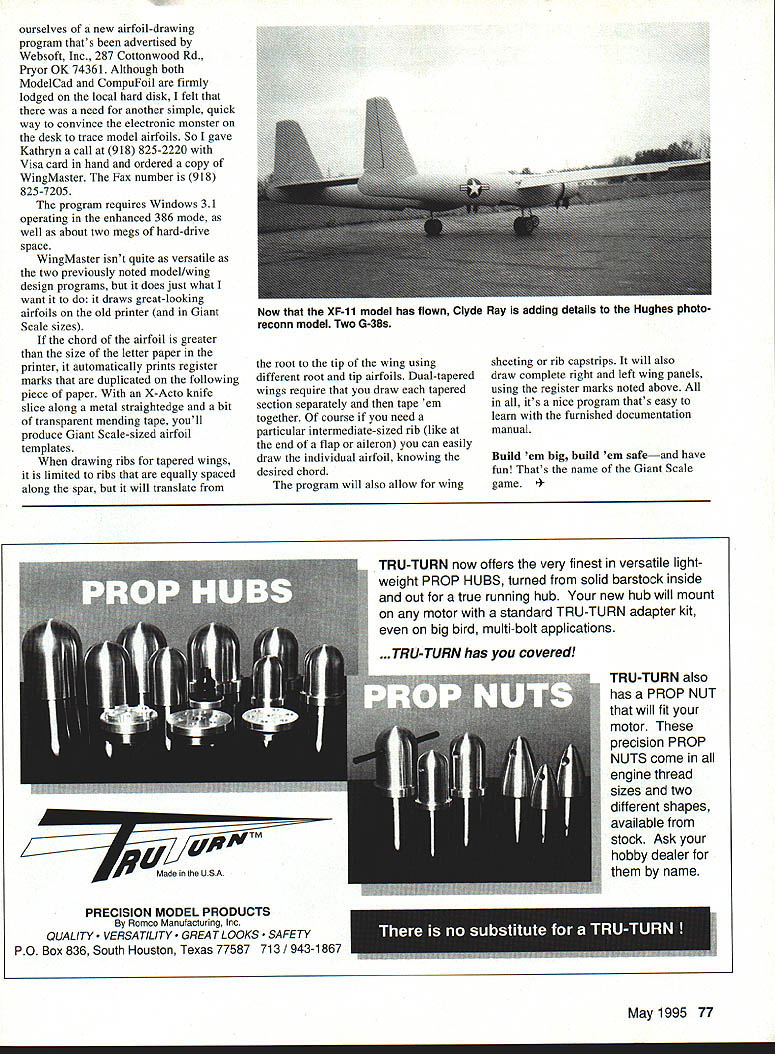
In the February 1995 column we published a photograph of a unique model built by Clyde Ray of Pekin, IL. It was a 12-foot, eight-inch-span version of the Hughes XF-11 twin-engined reconnaissance aircraft. The model was experimental in the same sense as the test models noted above.
Both Clyde and his test pilot, Hermon D. Lowrey, were concerned about the potential flight characteristics of the model because Clyde had duplicated the laminar-flow airfoil of the prototype XF-11. They had no experience with laminar-flow airfoils nor any direct knowledge of other modelers who had used them. Even when they polled the "experts," none could shed light on how their true-scale model might fly.
It took a big bunch of intestinal fortitude for Hermon to shove the throttles forward on the two G-38s on the first flight. Happily, their anxiety about the airfoil on the 50-pound model was soon allayed: the model flew beautifully. It was fast in cruise and had to be flown at higher-than-normal speeds on final (it's no "floater"). The sigh of relief in Pekin could be heard out here in Colorado. Clyde is now in the process of scale-detailing the model, now that it's a proven flyer.
Plastic kits and documentation
Many Giant Scale modelers rely on the thoroughly researched documentation provided by plastic "shelf models." Kit manufacturers must dig into the data to produce true-scale representations of prototypes. The plastic injection moldings usually include every external scale detail of the real aircraft, and the instruction sheet typically provides a three-view as well as color-and-markings information. Most plastic kits also provide full-color decal sheets.
Plastic kit documentation for many common Giant Scale projects can be found on hobby shop shelves. However, many scale subjects are not covered by current plastic kits.
Chances are good that there has been a plastic model of your latest scale RC subject—if only you could locate it. John W. Burns is the moving force behind the Kits Collectors' Clearinghouse and publishes a bimonthly booklet listing Wants and Disposals among the plastic-kit-collecting fraternity.
John is also the author and publisher of The Collectors' Value Guide For Scale Model Kits. The latest edition (No. 6) includes 24,224 out-of-production kits, listed by type, manufacturer, and range of current prices. For $30 you can have an exhaustive 350-page listing of practically every scale plastic kit ever made. Contact John Burns at 3213 Hardy Drive, Edmond, OK 73013 for this encyclopedia of scale model information.
Ordering supplies by computer
It had to come to it: ordering model supplies by computer. I was surprised when I received a mailing from Rollin Klingberg's Future Flight that included his e-mail address.
Although Future Flight is not involved in Giant Scale specifically, they offer bulk balsa wood in the sizes we use (six-inch-wide sheet stock) at reasonable prices. If your computer and modem are cranked up, you can contact Future Flight at: KWING@AOL.COM. For regular mail: 1256 Prescott Ave., Sunnyvale, CA 94089. Voice and fax: (408) 735-8260.
Airfoil drawing program: WingMaster
Still on the computer kick, we availed ourselves of a new airfoil-drawing program advertised by Websoft, Inc., 287 Cottonwood Rd., Pryor, OK 74361. Although both ModelCad and CompuFoil are firmly lodged on the local hard disk, I felt a need for another simple, quick way to get the computer to trace model airfoils. I called Kathryn at (918) 825-2220 with a Visa card in hand and ordered a copy of WingMaster. Fax: (918) 825-7205.
System requirements:
- Windows 3.1 operating in enhanced 386 mode
- About two megabytes of hard-drive space
WingMaster isn't quite as versatile as ModelCad or CompuFoil, but it does what I want: it draws great-looking airfoils on the printer (and in Giant Scale sizes).
Features and notes:
- If the chord of the airfoil is greater than the printer paper width, WingMaster prints register marks that match on the following sheet for easy alignment.
- With an X-Acto knife, a metal straightedge, and some transparent mending tape, you can produce Giant Scale-sized airfoil templates.
- When drawing ribs for tapered wings, the program is limited to ribs equally spaced along the spar, but it will translate from root to tip using different root and tip airfoils.
- Dual-tapered wings require drawing each tapered section separately and taping them together.
- If you need an intermediate-sized rib (for example, at the end of a flap or aileron), you can draw the individual airfoil at the desired chord.
- The program allows for wing sheeting or rib cap strips and can draw complete right and left wing panels using the register marks.
All in all, it's a nice program that's easy to learn with the furnished manual.
Build 'em big, build 'em safe—and have fun! That's the name of the Giant Scale game.
Transcribed from original scans by AI. Minor OCR errors may remain.

