
Radio Control: Giants
John A. de Vries 4610 Moffat Lane Colorado Springs, CO 80915
A Confession
A confession is due to our loyal readers. I've been building a "little" R/C model — a .40-powered Jemco P-51 that I began about 10 years ago. It's so old that the balsa has acquired that yellowish cast of aging that can only be removed by resanding the whole bird.
When I quit building the Mustang, it was ready for the radio installation and finishing. I figured it'd make a good test-bed for my new '91 radio, so I cut the wires that were suspending it from the garage ceiling.
Of course, the bird had been set up for the old Kraft radio, so the first item of reconstruction was to saw out the old servo rails and install new ones. That's when I discovered that this columnist wasn't the brightest guy in the world—yours truly. The new radio, with all of the bells and whistles, has proven to be more than this old soldier will ever need.
With its computer, six channels, PCM or PM modulation, three "flavors" of control (direct, dual-rate, or exponential), servo reversing and servo end-point adjustments, it's a daunting array. It's got switches that control switches and the capability of mixing channels that would baffle an Einstein. The manual that came with the radio just begins to scratch the surface of the system's capabilities.
I'll finish the Mustang and use the new radio—with a lot of trepidation. But, of course, when I become rich and famous (or win the state lottery!), I'll get a simple gold-stickered transmitter with six channels and servo reversing—period.
The purpose of this parable: since an R/C radio is a major cost factor in any model, Giant or otherwise, it's best to decide which features you need before you acquire one. There are a host of skillful modelers who are capable of using all the bells and whistles; and there are others of us whose needs are more modest. Examine your requirements for today and in the foreseeable future, and then decide which radio is for you.
Realism
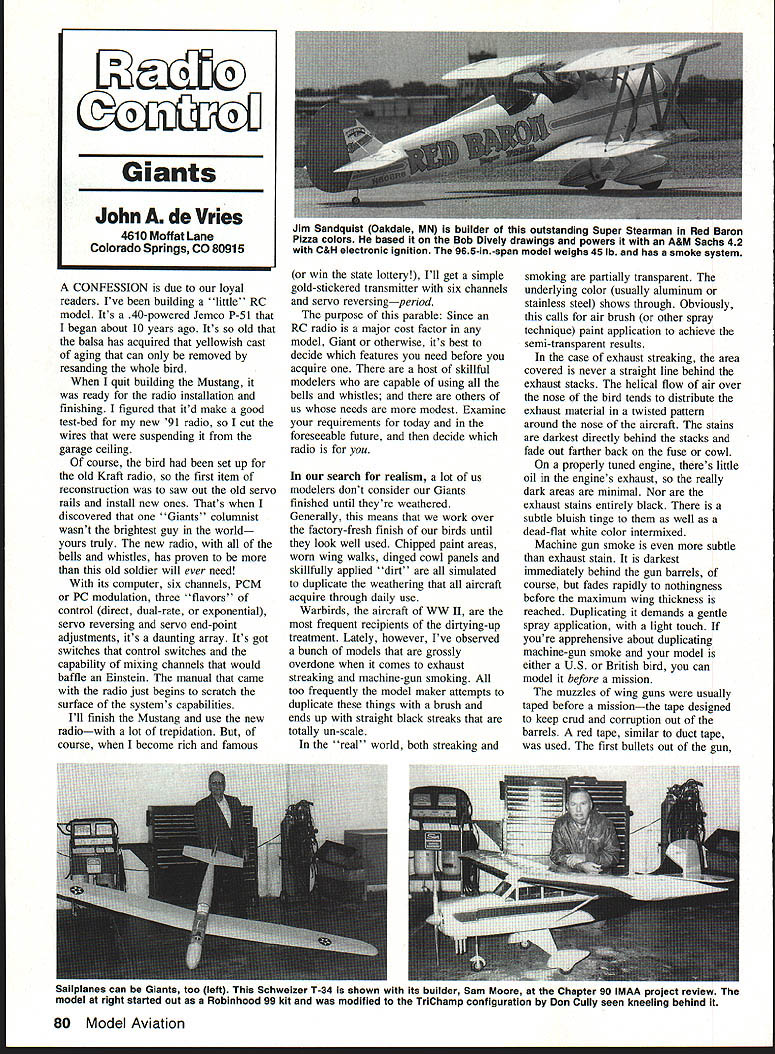
A lot of us modelers don't consider our Giants finished until they're weathered. Generally this means working over the factory-fresh finish of our birds until they look well used. Chipped paint areas, worn wing walks, dinged cowl panels and skillfully applied "dirt" all simulate the weathering that aircraft acquire through daily use.
Warbirds — the aircraft of WWII — are the most frequent recipients of the dirtying-up treatment. Lately, however, I've observed a bunch of models that are grossly overdone when it comes to exhaust streaking and machine-gun smoking. All too frequently the model maker attempts to duplicate these effects with a brush and ends up with straight black streaks that are totally un-scale.
In the real world, both streaking and smoking are partially transparent: the underlying color (usually aluminum or stainless steel) shows through. That calls for an airbrush (or other spray technique) to achieve the semi-transparent results.
Exhaust streaking is never a straight line behind the exhaust stacks. The helical flow of air over the nose of the bird tends to distribute the exhaust material in a twisted pattern around the nose. The stains are darkest directly behind the stacks and fade out farther back on the fuselage or cowl.
On a properly tuned engine there's little oil in the exhaust, so the really dark areas are minimal. Nor are the exhaust stains entirely black — there is often a subtle bluish tinge and sometimes dead-flat white intermixed.
Machine-gun smoke is even more subtle than exhaust stain. It is darkest immediately behind the gun barrels, but fades rapidly to nothingness before the maximum wing thickness is reached. Duplicating it demands a gentle spray application, with a light touch.
If you're apprehensive about duplicating machine-gun smoke and your model is either a U.S. or British bird, you can model it before a mission. The muzzles of wing guns were usually taped before a mission to keep crud and corrosion out of the barrels. A red tape, similar to duct tape, was used. The first bullets out of the gun blew holes in the tape — super-scale, perhaps — but a bird with machine-gun-smoked wings should also feature the tattered remains of the red tape.
My recommendation: take it easy with exhaust smoke when applying realism to model warbirds. Use an airbrush or stand well off with a spray can. Keep things light and semi-transparent.
QSAA Fly-In Exhibitors
Whenever Giant builders congregate in substantial numbers, several manufacturers take the opportunity to display wares. A recent gathering at the Nevada dry lake, the QSAA Annual Fly-In, was no exception — a sterling opportunity to see first-hand some fascinating bits and pieces currently available. Four commercial participants at the QSAA show attracted my attention.
Walshcraft
Norm and Dennis market a solid steel building jig that's eminently suitable for our larger R/C models. Fundamentally, the jig is a slotted "hat-section" steel beam. Several metal adapters are provided that hold fuselage formers and wing ribs in rigid alignment.
The adapters are easily adjusted by simply loosening a bolt or two. Although the basic jig will handle the average Giant, extensions to the beam (up to three feet) may be bolted in place for the larger model. Walshcraft's jig is a quality product that'll assure a dead-on true fuselage or wing.
Contact: P.O. Box 1447, Gilroy, CA 95021; Tel.: (408) 848-3434.
Concept Technology (Dave Bessel)
Dave Bessel of Concept Technology is an electronics genius who knows both model airplanes and computers. He provides a precision plans-enlarging service — mind-boggling since the Windsoft programs can produce drawings up to 91 feet in length.
Contact: Concept Technology, P.O. Box 669, Poway, CA 92074-0669.
Aerowx (Klaus Nowak)
Klaus Nowak, an old friend and president of Aerowx, Inc., looked proud as punch when I talked with him in Vegas. His fine engines did well at the R/C Unlimited Championship Air Races at Madera, California. Fifty percent of the Aerowx-powered qualifiers ended up as winners — including a second place in the prestigious Gold category.
Klaus manufactures and markets Aerowx and Quadra engines in a full range of sizes.
Contact: Aerowx, Box 183, Perth, Ontario K7H 3E3, Canada; Tel.: (613) 264-0010.
MGA Enterprises
MGA Enterprises sponsored another booth on the dry lake, and it caused me to pause for a bit of conversation. MGA markets an extensive line of highly detailed, lightweight, vinyl pilot busts. Although I've seen their advertisements in the magazines, the full impact of their pilots can be appreciated only when you see them in the "flesh," as it were.
MGA covers most of the Giant Scale sizes in pilots from most historical eras. They're fully painted and ready to insert. If you want to customize your model's pilot, some Testor's acrylic paint is all you'll need.
Contact: MGA, P.O. Box 5631, Fresno, CA 93755; Tel.: (209) 224-4170. A SASE with your inquiry will be appreciated.
That's it for this month. I hope your winter Giant project is coming along and will be ready to fly when the spring zephyrs blow.
Transcribed from original scans by AI. Minor OCR errors may remain.

