
RADIO CONTROL GIANTS
John A. de Vries, 4610 Moffat Lane, Colorado Springs, CO 80915
I first met Phil Kent in Paris in 1984. We were covering an international scale contest for our respective magazines. Phil writes the Scale column for the British magazine RCM&E (Radio Control Models & Electronics), the top-selling RC magazine in the United Kingdom. Phil and I hit it off and agreed to swap magazines. For the past 11 years I've been sending him Model Aviation and he's been sending RCM&E to me.
In Phil's latest mailing, I found that an Italian company, Robotec s.r.l., has come up with something that'll knock your socks off! For about $1,225 they'll send you your very own pilot.
Maverick — the radio-controlled pilot
Maverick is a radio-controlled pilot available in 1/6, 1/4, and 1/3 scale by special order. He has Ni-Cd batteries in his legs and a complete RC system (receiver and servos) installed in his torso. He comes ready for flight, dressed in your choice of a variety of costumes.
To have Maverick actually fly your scale aircraft, the model must be built with him in mind. All of the controls must be operated from the cockpit, just like a full-scale aircraft. You will have to provide a seat for Maverick (with a functional safety belt), along with working cockpit controls. Position Maverick with his feet on the rudder pedals, his right hand on the control stick, and his left hand on the throttle.
- Required cockpit components:
- Seat with a functional safety belt
- Two rudder pedals
- Control stick
- Working throttle quadrant
Control routing and actions:
- The pilot's legs operate the rudder.
- His right arm operates the elevators.
- The ailerons are controlled by twisting his torso right and left.
- On the deluxe version, the aileron action is tied into Maverick's head so that he "looks" left and right.
- His left arm operates the throttle, which is connected to the carburetor bellcrank by a simple pushrod.
Of course, Maverick's extremities must be firmly fixed to the controls — the first high-g turn with loose linkages would result in an unpredictable loss of control.
There is an advantage to using Maverick: assuming you have two (or more) models set up for his use, Maverick makes it a snap to swap radios.
Unfortunately, there is no indication that the model pilot is compatible with U.S. radio-control frequencies (nor is there any indication of which antenna he uses). If you want to be the first kid on your block to have a model pilot (and can modify him with an appropriate receiver), he's available from:
Robotec s.r.l. Polisen 30, Montalto Dora, To., Italy
They also market appropriate control-system components as well as scale airplane model kits designed for this unique RC method.
The 3rd Hand clamp
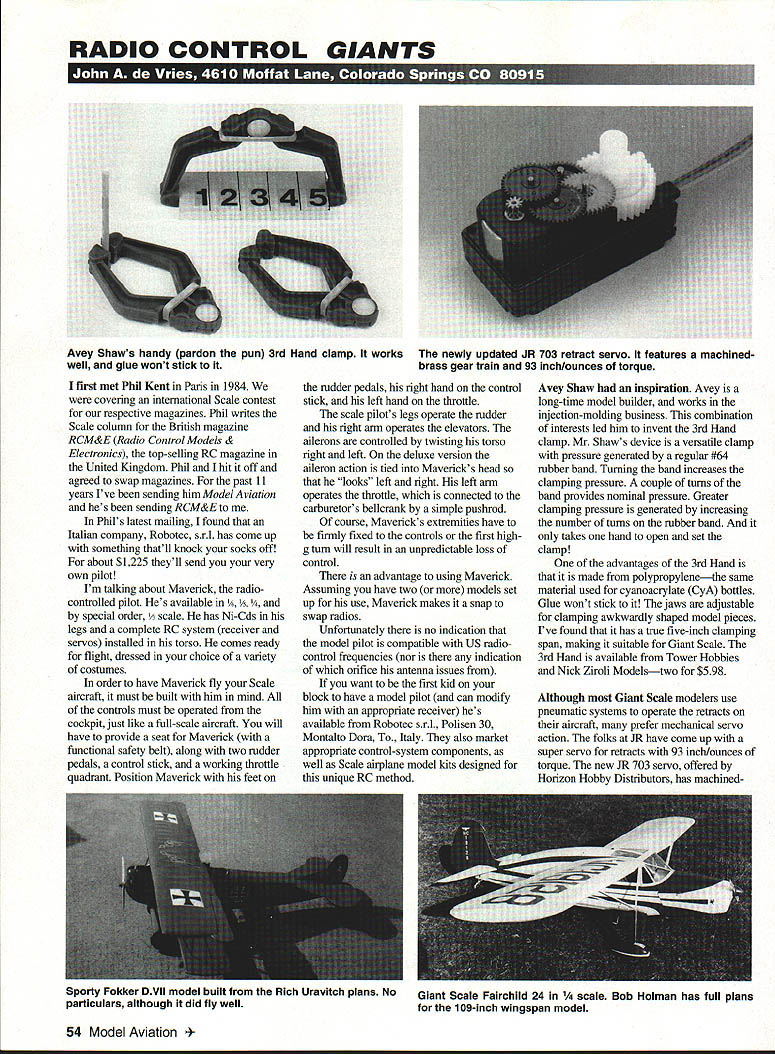
Avey Shaw, a long-time model builder who works in the injection-molding business, invented the 3rd Hand clamp. The device is a versatile clamp with pressure generated by a #64 rubber band. Turning the band increases the clamping pressure: a couple of turns provides nominal pressure, and additional turns increase clamping force. It only takes one hand to open and set the clamp.
One advantage of the 3rd Hand is that it is made from polypropylene — the same material used for cyanoacrylate (CyA) bottles — so glue won't stick to it. The jaws are adjustable for clamping awkwardly shaped model pieces. I found that it has a true five-inch clamping span, making it suitable for Giant Scale.
The 3rd Hand is available from Tower Hobbies / Nick Ziroli Models — two for $5.98.
JR 703 servo for retracts
Although most Giant Scale modelers use pneumatic systems to operate retracts, many prefer mechanical servo action. JR has introduced a powerhouse servo for retracts with 93 inch-ounces of torque. The JR 703, offered by Horizon Hobby Distributors, features a machined-brass gear train and 93 inch-ounces of torque. The brass gears are virtually impossible to strip; properly installed, it will handle the huskiest retract mechanisms. Horizon also offers replacement gear sets to upgrade older versions.
Fairchild 24 — Giant Scale plans
The Fairchild 24 is an ideal subject for Giant Scale. The high-wing monoplane is relatively easy to balance and flies well. Bob Holman has full plans and particulars for a 109-inch wingspan model. The model will accept a .90 two-stroke or a .120 four-stroke engine and has a reasonable empty weight. The original 109-inch span model was designed and built in the U.K. by Graham Smith, who has been flying his model for ten years.
A full set of plans is available from Bob for $36 plus $3 shipping and handling. Write:
Box 741 San Bernardino, CA 92402
Bob also has photo packs and full-scale aircraft documentation.
Santos-Dumont Demoiselle project
Recently I received an interesting letter from a Giant Scale modeler in New South Wales, Australia. He wanted to design and build a 1/3-scale model of the pioneering Santos-Dumont Demoiselle monoplane. His documentation needs were very specific: he wanted to reproduce the Demoiselle that flew in the movie Magnificent Men and Flying Machines — the aircraft used in the film was a modified Santos-Dumont Model No. 20 with the addition of ailerons to the high-wing monoplane. These replaced the original wing-warping system.
Happily, I had several references in my library for the airframe. These included the sizes of the steel-tubing wing struts used in place of the original wire wing bracing.
The completed model is going to be a bear to balance, as the engine is mounted on the leading edge of the wing. The pilot sits directly below the engine, so he's going to have to be made quite heavy — perhaps even lead! This might be a good model for a Maverick installation.
Bell XFM-1A — request for three-views
Speaking of references, I would like to design a scale version of the Bell XFM-1A, the tricycle-landing-geared version of the pre–World War II twin-engined Airacuda escort fighter. After a lot of digging, the only three-views I've been able to find are from old issues of Model Airplane News and American Aircraft Modeller. These are totally inadequate as the basis for a scale model.
I have two beautiful old long-crankcase HP .61s I'd love to use in the completed model. If anyone knows of some accurate three-view drawings of the Bell XFM-1A, I'd sure like to hear about them.
I hope all of you are having a thoroughly delightful summer flying season with your Giant Scale models!
— Phil Kent
Transcribed from original scans by AI. Minor OCR errors may remain.

