
RADIO CONTROL GIANTS
John A. de Vries 4610 Moffat Lane, Colorado Springs, CO 80915
Markings and Lettering
Aircraft manufacturers, military organizations, and even home-builders of experimental aircraft use a lot of small printed markings on full-scale aircraft. A basic World War II fighter is practically one big sign board: legends and instructions are printed all over the airframe for maintenance personnel.
Examples include:
- Fuel tank capacity and required fuel octane next to filler caps
- Tire pressure information on landing gear doors or wheels
- Oil filler cap and coolant hatch stencils
- Dzus fastener alignment stripes
- "Lift Here," "No Step," "Ground Here," "Do Not Paint," and many other small signs
Duplicating these tiny markings on a scale model is tedious. When reduced to scale, already-small printing becomes minuscule. A modeler who wants accurate markings must copy the legends and apply them precisely.
Methods to Reproduce Markings
Many scale builders use sheets of tiny press-on letters from office-supply stores. This method requires several steps and a lot of patience:
- Sort through many sheets to find lettering of the proper size, color, and font.
- List all the legends and note their proper locations on the model.
- Use removable alignment lines to keep letters and words straight.
- Burnish the tiny letters, often over curved surfaces or fabric.
- Protect the applied lettering with a compatible clearcoat to prevent handling from erasing it.
Adding proper lettering to an average Giant Scale model can take almost as much time as the construction itself.
Greeking: A Time-Saving Alternative
You don't always need legible text to suggest realism. "Greeking" is the practice of representing real words with nonsense or unreadable marks that approximate the size and shape of the lettering. At typical viewing distances—such as a 15-foot judging distance in Sport Scale—actual markings are too small to read, so a visual representation is often sufficient.
Tips for greeking:
- Use a standard inking pen and paint to draw the marks.
- Represent the size, shape, and rhythm of words rather than legibility.
- Simulate blocks of text with lines interrupted at regular intervals to suggest word spacing.
Greeking is a practical compromise that saves time while preserving the appearance of detail.
Metal Construction
There are relatively few Giant Scale builders who work extensively with metal, but the exceptions are notable craftsmen who produce impressive, scale-accurate models.
Notable metalworkers:
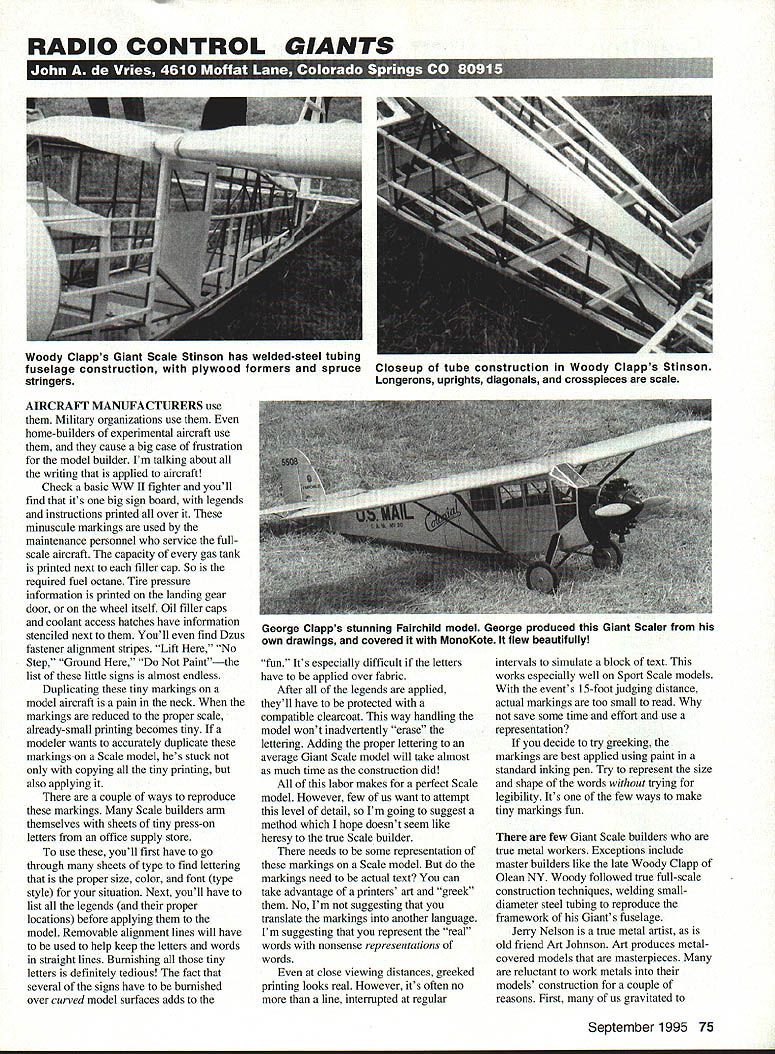
- The late Woody Clapp (Olean, NY) — used full-scale construction techniques with welded small-diameter steel tubing for fuselages.
- Jerry Nelson — a skilled metal artist.
- Art Johnson — produces metal-covered models that are masterpieces.
- George Fisher — uses brazing and silver-soldering to create scale engine mounts.
Many modelers avoid metal construction for two main reasons:
- They began with smaller wooden models and are comfortable with woodworking techniques, reluctant to learn metalworking.
- Concerns about electronics compatibility with metal construction, recalling older issues where metal-to-metal moving parts caused electronic noise and glitches.
Woody Clapp's Techniques and Tools
Woody's experience building full-scale airplanes gave him an advantage. His model-making equipment was simple:
- A small hand-held torch
- A wooden welding jig to hold fuselage longerons and uprights for welding
- A hacksaw and small files
Fuselage uprights and cross pieces had to be fitted precisely, a process only slightly longer than cutting and sanding wooden parts. The result was a dead-on-scale framework that was strong and extremely light, to which he then attached plywood formers and spruce stringers.
George Fisher's methods (brazing and silver-soldering) produce scale mounts that are strong and light and require less heat than welding.
Advantages and Alternatives
Advantages of metal construction:
- True scale appearance where metal tubing is visible
- Comparable weight to wood
- Once learned, only a bit of practice is needed
Alternatives and their drawbacks:
- Birch dowels can simulate metal tubing in visible cockpit areas, but they are heavy and difficult to integrate into wooden structures. They must be glued with epoxy or thick cyanoacrylate to be structurally integral. Real steel tubing is preferable where feasible.
Propellers
A plea to propeller carvers: there are only a few three- and four-bladed flight props available at hobby shops, and those that exist often cover only smaller Giant Scale engines. Left-handed props are even scarcer. That scarcity makes it difficult to reproduce aircraft with contra-rotating propellers, such as the P-38 or F-82.
While there are beautiful scale propellers sold for static judging, many are unsuitable for flight. It's a shame, because larger gasoline and glow engines have enough power to turn multiblade props, and multiblade propellers tend to be slightly quieter than two-bladed ones.
Transcribed from original scans by AI. Minor OCR errors may remain.

