
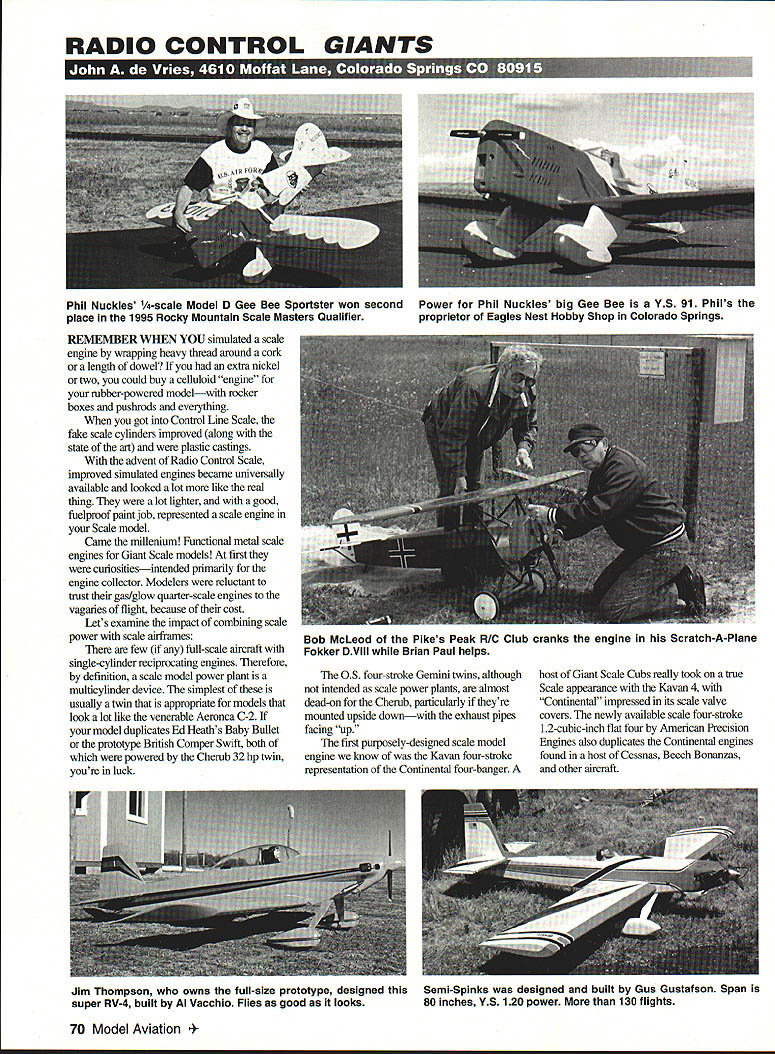

Radio Control: Giants
John A. de Vries, 4610 Moffat Lane, Colorado Springs CO 80915
Intro: From Corks to Functional Scale Engines
Remember when you simulated a scale engine by wrapping heavy thread around a cork or a length of dowel? If you had an extra nickel or two you could buy a celluloid "engine" for your rubber-powered model—with rocker boxes and pushrods and everything.
When Control Line Scale became popular, those fake cylinders improved (along with the state of the art) and became plastic castings. With the advent of Radio Control Scale, simulated engines became widely available and looked much more like the real thing: lighter and, with a good fuelproof paint job, convincing on a scale model.
Came the millennium: functional metal scale engines for Giant Scale models. At first they were curiosities intended mainly for collectors. Modelers were understandably reluctant to trust costly quarter-scale gas/glow engines to the vagaries of flight. Still, the combination of scale power and scale airframes has had a strong influence on the hobby.
Scale Powerplants — Multicylinder Reality
There are few (if any) full-scale aircraft powered by single-cylinder reciprocating engines. Therefore a scale model powerplant is, by definition, multicylinder. Typical examples:
- Twins: The simplest multicylinder layout. Appropriate for models resembling the Aeronca C-2 and similar types. If your model duplicates Ed Heath's Baby Bullet or the British Comper Swift (both powered by the Cherub 32-hp twin), you’re in luck.
- O.S. four-stroke Gemini twins, though not intended as scale powerplants, are almost dead-on for the Cherub—particularly when mounted upside down with the exhaust pipes facing up.
- Inline fours and flat-fours: The Kavan four-stroke representation of the Continental four-banger gave many Giant Scale Cubs a true scale appearance, with "Continental" impressed on its valve covers. The newly available 1.2 cu in flat-four from American Precision Engines also duplicates Continental engines found in many Cessnas and Beech Bonanzas.
- Radials: Technopower radials (three, five and seven cylinders) have added gemlike, fully functional radials to the scene. Seidel, Saito and Robart produce almost-scale radials with more-than-adequate power for Giant Scale models.
- More exotic/rare types: Custom-crafted Cirrus inline engines, V-8 OX-5s, and rotaries have been available in limited numbers.
A practical note about rotaries: they are difficult to throttle in scale form. Full-size rotaries used a "coupe switch" that cut ignition to cylinders; reproducing such a mechanism in a World War I scale powerplant is difficult, and that has limited their installation in models.
Custom and Homebuilt Engines
Don't forget the shop-made jewels from builders such as Forest Edwards. For the do-it-yourself machinist handy with lathes, drill presses and milling machines, it’s possible to fabricate quarter-scale engines (for example, Kinner K-5s) from available drawings and magazine projects. The machinists' magazine Strictly I.C. has offered such projects (contact: 24920 43rd Ave. S., Kent WA 98032-4160).
The Liquid-Cooling Gap
There is a notable lack of scale engines representing liquid-cooled prototypes. Allisons and Merlins are conspicuously absent. The reasons:
- Complicated plumbing and radiators are difficult to duplicate in miniature.
- A reliable coolant pump at 1/4 scale is a significant engineering challenge.
Some attempts to work around the problem:
- The late Doc Pepino mounted a normal air-cooled model engine in a scale mid-fuselage location on a Giant Bell P-39 and ducted cooling air to scale carb and radiator locations. Whether this approach was superior to true liquid cooling is unclear, though it may offer a better cooling solution in some cases.
- Other modelers have had varying success using water-cooling jackets intended for boat engines to cool aircraft engines.
We’ve heard that some folks are planning to try a true liquid-cooled scale RC engine, but things are too preliminary to discuss in detail. If and when progress is made, we’ll report it.
Documentation and Drawings
Although this is primarily the Giant Scale column, we’re equally fascinated with the documentation side of the hobby. We’ve found an outstanding draftsman whose aircraft drawings rival those of Bill Wylam and the late Paul Matt: Stanley Teachman.
- Stanley Teachman (71 East Ave., Fairport NY 14450-1430) produces superb pen-and-ink multiview drawings suitable for copying and enlarging to Giant Scale sizes.
- Available drawings include Curtiss P-36/H-75 and Mitsubishi A5M4 "Claude" RC drawings ($40 each plus $3 P&H). The Curtiss drawings show both retractable and fixed-gear versions.
- Teachman also offers Albatros D.II and Bristol Scout multiview drawings that are truly definitive; they’re more expensive but worth it, especially when enlarged to "Big Bird" sizes.
The Big Bird Dilemma
Here’s a frustrating paradox: in recent months some truly outstanding Scale RC models have been published, but their designers stopped just short of Big Bird status. Many of these monoplane designs have wingspans in the 70+ inch category—close, but not quite large enough.
If designers had increased wingspan by only five to ten inches, those models would have reached the "magic" Big Bird sizes. The marginally larger models would still fly with the same powerplants and use the same accessories (such as retracts), and would qualify for Big Bird events without requiring massive enlargement photocopying.
It’s a small nudge in scale that would make a big difference to Giant Scale modelers.
Transcribed from original scans by AI. Minor OCR errors may remain.

