

RADIO CONTROL: GIANTS
John A. de Vries, 4610 Moffat Lane, Colorado Springs, CO 80915
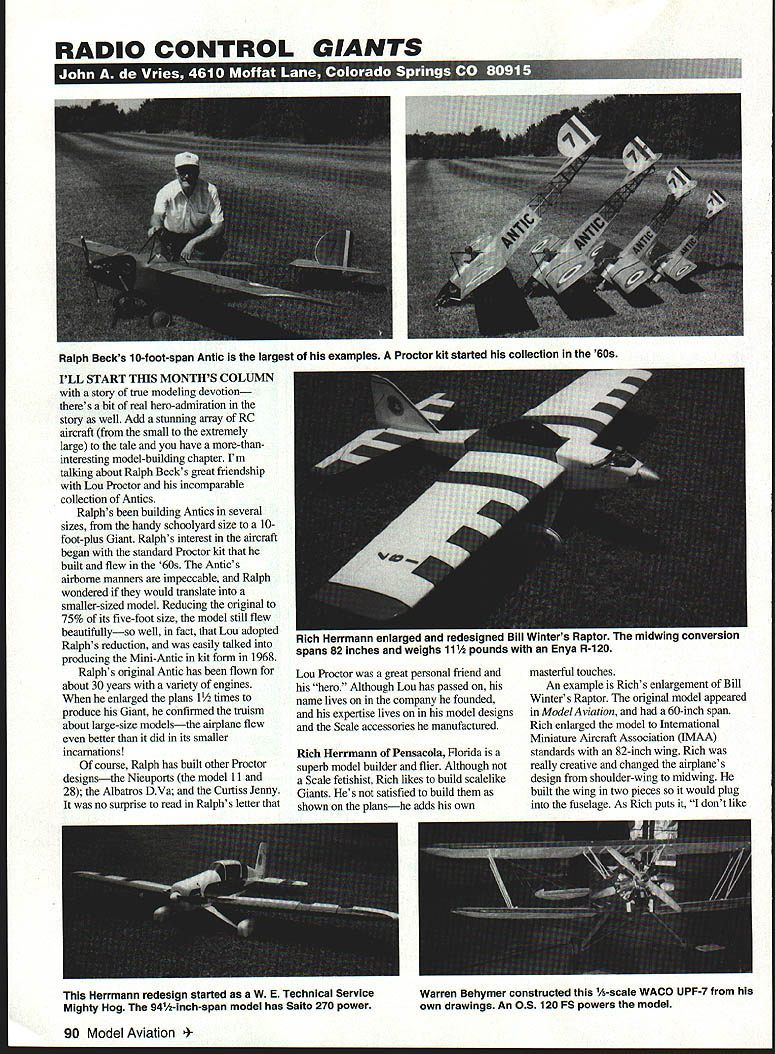
I'll start this month's column with a story of true modeling devotion—there's a bit of real hero-admiration in the tale as well. Add a stunning array of RC aircraft (from the small to the extremely large) to the mix and you have a more-than-interesting model-building chapter. I'm talking about Ralph Beck's great friendship with Lou Proctor and his incomparable collection of Antics.
Ralph Beck and the Antic family
Ralph has been building Antics in several sizes, from the handy schoolyard size to a 10-foot-plus Giant. His interest began with the standard Proctor kit that he built and flew in the 1960s. The Antic's airborne manners are impeccable, and Ralph wondered if they would translate into a smaller-sized model. Reducing the original to 75% of its five-foot size, the model still flew beautifully—so well, in fact, that Lou adopted Ralph's reduction and was easily talked into producing the Mini-Antic in kit form in 1968.
Ralph's original Antic has been flown for about 30 years with a variety of engines. When he enlarged the plans 1½ times to produce his Giant, he confirmed the truism about large-size models—the airplane flew even better than it did in its smaller incarnations.
Ralph has also built other Proctor designs: the Nieuports (models 11 and 28), the Albatros D.Va, and the Curtiss Jenny. Lou Proctor was a great personal friend and Ralph's "hero." Although Lou has passed on, his name lives on in the company he founded, and his expertise lives on in his model designs and the scale accessories he manufactured.
Rich Herrmann — creative Giant builder
Rich Herrmann of Pensacola, Florida, is a superb model builder and flier. Although not a scale fetishist, Rich likes to build scale-like Giants and is not satisfied to build them exactly as shown on the plans—he adds his own masterful touches.
An example is Rich's enlargement of Bill Winter's Raptor. The original model appeared in Model Aviation and had a 60-inch span. Rich enlarged the model to International Miniature Aircraft Association (IMAA) standards with an 82-inch wing. He was really creative and changed the airplane's design from shoulder-wing to midwing and built the wing in two pieces so it would plug into the fuselage. As Rich puts it, "I don't like to show up at the field with the same old tired airplanes everyone else has."
Warren Behymer and other notable Giant modelers
I'm calling the roll of expert Giant Scale modelers and must mention Warren Behymer of Wilmington, Ohio. Sixty-nine years young, Warren is inclined to go the entire route—from the drafting board to the flying field. Two gems shown in the photos are:
- WACO UPF-7 (designed in 1/6 scale, originally had an O.S. 120 FS in the nose; an admirer bought the beautiful biplane and Warren no longer has it).
- Aeronca Sedan (1/5 scale), powered by a Saito 90T that fits neatly in the cowling. The model spans a healthy 85 inches and weighs a featherweight 12 pounds. Outstanding!
Just wait until next month's column—I have some great photos of a Sopwith Schneider Cup racer by Lawrence Klingberg of Canyon Lake, California, who is working on a stunning radial-powered biplane seaplane.
Joe Phillips' quarter-scale Stearman plans
The mailman rang the doorbell recently with a priority package that wouldn't fit my oversized Giant Scale mailbox—long, thin, it usually holds a set of large-scale drawings. Sure enough it did: Joe Phillips (7614 Francis Road, Bryan, TX 77808) sent a roll of plans for a quarter-scale Stearman 4-450.
According to Joe, the drawings are dead-on scale: the angle of incidence is drawn on the upper wing. The plans show both single-place and twin-cockpit versions of the modified WWII primary trainer. Joe is fascinated by the 450-hp aerobatic biplane with the sporty round cowling.
Unrolling the massive coil of paper on the family room floor revealed a superb set of drawings. Joe wasn't too clear about his intent—I'm sure he intends to sell the drawings or produce a Stearman kit. In any event, the draftsmanship is masterful and includes some nice design touches. For example:
- The wings are built on metal tubes for alignment.
- The fuselage is jigged.
- The cabane is shown as a base structure.
- A landing-gear mounting block is detailed.
Joe has also put together a building manual that's truly detailed. It parallels the good old instruction books that the Heathkit folks produced—every construction step is covered, and the manual serves as a checklist. He's currently developing a pair of fiberglass landing-gear leg fairings to go along with the model. If you've got the hots to build a 30-pound round-engine Stearman model that takes a 4.5 hp engine, drop Joe a line.
Publications: GBs & Gee Bees
Although the title's a bit redundant, Bill Hannan's latest publishing effort maintains the superior quality of his books. GBs & Gee Bees features Bill's (and others') great scale drawings. The "GB" refers to the Gordon Bennett airplane races of 1910–12, which are detailed in the book's text.
As I've said before, although Bill's books include mostly Peanut Scale drawings, they're easy to enlarge to Giant size. If your thing is building and flying "Pioneer Era" models, GBs & Gee Bees is for you. The book is $10.95 (plus $2.50 shipping and handling) from Hannan's Runway, Box 210, Magalia, CA 95954. The book's Gee Bee canard model drawings will blow your mind!
On scale detail — how much is too much?
One of the benefits of Giant Scale is that scale detail can be lavished on the model without seriously affecting its flying characteristics. All the bits and pieces that make an RC model a true miniature airplane impose only a small weight penalty. There are limits, of course—particularly with the scale detail that is hidden from view.
In August of 1995 I built a plastic model of the Northrop XB-35 flying wing experimental bomber. The kit was a superb representation of the B-2's ancestor and included a lot of cockpit detail. The first time I built the kit I forgot to install the bulkhead; the cockpit unit was glued into the lower wing half and then covered by the upper half. When the clear-plastic glazing was added, the only things visible in the cockpit were the pilot's seat and the top of the gunsight. All the detailed painting was, essentially, invisible.
Regardless of scale, size, or building materials, the work expended to duplicate details is wasted effort if those details aren't visible. Of course there's always the satisfaction of knowing the detail is there, even though it's like hiding your light under a bushel basket. Artistic scale touches that are covered up by cowlings or streamlined covers are what I'm talking about—I wonder if they're really necessary.
If you're counting, this is my 100th Model Aviation column—with no end in sight. Back with you next month!
—JdV
Transcribed from original scans by AI. Minor OCR errors may remain.

