
RADIO CONTROL GIANTS
John A. de Vries 4610 Moffat Lane Colorado Springs, CO 80915
Featured project: Sopwith Schneider Cup racer (1/3 scale)
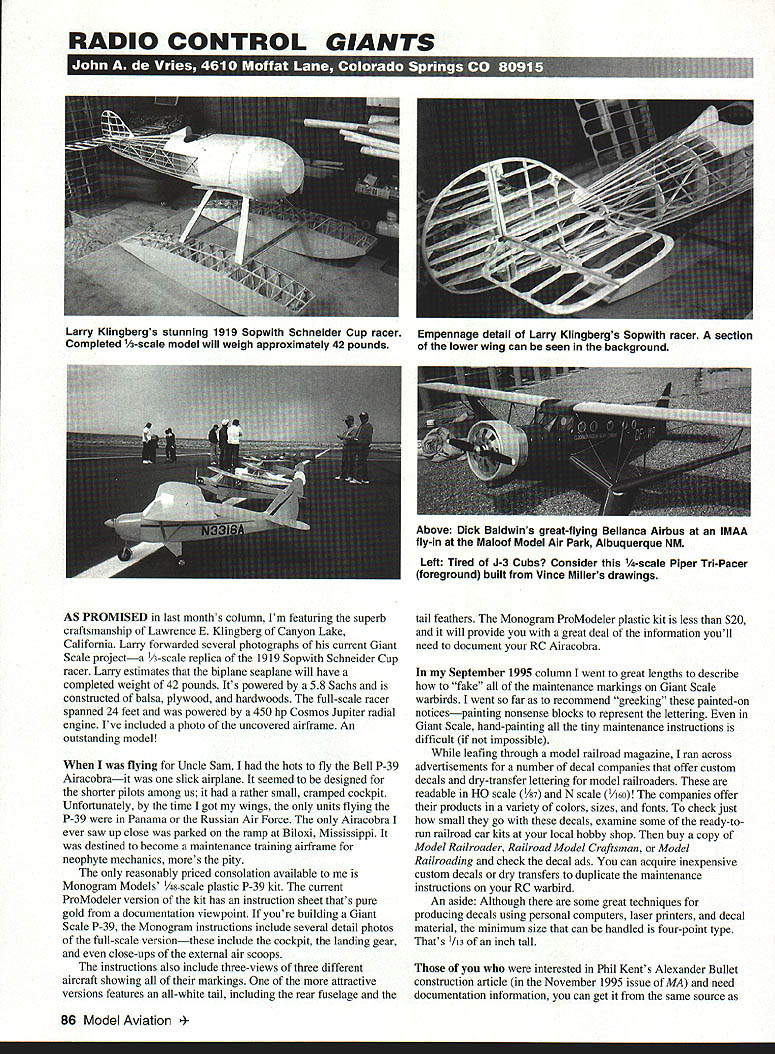
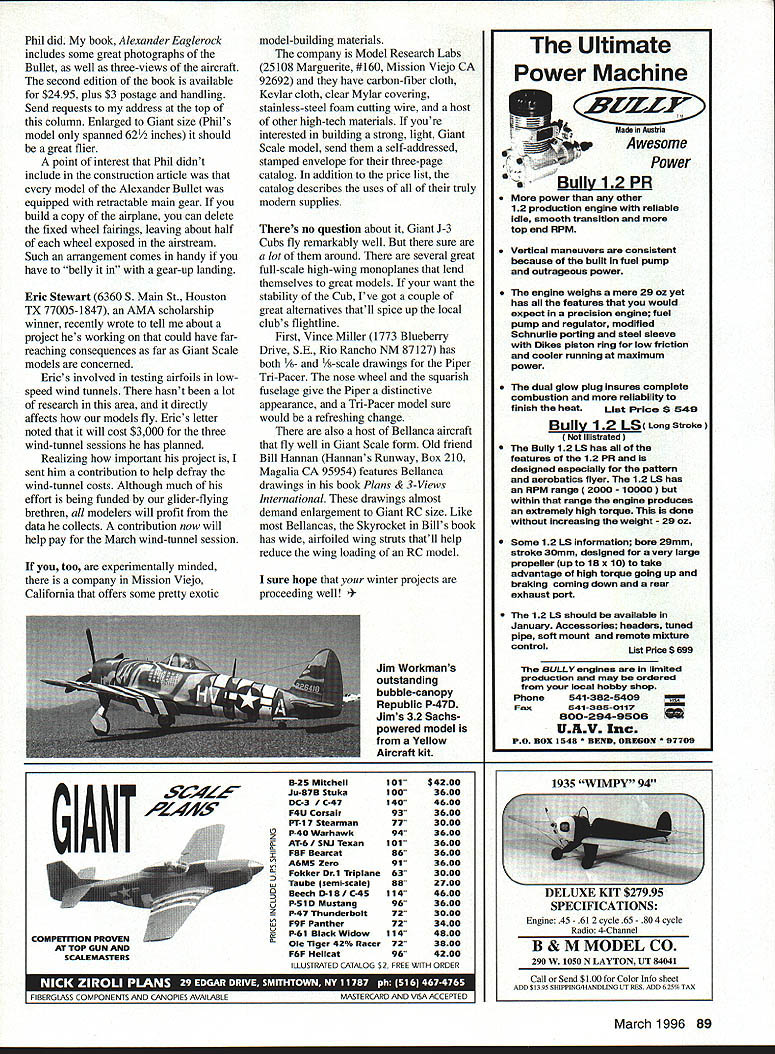
As promised in last month's column, I'm featuring the superb craftsmanship of Lawrence E. Klingberg of Canyon Lake, California. Larry forwarded several photographs of his current Giant Scale project — a 1/3-scale replica of the 1919 Sopwith Schneider Cup racer. Larry estimates the biplane seaplane will have a completed weight of about 42 pounds. It's powered by a 5.8 Sachs engine and is constructed of balsa, plywood, and hardwoods.
The full-scale racer spanned 24 feet and was powered by a 450 hp Cosmos Jupiter radial engine. I've included a photo of the uncovered airframe. An outstanding model!
P-39 Airacobra and documentation
When I was flying for Uncle Sam, I had the hots to fly the Bell P-39 Airacobra — it was one slick airplane. It seemed designed for the shorter pilots among us; it had a rather small, cramped cockpit. Unfortunately, by the time I got my wings, the only units flying the P-39 were in Panama or the Russian Air Force. The only Airacobra I ever saw up close was parked on the ramp at Biloxi, Mississippi. It was destined to become a maintenance training airframe for neophyte mechanics, more's the pity.
The only reasonably priced consolation available to me is Monogram Models' 1/8-scale plastic P-39 kit. The current ProModeler version of the kit has an instruction sheet that's pure gold from a documentation viewpoint. If you're building a Giant Scale P-39, the Monogram instructions include several detail photos of the full-scale version — these include the cockpit, the landing gear, and close-ups of the external air scoops.
The instructions also include three-views of three different aircraft showing all of their markings. One attractive version features an all-white tail, including the rear fuselage and the tail feathers. The Monogram ProModeler plastic kit is less than $20 and will provide you with a great deal of the information you'll need to document your RC Airacobra.
Maintenance markings and decals
In my September 1995 column I went to great lengths to describe how to "fake" maintenance markings on Giant Scale warbirds. I even recommended "greeking" these painted-on notices — painting nonsense blocks to represent lettering. Even in Giant Scale, hand-painting all the tiny maintenance instructions is difficult (if not impossible).
While leafing through a model railroad magazine, I ran across advertisements for several decal companies that offer custom decals and dry-transfer lettering for model railroaders. These are readable in HO scale (1/87) and N scale (1/160). The companies offer products in a variety of colors, sizes, and fonts.
To see how small they go with these decals, examine some of the ready-to-run railroad car kits at your local hobby shop. Then buy a copy of Model Railroader, Railroad Model Craftsman, or Model Railroading and check the decal ads. You can acquire inexpensive custom decals or dry transfers to duplicate the maintenance instructions on your RC warbird.
- Aside: Although there are good techniques for producing decals using personal computers and laser printers, the minimum size that can be handled reliably is four-point type (1/13 of an inch tall).
Alexander Bullet resources
Those of you who were interested in Phil Kent's Alexander Bullet construction article in the November 1995 issue of MA and need documentation can get it from the same source Phil used. My book, Alexander Eaglerock, includes some great photographs of the Bullet as well as three-views of the aircraft. The second edition of the book is available for $24.95, plus $3 postage and handling. Send requests to my address at the top of this column.
Enlarged to Giant size (Phil's model only spanned 62½ inches) it should be a great flier.
A point Phil didn't include in the construction article: every model of the Alexander Bullet was equipped with retractable main gear. If you build a copy of the airplane, you can delete the fixed wheel fairings, leaving about half of each wheel exposed in the airstream. Such an arrangement comes in handy if you have to "belly it in" with a gear-up landing.
Wind-tunnel airfoil testing
Eric Stewart (6360 S. Main St., Houston, TX 77005-1847), an AMA scholarship winner, recently wrote to tell me about a project he's working on that could have far-reaching consequences for Giant Scale models.
Eric is testing airfoils in low-speed wind tunnels. There hasn't been a lot of research in this area, and it directly affects how our models fly. Eric's letter noted that it will cost $3,000 for the wind-tunnel sessions he has planned.
Realizing how important his project is, I sent him a contribution to help defray the wind-tunnel costs. Although much of his effort is being funded by our glider-flying brethren, all modelers will profit from the data he collects. A contribution now will help pay for the March wind-tunnel session.
Materials source: Model Research Labs
If you're experimentally minded, there's a company in Mission Viejo, California that offers some exotic model-building materials.
Model Research Labs 25108 Marguerite, #160 Mission Viejo, CA 92692
They have:
- carbon-fiber cloth
- Kevlar cloth
- clear Mylar covering
- stainless-steel foam-cutting wire
- and a host of other high-tech materials
If you're interested in building a strong, light Giant Scale model, send them a self-addressed, stamped envelope for their three-page catalog. In addition to the price list, the catalog describes the uses of all of their modern supplies.
Alternative Giant-scale aircraft suggestions
There's no question that Giant J-3 Cubs fly remarkably well, but there are a lot of them around. If you want the stability of the Cub but want something different, here are a couple of great alternatives that'll spice up the local club's flightline.
- Vince Miller (1773 Blueberry Drive S.E., Rio Rancho, NM 87127) has both 1/4- and 1/3-scale drawings for the Piper Tri-Pacer. The nose wheel and the squash fuselage give the Piper a distinctive appearance, and a Tri-Pacer model would be a refreshing change.
- Bellanca aircraft also make great Giant Scale models. Bill Hannan (Hannan's Runway, Box 210, Magalia, CA 95954) features Bellanca drawings in his book Plans & 3-Views International. These drawings almost demand enlargement to Giant RC size. Like most Bellancas, the Skyrocket in Bill's book has wire, airfoiled wing struts that help reduce the wing loading of an RC model.
I sure hope that your winter projects are proceeding well!
Jim Workman
Transcribed from original scans by AI. Minor OCR errors may remain.

