
RADIO CONTROL: GIANTS
John A. de Vries
4610 Moffat Lane, Colorado Springs, CO 80915
Ah, the frustrations of writing a monthly column! Three pages on disk, then the bottom fell out of everything. Let me elucidate.
The December 1995 issue of Kitplanes magazine contains their yearly compendium of data on homebuilt aircraft kits and plans. It includes information on 537 different full-scale airplanes. The best part of the exercise is that many of the aircraft lend themselves admirably to reproduction as Giant Scale models. Many manufacturers and designers offer information packages that not only document the aircraft but usually include great three-views at a very reasonable cost.
However, we're caught between a rock and a hard place. By the time this column appears, the Kitplanes annual directory of homebuilt aircraft may no longer be readily available, and the publishers don't provide a back-issue service. If you're lucky enough to find a copy of the directory issue in your local library, it's well worth examining at length. There are designs that would be easily adaptable for RC modelers. The directory includes names, addresses, and costs for most of the info packages.
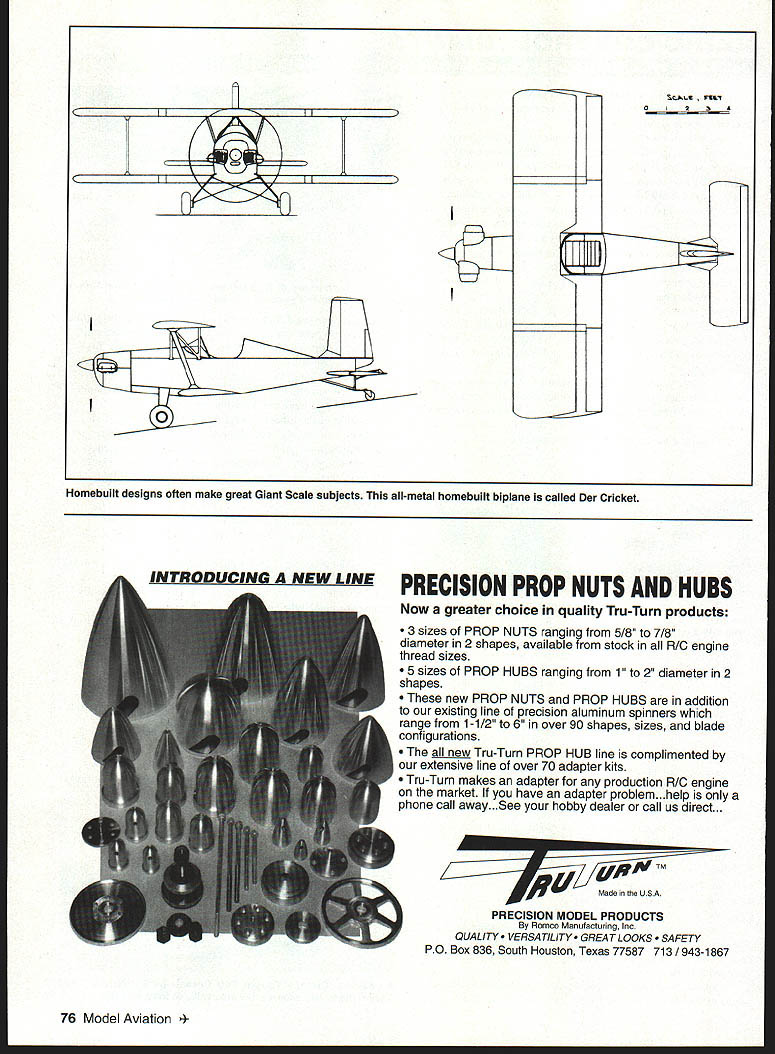
About nine years ago I took my own advice and acquired the information package for an all-metal homebuilt biplane called Der Cricket. The pack included a neat set of 1/6-scale drawings that were easily enlarged to Giant Scale size. I considered using them to build a model powered by a .40-size engine at 2.5 inches to the foot. Even in 1/4 scale the wingspan would only have been 48 inches for the 16-foot-span biplane!
I never did build the model, because the fin/rudder and stabilizer/elevators were all-moving surfaces and I was wary of their operation in scale-model size. The whole design exercise was a lot of fun, however—and easily accomplished.
Weathering Giant Scale Models
There are two schools of thought among Giant Scalers: those who prefer to complete their models so they look "factory-fresh," and those who like their models weathered—showing definite signs of use. I'll address the second group this month, since I have a really neat (and easy) way to weather model aircraft.
Any metal airplane that is painted (including most WWII warbirds) soon finds its finish beginning to wear thin after a few flights. Paint at the front edges of cowlings, air scoops, and the leading edges of flight surfaces begins to show aluminum after only a few flights. If the aircraft has been flown through a rainstorm, the paint erodes even more rapidly. Even the most pristine aircraft will show some silver on the leading edges of black-painted propeller blades.
Some modelers simulate paint erosion by randomly adding dabs of aluminum paint over the basic paint job. It looks okay at sport-scale viewing distances—but you can duplicate the natural process more convincingly by using rubber cement.
Steps to simulate worn paint with rubber cement:
- Coat the areas to be weathered with aluminum-colored paint. An overall aluminum undercoat can be useful so you can show minor scrapes elsewhere on the model.
- When the aluminum undercoat is dry, pour a bit of rubber cement into a shallow jar lid.
- Using the side of your thumb, apply a thin coat of rubber cement to the areas where you want the aluminum to show through. Keep the cement coat thin and only go over the weathered areas once. Don't make it neat and even—randomness adds realism. You might even skip an area for variety.
- When the cement-covered areas are dry, apply the cover coats of paint (camouflage, etc.). Spray painting or airbrushing is best; a brush may erode the rubber cement-covered areas prematurely.
- After the overcoat is dry, rub the rubber cement-masked areas clean to reveal the aluminum below.
- Lightly work the weathered areas with 400-grit wet-or-dry sandpaper to blend the edges and complete the effect.
Properly done, the weathering will make your model look "war weary" with a minimum of effort.
Publications and Resources
Old friend Bob Banka has recently published his latest Scale Aircraft Documentation and Resource Guide, and it's a doozer. Highlights:
- Price: $8
- Length: 188 pages
- Contents: listings of Bob's extensive "foto-paaks"; aircraft covered range from the Wright Brothers to the latest military jets
- Collection size: about 5,800 different color foto-paaks and some 33,000 pages of three-views and documentation data
- The book serves as a professional catalog and also includes 13 articles
Bob's collection is truly mind-boggling and an excellent resource for scale modelers.
IMAA District IV "Meeting of the Giants"
The folks who sponsored the 1995 Rally of Giants are planning an IMAA District IV "Meeting of the Giants" on June 20–23 at the Danville Regional Airport in Danville, Virginia. They will be assisted by the Danville Parks and Recreation Department.
Event details:
- Dates: June 20–23
- Location: Danville Regional Airport, Danville, VA
- Contest Director: Mike Farlow, 219 Courtney St., Danville, VA 24540; Tel.: (804) 836-2135
- Preregistration: $10; on-site: $20 (or $5 per day)
- A big banquet is scheduled for Friday night
- Expect day and night flying
Giant-Scale Corsair Notes
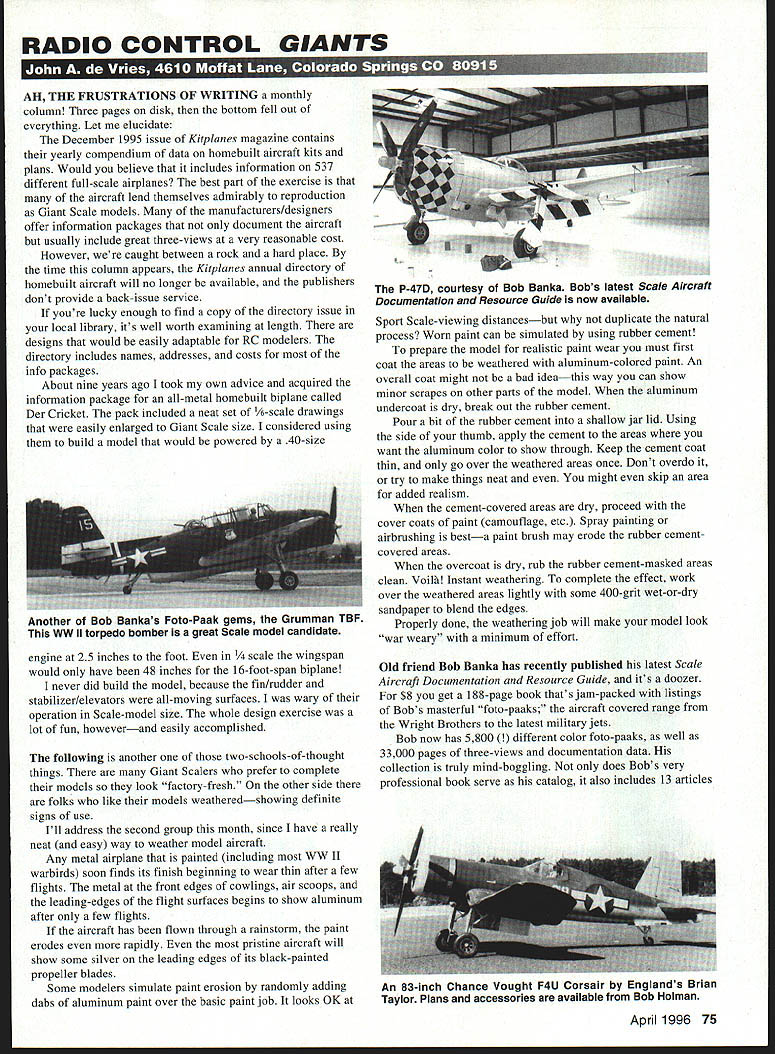
One of the most difficult tasks in designing a Giant Scale model is making it look "right" when it's sitting on the ground. Landing-gear length, wheel diameter, and strut diameter contribute to the proper "set." The Chance Vought F4U Corsair is especially challenging to get that proper "stalky" look when perched on its gear.
Britain's Brian Taylor has achieved the look with his Giant Scale (82-inch wingspan) F4U-1. Bob Holman (Box 741, San Bernardino, CA 92402) is offering his drawings. Bob also has a compatible accessory kit that includes:
- Fiberglass cowling
- Wing crank
- Canopy
- Prop nut
He plans to have laser-cut parts for the Corsair, and retracts for the aircraft are also available.
I could use photos of your Giant Scale model(s) to illustrate these pages. Send photos to the address at the top of this column; I'll be happy to credit you and/or your photographer.
Transcribed from original scans by AI. Minor OCR errors may remain.

