
RADIO CONTROL GIANTS
Author
John A. de Vries 4610 Moffat Lane, Colorado Springs, CO 80915
NO QUESTION ABOUT IT: Leonardo da Vinci would be amazed at the uses his invention fostered. Among his other aerial hardware, Old Leo designed a pyramidal parachute. He got the idea right, even if he got the shape all wrong. His "aerial lifesaver" has been worked over by a lot of people. They've adapted it and found a number of uses that have extended its usefulness and utility.
Of course, parachutes made of silk or rip-stop nylon are worn by aircrewmen for emergency purposes. On the RC model front, they've been adapted for air shows. "Charlie" — his torso stuffed with receivers, batteries, and servos — has been known to "bail out" with a radio-controlled descent, to the delight of modelers and spectators.
Of late, scale ribbon-drogue chutes have appeared on the market; they duplicate the full-scale practice to slow ducted-fan models after landing. They're available from MRM Products, Box 7383, Macon, GA 31209-7383; Tel.: (912) 477-1317.
There are even RC models whose only aerodynamic support is a scale-size parachute of the currently favored rectangular pattern. (They aren't Giants, though.)
Yet to appear is a Charlie that copies the old barnstorming jumpers' technique of "parachute slipping." To thrill airshow crowds in the '20s and '30s, aerial daredevils loaded their packs with several canopies. As they fell, they would cut one (or more) of the canopies loose — always with one in reserve to ensure a soft landing.
Also, RC modelers haven't scaled the anti-spin parachutes that are installed on experimental aircraft to bring them out of any "unusual positions" they might assume during testing. Nor have we seen the "safety chutes" that are available for full-scale ultralight and homebuilt aircraft. They're designed to let the aircraft down softly when the pilot runs out of airspeed, altitude, and ideas — at the same time.
Finally, we've yet to see an F-111 swing-wing model equipped with an emergency capsule. Early versions of the fighter/bomber featured an ejectable cockpit that provided a pressurized environment with its own massive parachute system. It carried the pilot and systems officer safely to the ground in an emergency.
As modelers, our usual "tribute" to the parachute is to include them on the pilots of aerobatic and military airplanes. Now, if we could only design a scale ejection seat to "save" our plastic pilots in the event that the unthinkable happens and our model heads for a "powder job!" Of course, nonfunctional ejection seats have shown up in detailed scale models, but nobody's adapted them to blank .22-caliber cartridge ejection mechanisms. (Early full-scale ejection seats used blank 37mm cannon shells; later models used rocket power.)
Photo Feature
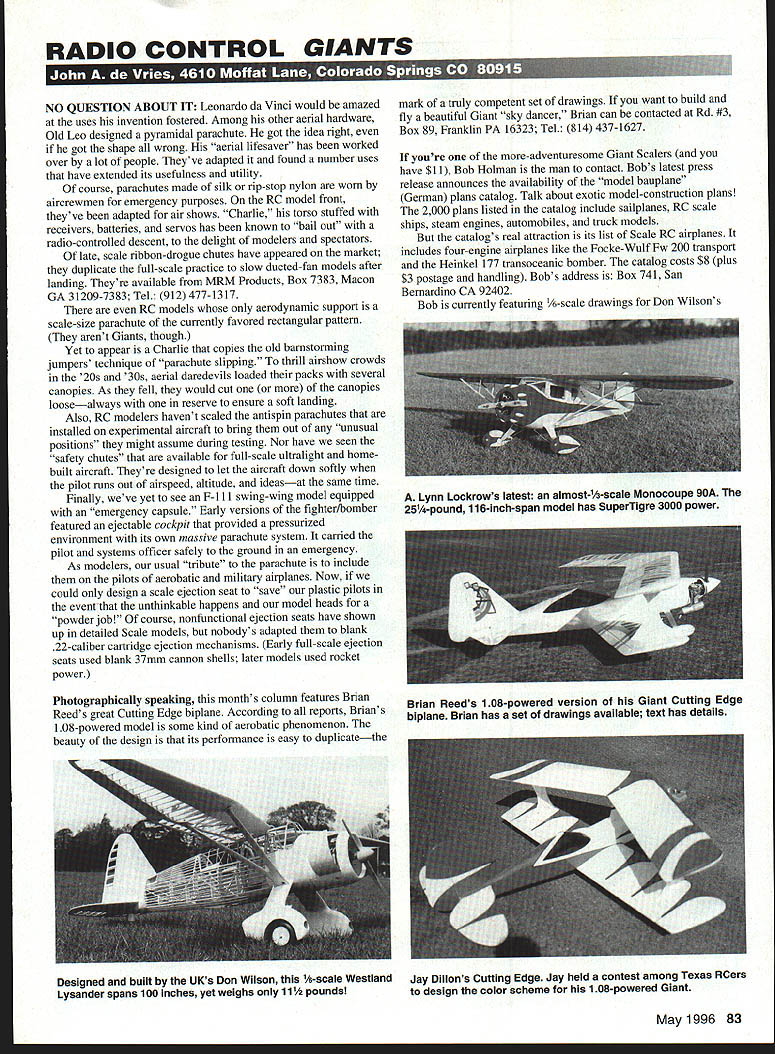
Photographically speaking, this month's column features Brian Reed's great Cutting Edge biplane. According to all reports, Brian's O.S. 1.08-powered model is some kind of aerobatic phenomenon. The beauty of the design is that its performance is easy to duplicate — the mark of a truly competent set of drawings. If you want to build and fly a beautiful Giant "sky dancer," Brian can be contacted at R.D. #3, Box 89, Franklin, PA 16323; Tel.: (814) 437-1627.
Plans and Catalogs
If you're one of the more-adventuresome Giant Scalers (and you have $11), Bob Holman is the man to contact. Bob's latest press release announces the availability of the "model bauplane" (German) plans catalog. Talk about exotic model-construction plans! The 2,000 plans listed in the catalog include sailplanes, RC scale ships, steam engines, automobiles, and truck models.
The catalog's real attraction is its list of Scale RC airplanes. It includes four-engine airplanes like the Focke-Wulf Fw 200 transport and the Heinkel 177 transoceanic bomber. The catalog costs $8 (plus $3 postage and handling). Bob's address is Box 741, San Bernardino, CA 92402.
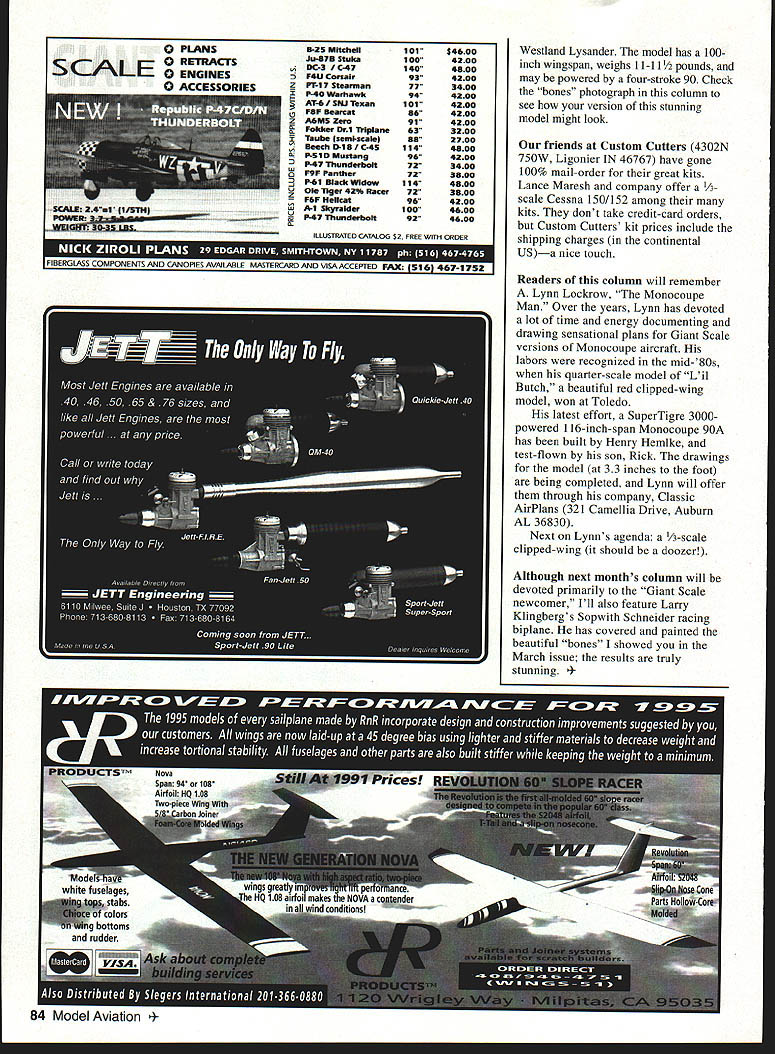
Bob is currently featuring 1/6-scale drawings for Don Wilson's Westland Lysander. The 1/6-scale model spans 100 inches, weighs 11-1/2 pounds, and may be powered by a four-stroke .90. Check the "bones" photograph in this column to see how your version of this stunning model might look.
Kits and Suppliers
Our friends at Custom Cutters (4302 N 750 W, Ligonier, IN 46767) have gone 100% mail-order for their great kits. Lance Marsh and company offer a 1/4-scale Cessna 150/152 among their many kits. They don't take credit-card orders, but Custom Cutters' kit prices include the shipping charges (in the continental U.S.) — a nice touch.
People and Projects
Readers of this column will remember A. Lynn Lockrow, "The Monocoupe Man." Over the years, Lynn has devoted a lot of time and energy documenting and drawing sensational plans for Giant Scale versions of Monocoupe aircraft. His labors were recognized in the mid-'80s, when his quarter-scale model of "Li'l Butch," a beautiful red clipped-wing model, won at Toledo.
His latest effort, a Super Tigre 3000–powered 116-inch-span Monocoupe 90A, has been built by Henry Hemke and test-flown by his son, Rick. The drawings for the model (at 3.3 inches to the foot) are being completed, and Lynn will offer them through his company, Classic AirPlans (321 Camellia Drive, Auburn, AL 36830).
Next on Lynn's agenda: a 1/3-scale clipped-wing (it should be a doozer!).
Although next month's column will be devoted primarily to the "Giant Scale" newcomer, I'll also feature Larry Klingberg's Sopwith Schneider racing biplane. He has covered and painted the beautiful "bones" I showed you in the March issue; the results are truly stunning.
Transcribed from original scans by AI. Minor OCR errors may remain.

