
RADIO CONTROL GIANTS
Author
John A. de Vries 4610 Moffat Lane, Colorado Springs, CO 80915
Introduction
To set the tone for this year's Newcomer Giant Scale column, I'd like to quote the elder statesman of "Big Is Beautiful," Dick Phillips, magazine columnist and past president of the International Miniature Aircraft Association (IMAA).
I had expressed my doubts to him about modelers building Giant Scale models for their first RC projects. "I don't agree with your hypothesis that nobody should begin with a large airplane," he said. "However, there are some caveats. They should absolutely stick with a trainer and they should have a lot of good, experienced help available. Without those two details, they should, most assuredly, stay away from the big stuff."
Although I don't have a survey to support the contention, most modelers who are involved in Giant Scale came to it with a long and varied background building and flying smaller RC models. Anyone contemplating a Giant Scale model should certainly follow Dick Phillips' advice—experience with more conventionally sized models would be a great-big plus.
Defining Giant RC Models
The basic IMAA definition includes:
- Monoplanes with wingspans of 80 inches or more.
- Biplanes that have at least one wing that spans 60 inches or more.
- True 1/4-scale models meet the criteria.
- A ducted-fan (jet) model qualifies if its fuselage length combined with its wingspan totals 140 inches.
Although weight is not a formal criterion, Giants typically weigh from 10 to 55 pounds. They are powered by a wide variety of engines, from .90 four-strokes to the largest of gas-burners. Gas engines pose new problems for the model builder—big propellers, gas-oil mixtures, and manual or servo-operated "kill switches" are unique to Giant Scale models.
Because of the inflight stresses that Giants experience, there's a lot of plywood, spruce, and carbon fiber in their construction. Although there's plenty of balsa in the average Giant, the construction more closely approximates full-scale rather than traditional model-building techniques.
Costs and Equipment
While there are a few ways to save money when building and operating Giant Scale models, they aren't for the faint of heart when it comes to expense.
Typical costs:
- Engines: $300 to $3,000 or more.
- Kits: can top $2,000.
- Giant radios: relatively affordable compared to other components, but extra or high-torque servos (around 140 in.-oz.) add cost.
- Batteries: extra-capacity packs (1,200–1,500 mAh) cost more than standard 400 mAh packs; often two packs per model are used for redundancy and safety.
- Props: some Giant Scale propellers cost $20 or more.
Starting from scratch, a $1,000 investment isn't unusual just to put a Giant Scale RC model in the air. With that kind of investment, the prudent modeler will want cast-iron assurance that his effort will be crowned with success.
IMAA and Flying Philosophy
One fundamental idea behind Giant Scale RC models is that they're built and flown for fun. The IMAA, AMA's Giant Scale Special Interest Group, was founded in 1980 on a noncompetitive basis. An IMAA Fly-In reflects this philosophy: no judging, no competition—just a get-together of modelers with a common interest. The only evaluation at an IMAA Fly-In is for safety reasons. The meet's organizers will inspect every model to make sure that it is airworthy — a practice that is as old as the SIG itself.
A properly set up Giant model will generally fly better than its smaller brethren. The majesty of Giant Scale flight is a big attraction to RC modelers, and many appreciate the increased visibility that the Giant Scale models provide.
Advice for Newcomers
If you're a newcomer to the clan of Giant Scale model owners, take these suggestions to heart:
- Start out with a Giant trainer model.
- Get as much experienced help as you can find, and keep using it throughout the process.
- Get competent assistance when you learn to fly your Giant Scale model.
- Have someone double-check the safety of your model at every opportunity.
No one has ever claimed that Giant Scale is easy, but with a conscientious approach it can be very satisfying.
Member Notes and News
Larry Klingenberg
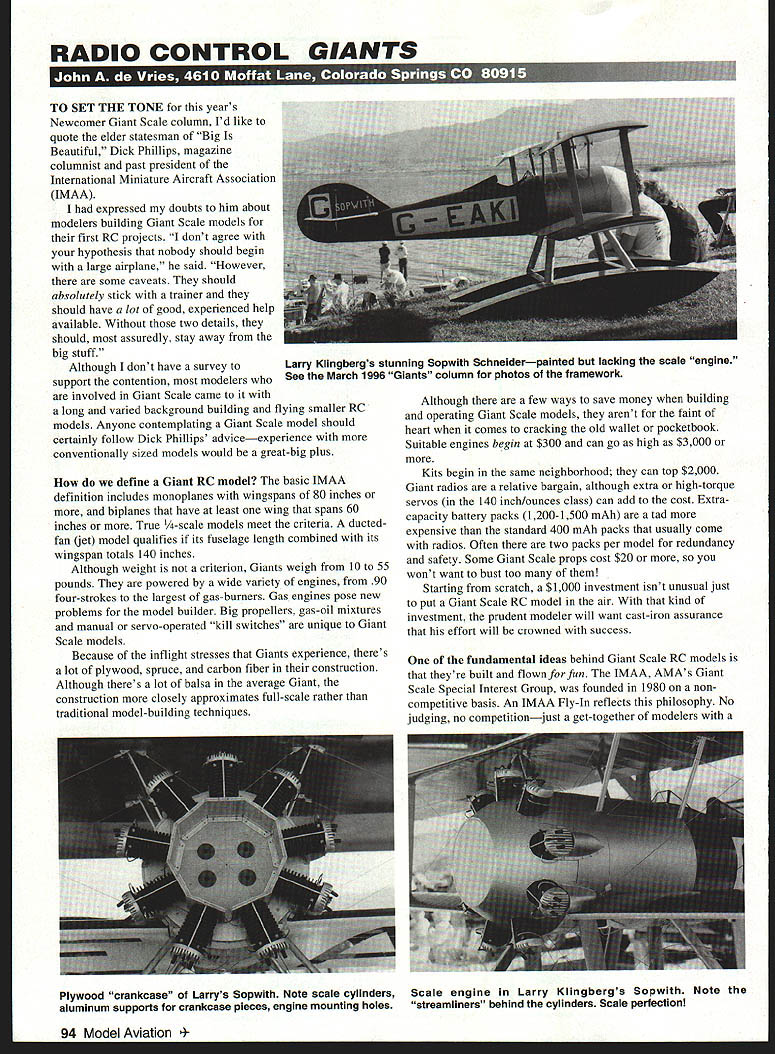
In last month's column I promised to include some photographs of Larry Klingenberg's masterpiece — his 1/3-scale Sopwith biplane Schneider Cup racer. Larry has covered and painted his superb model and, as of this writing, it's almost ready for flight. Note the scale "engine" that he has built. The perfection of Mr. Klingenberg's construction is breathtaking!
Jerry Nelson — Clevises
Jerry Nelson has come up with some sturdy clevises for the Giant Scaler. Two varieties are available; both are made of steel and are secured with cotter pins. One is drilled for soldered applications, the other is threaded to accept 2-56 pushrod ends. It would be nice if Jerry would produce one of these great clevises with a 4-40 thread for bigger models.
Contact Nelson Aircraft: 21550 NW Nicholas Ct., Unit D, Hillsboro, OR 97124 Tel.: (503) 629-5277
Dick Smith — Shaft Fix (Anecdote)
Dick Smith (we graduated from the same high school together in '42) writes the Century Flier, the newsletter for IMAA Chapter 100. In his latest issue he reports a clever repair:
"The shaft on my G-62 was badly bent when I crashed my Pitts S-2 (model). I put the engine in my P-51 and it shook so badly that I lost an aileron on one flight. I removed the engine and attempted to straighten the crankshaft in my lathe. I got it running pretty true but the last part of the shaft out by the threads was still running out .010.
"As I was reinstalling the crankshaft, I noticed that the shaft was identical front or back! That is, the two halves of the shaft were identical. I installed the shaft with the back end in the front and it runs very true, with no vibration. If any of you experience a bent shaft on a G-62, you can use the same method to save the engine."
Dick is a master machinist with years of experience. He knows what he's talking about!
Farman Moustique and Contacts
I've included a rather strange photograph with this column. It's of a Farman Moustique CO2-powered model, designed and built by Bill Hannan. I've included this 18-year-old model as a "plug" for another old friend, Norm Rosenstock. Norm has some great Giant Scale drawings available for the same Farman. If you enjoy building and flying early models, contact Norm:
Norm Rosenstock 124 Granada St., Royal Palm Beach, FL 33411
Also — Bill Hannan has one of his fine books that will provide most of the documentation you'll need for the model. Contact Bill at:
Hannan's Runway Box 210, Magalia, CA 95954
Transcribed from original scans by AI. Minor OCR errors may remain.

