
Radio Control: Giants
John A. de Vries 4610 Moffat Lane Colorado Springs, CO 80915
Even in Giant Scale, it's the little things that count. We're talking about scale details, many of which have been neglected by modelers. There are a host of small, albeit visible, bits and pieces that would certainly complement a complete scale reproduction.
Scale details often overlooked
- Grounding wires
Almost every warbird had a grounding wire. Because the aircraft was insulated by its tires, it was necessary to use some method of grounding the plane, particularly while it was taxiing. A small bit of stiff wire, attached to the aircraft, dragged on the ground and prevented the buildup of static electricity. The wire usually led from a component of the landing gear to the tarmac. Have you ever seen one on a model?
- Static-discharging wicks
Although all metal components in an aluminum airplane were bonded to minimize radio interference, a static charge built up as the plane flew. The wicks were short lengths of frayed cord (like clothesline), covered for most of their length with black rubber tubing and attached by means of small aluminum fittings to ailerons, elevators, and sometimes rudders. The wicks provided a path for discharging static electricity.
- C-47 window holes and plugs
Many Gooney Birds (C-47s) had a black rubber grommet installed in each cabin window; during normal operations a plastic plug fit in each hole. When paratroops were transported and the Gooney was under attack, the plugs could be pulled and troops could fire out the window. The effect wasn't a major tactical deterrent, but the grommets and plugs are a distinctive scale detail few models duplicate.
- Yaw string (F-80/T-33)
The yaw string was a length of thin cord attached at its forward end to the upper centerline of the aircraft's nose. During a coordinated turn it stayed along the centerline; when skidding it streamed to the side. The preflight checklist included making sure the yaw string, which could be trapped by the forward nose hatches, was free and clear. Have you ever seen an F-80 or T-33 model with one?
- Blow-in doors (F-80/T-33)
These spring-loaded doors were located atop the fuselage aft of the canopy and above the engine's plenum chamber. Negative pressure in the plenum would suck them in to provide extra air for ground and low-speed operation. At flying speed the doors closed to streamline the fuselage.
- Opening cockpit windows and wipers
Many closed aircraft of the 1920s–1940s featured cockpit windows that could be opened in flight. If the windshield wipers didn't work, the pilot could open the window and scrape off snow or ice by hand. Few scale models duplicate working wipers or operable windows.
- High-frequency wire antennas
Before VHF and UHF communications became standard, many radio-equipped aircraft used HF transmitters and receivers that required a long external wire antenna, usually routed from a mast to the vertical tail. While most RC sets today need an external antenna, how many modelers have used scale installations on their old-time birds?
- Very pistol hole on the P-51 Mustang
There's a small, round hole in the left side of a Mustang's fuselage just below the canopy. It lined up with a Very pistol mount inside the cockpit. To launch a flare the pilot hooked up the pistol to the mount, aimed, and pulled the trigger. That hole would make a fine, very-scale addition to a model Mustang.
- Recognition lights (Mustang and others)
On the full-scale P-51 three circular lights were mounted in line on the bottom of the wing near the right tip: red, green, and amber. They displayed the "code of the night" so friendly antiaircraft gunners would not fire. Many other U.S. aircraft also had recognition lights.
- Tail-mounted warning radar
Some WWII fighters had a tail-mounted warning radar secured to the vertical tail surface. It functioned like an early "buzz buster": if an enemy aircraft slipped into the ideal tail-on firing position, the radar gave a visual or audible alarm in the cockpit.
- Formation lights
These blue lights, usually mounted on the upper surface of an aircraft, served as reference points to aid wingmen in maintaining position in formation at night.
As I said at the beginning of this column, small details are often overlooked by scale modelers. Working in Giant Scale, we can duplicate these features with little difficulty. Our birds will be much the better for it—they'll truly be miniature aircraft!
News and resources
- Scale Plans & Photo Service video/catalog
Doc Pepino had an inspiration. The jovial proprietor of Scale Plans & Photo Service (3209 Madison Ave., Greensboro, NC 27403) has produced a video catalog of his scale designs. For $10 Jim will send you the tape so you can see his drawings in the flesh—and in the air. The $10 can be applied to the price of his drawings when you order. He also has a new paper catalog ($5) which includes info on all his RC designs and his photo packs. Either way (VCR tape and/or black-and-white printing), it's a useful resource.
Kits and suppliers
- Reid's Quality Model Products
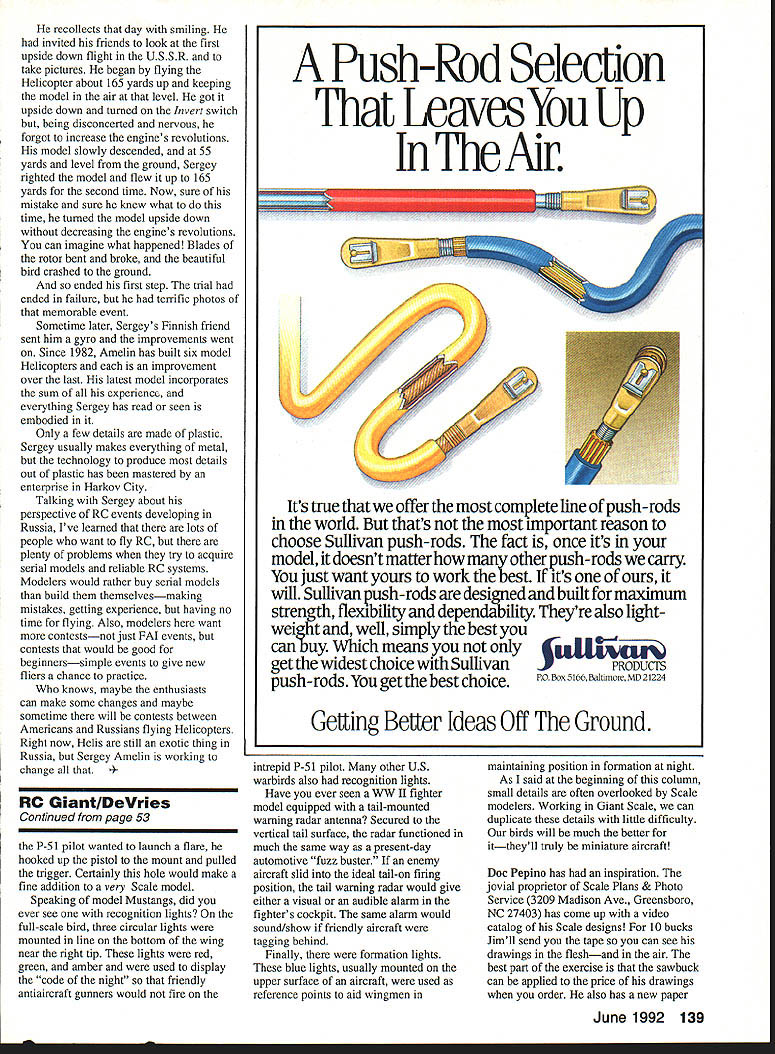
My friends in Phelps, New York, have taken over Jim Messer's Quality Model Products. Dave and Juanita Reid will continue Jim's line of Giant Scale RC kits, including the Erco/Comet, the Piper Tomahawk T-tail, and the J-3 Kitten. I have seen all three kits and they are winners. The Reids are also producing sporty WWI wheels: quarter-scale rollers are 7½ inches in diameter; ¾-scale wheels are 10 inches across. Contact: Reid's Quality Model Products, 135 Main St., Phelps, NY 14532.
- PBY-5A Catalina kit (Bill Price)
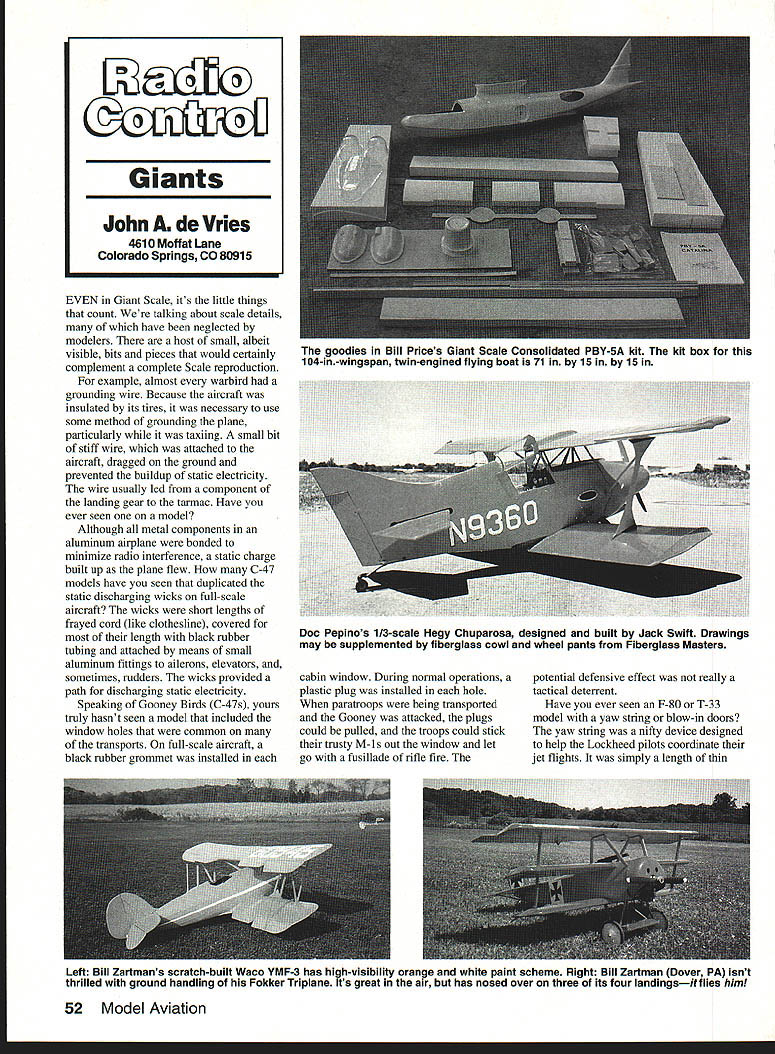
If big PBY-5A Catalina models appeal to you, Bill Price offers a half-scale kit. At 1/2-scale the twin-engined flying boat spans 104 in., weighs about 23 lb., and takes two .60 two-cycle engines or a pair of .90 four-cycle engines. The fuselage and pylon are fiberglass and already joined; the wing is foam. A set of retracts is offered (requires a Robart air cylinder), and Bill has a construction video to complement the instruction book. The Cat's wing tip floats can be made retractable as well. The wings detach outboard of the engine nacelles and are held in place by functional struts. For more information send a SASE to G&P Sales, 410 College Ave., Angwin, CA 94508.
Back with you Giant Scalers next month. If you write, I would appreciate a #10 SASE—it'll speed up answers a bunch!
John de Vries 4610 Moffat Lane Colorado Springs, CO 80915
Transcribed from original scans by AI. Minor OCR errors may remain.

