
RADIO CONTROL GIANTS
Byline
John A. de Vries, 4610 Moffat Lane, Colorado Springs, CO 80915
Mercury Chic and All-Flying Tails
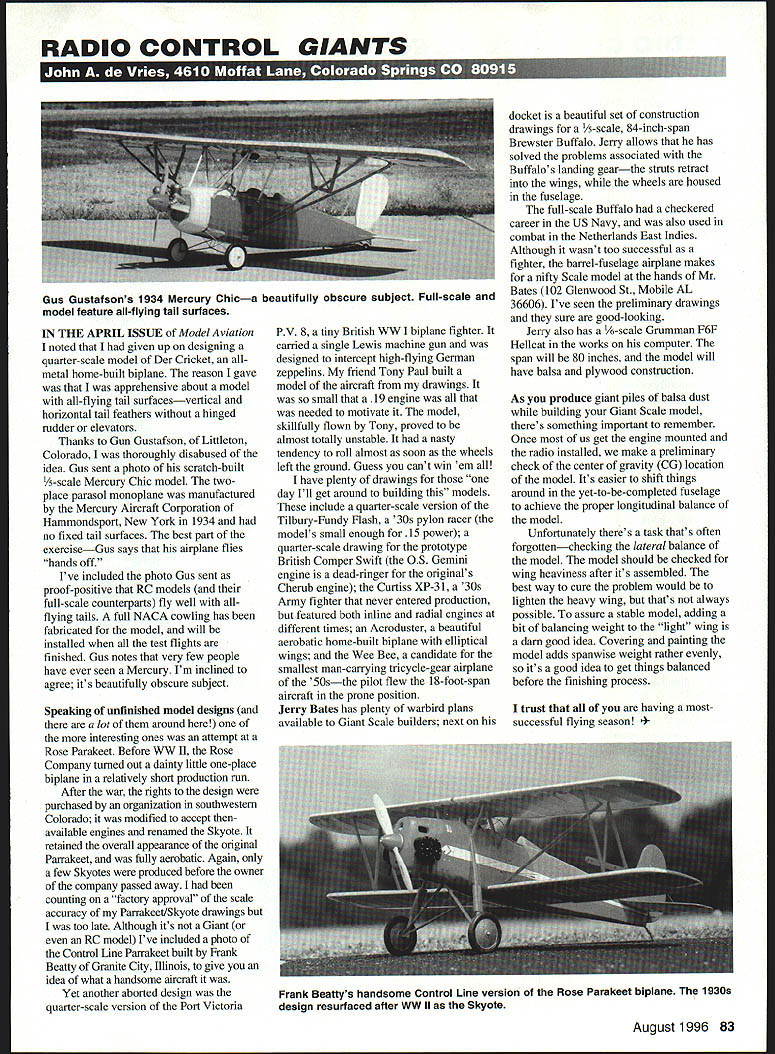
In the April issue of Model Aviation I noted that I had given up on designing a quarter-scale model of Der Cricket, an all-metal home-built biplane. The reason I gave was that I was apprehensive about a model with all-flying tail surfaces—vertical and horizontal tail feathers without a hinged rudder or elevators. Thanks to Gus Gustafson, of Littleton, Colorado, I was thoroughly disabused of the idea. Gus sent a photo of his scratch-built 1/5-scale Mercury Chic model. The two-place parasol monoplane was manufactured by the Mercury Aircraft Corporation of Hammondsport, New York in 1934 and had no fixed tail surfaces. The best part of the exercise—Gus says that his airplane flies "hands off."
I've included the photo Gus sent as proof positive that RC models and their full-scale counterparts fly well with all-flying tails. A full NACA cowling has been fabricated for the model and will be installed when all the test flights are finished. Gus notes that very few people have ever seen a Mercury. I'm inclined to agree; it's a beautifully obscure subject.
Unfinished Designs and Historical Notes
Speaking of unfinished model designs (and there are a lot of them around here!), one of the more interesting was an attempt at a Rose Parakeet. Before WWII, the Rose Company turned out a dainty little one-place biplane in a relatively short production run.
After the war, the rights to the design were purchased by an organization in southwestern Colorado; it was modified to accept then-available engines and renamed the Skyote. It retained the overall appearance of the original Parakeet and was fully aerobatic. Again, only a few Skyotes were produced before the owner of the company passed away. I had been counting on a "factory approval" of the scale accuracy of my Parakeet/Skyote drawings but I was too late. Although it's not a Giant (or even an RC model), I've included a photo of the Control Line Parakeet built by Frank Beatty of Granite City, Illinois, to give you an idea of what a handsome aircraft it was.
Yet another aborted design was the quarter-scale version of the Port Victoria P.V. 8, a tiny British WW I biplane fighter. It carried a single Lewis machine gun and was designed to intercept high-flying German zeppelins. My friend Tony Paul built a model of the aircraft from my drawings. It was so small that a .19 engine was all that was needed to motivate it. The model, skillfully flown by Tony, proved to be almost totally unstable. It had a nasty tendency to roll almost as soon as the wheels left the ground. Guess you can't win 'em all!
One-Day Projects (Drawings Waiting to Be Built)
I have plenty of drawings for those "one day I'll get around to building this" models. These include:
- A quarter-scale version of the Tilbury-Fundy Flash, a '30s pylon racer (the model's small enough for .15 power).
- A quarter-scale drawing for the prototype British Comper Swift (the O.S. Gemini engine is a dead ringer for the original's Cherub engine).
- The Curtiss XP-31, a '30s Army fighter that never entered production, but featured both inline and radial engines at different times.
- An Acroduster, a beautiful aerobatic home-built biplane with elliptical wings.
- The Wee Bee, a candidate for the smallest man-carrying tricycle-gear airplane of the '50s—the pilot flew the 18-foot-span aircraft in the prone position.
Jerry Bates and Warbird Plans
Jerry Bates has plenty of warbird plans available to Giant Scale builders; next on his docket is a beautiful set of construction drawings for a 3/5-scale, 84-inch-span Brewster Buffalo. Jerry allows that he has solved the problems associated with the Buffalo's landing gear—the struts retract into the wings, while the wheels are housed in the fuselage.
The full-scale Buffalo had a checkered career in the US Navy and was also used in combat in the Netherlands East Indies. Although it wasn't too successful as a fighter, the barrel-fuselage airplane makes for a nifty scale model at the hands of Mr. Bates (102 Greenwood St., Mobile, AL 36606). I've seen the preliminary drawings; sure looks good-looking. Jerry also has a 1/6-scale Grumman F6F Hellcat in the works on his computer. The span will be 80 inches, and the model will have balsa and plywood construction.
Construction Tip: Lateral Balance
As you produce giant piles of balsa dust while building your Giant Scale model, there's something important to remember. Once most of us get the engine mounted and the radio installed, we make a preliminary check of the center of gravity (CG) location of the model. It's easier to shift things around in the yet-to-be-completed fuselage to achieve the proper longitudinal balance of the model.
Unfortunately there's a task that's often forgotten—checking the lateral balance of the model. The model should be checked for wing heaviness after it's assembled. The best way to cure the problem is to lighten the heavy wing—that's always possible. If that cannot be done, one way to correct the problem is to add a bit of balancing weight to the light wing. Covering and painting the model adds spanwise weight rather evenly; it's a good idea to get things balanced before the finishing process.
I trust that all of you are having a most successful flying season!
Transcribed from original scans by AI. Minor OCR errors may remain.

