
RADIO CONTROL GIANTS
John A. de Vries
4610 Moffat Lane, Colorado Springs, CO 80915
The Allison engine purred, hurtling the P-40N through the cloud canyons. The practice stall series, the purpose of the training flight, had been completed, and there was plenty of gas left in the wing tanks. There wasn't any sense in returning to base just yet — not when the billowing Alabama cumulus clouds were begging to be buzzed. Air Force regulations prohibited "real" buzzing—low flight over the ground—because it was deemed dangerous. But there wasn't anything in the rule book about bending an airplane around isolated cloud build-ups at a safe altitude.
Without a doubt, cloud buzzing was the most fun a fighter pilot could have. It had the added advantage of providing all three dimensions to the indulging airplane driver: up, around, over and under. Pulling six or seven Gs, it was great maneuvering practice. Inadvertently nipping the foggy edge of a cloud wouldn't result in any damage to the Warhawk, and cascading down a filmy column wouldn't bring on a case of "the old pilots' disease" (hitting the ground too hard). It was sheer joy, and it was hard to quit and go home and land.
Cloud buzzing is just about the only thing you can't do with a Giant Scale RC model airplane. In fact, RC models can do a lot of things that would be impossible with full-scale airplanes. Typical model power-to-weight ratios exceed those of all but the most potent jet aircraft (where thrust is greater than the airplane's weight). Also, the use of clunk tanks in models permits extended inverted flight that, in full scale, is limited to aircraft designed for aerobatic flight. Tech orders for the fighters of WWII usually cautioned the pilot against inverted flight for longer than 10 seconds to avoid engine oil starvation.
The purpose of all this discussion is to suggest that even though your Giant has a healthy power plant, it sure isn't scale to put your WWII warbird into an out-of-sight vertical climb. Nor is it realistic to flip your big Mustang upside down for an extended tour of the local model flying field. Although your model is capable of it, it's not a great idea to fly your B-17 or B-25 with the extended landing gear pointing at the sky. Save the spectacular aerobatics for your Pitts, Ultimate, or Extra and stick to 45° (or shallower) banks for your multiengine prop-driven scale Giants.
Why models can outperform full-scale airplanes
- Higher power-to-weight ratios compared to most full-scale aircraft.
- Clunk fuel tanks allow extended inverted flight.
- Less risk to pilot and no structural limitations of a manned aircraft.
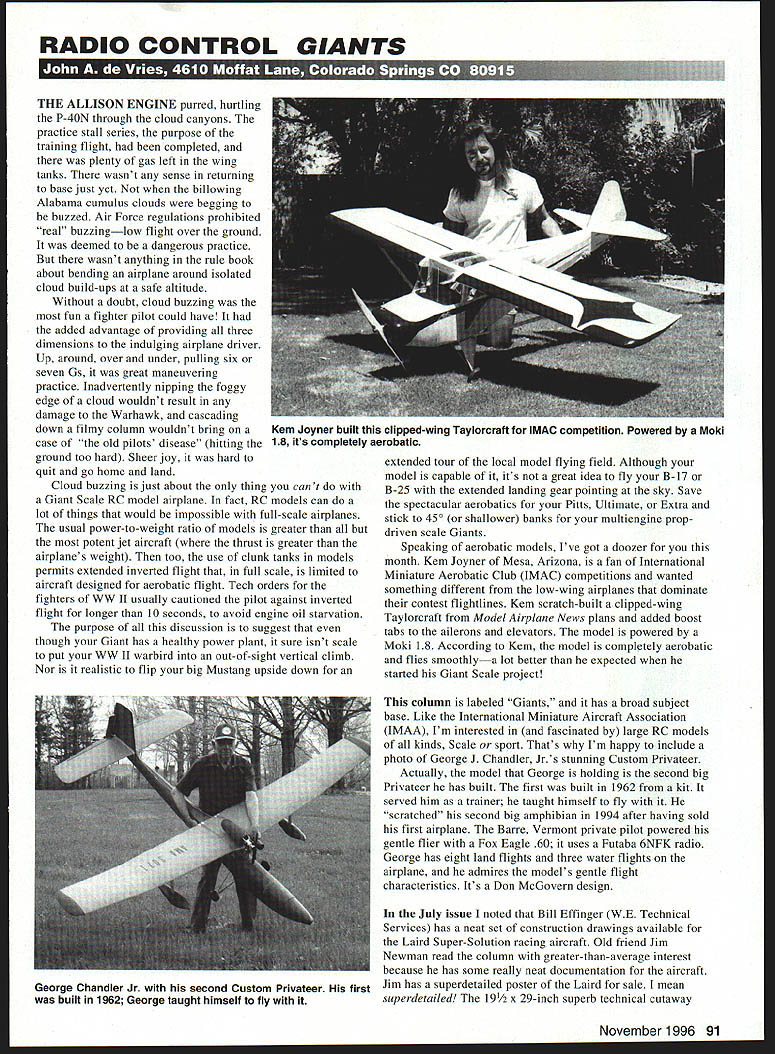
A neat aerobatic Giant: Kem Joyner's clipped-wing Taylorcraft
Speaking of aerobatic models, I've got a doozer for you this month. Kem Joyner of Mesa, Arizona, is a fan of International Miniature Aerobatic Club (IMAC) competitions and wanted something different from the low-wing airplanes that dominate their contest flightlines. Kem scratch-built a clipped-wing Taylorcraft from Model Airplane News plans and added boost tabs to the ailerons and elevators. The model is powered by a Moki 1.8. According to Kem, the model is completely aerobatic and flies smoothly—a lot better than he expected when he started his Giant Scale project.
Custom Privateer: George J. Chandler, Jr.
This column is labeled "Giants," and it has a broad subject base. Like the International Miniature Aircraft Association (IMAA), I'm interested in (and fascinated by) large RC models of all kinds, scale or sport. That's why I'm happy to include a photo of George J. Chandler, Jr.'s stunning Custom Privateer.
Actually, the model that George is holding is the second big Privateer he has built. The first was built in 1962 from a kit and served him as a trainer; he taught himself to fly with it. He "scratched" his second big amphibian in 1994 after having sold his first airplane. The Barre, Vermont private pilot powered his gentle flier with a Fox Eagle .60; it uses a Futaba 6NFk radio. George has eight land flights and three water flights on the airplane, and he admires the model's gentle flight characteristics. It's a Don McGovern design.
Laird Super-Solution poster
In the July issue I noted that Bill Effinger (W.E. Technical Services) has a neat set of construction drawings available for the Laird Super-Solution racing aircraft. Old friend Jim Newman read the column with greater-than-average interest because he has some really neat documentation for the aircraft. Jim has a super-detailed poster of the Laird for sale. I mean super-detailed! The 19½ x 29-inch superb technical cutaway drawing is available from Jim at:
Jim Newman 4 Cleveland Terrace Hobart, IN 46342-3418
Price: $30 postpaid.
Please: how to send photos
It's a shame and a concern around here. I've asked all of you to send photos of your Giant Scale models and several of you have honored me with some great shots. Unfortunately, from time to time I get color prints of nifty models that are defaced to the point where they can't be included in the magazine. Some folks use felt-tipped pens to include model specifics on the back of their prints. The captions transfer to the fronts of the other prints in the stack and they become unusable.
I don't want to keep anybody from sending photos of their models, but things will work a lot better if the captions are written on plain paper and then taped to the back of the prints. So keep those cards, letters, and model photos coming!
Society news: Cleveland Model & Supply
The May–June issue of Golden Pylons, the newsletter of the Society of Air Racing Historians, included information for every scale model builder. Don Berliner, the newsletter editor, noted that a new member had joined the Society. The new associate is John O. Jacox (5434 N. Pennsylvania, Indianapolis, IN 46220) and he has bought Cleveland Model & Supply from Ed Packard!
I feel very fortunate to have three of Ed's original Dwarf (1/2-inch scale) Thompson Trophy model kits in my collection. They were purchased (at 50 cents each) with the prize money I received in a contest flying my Denny Condor rubber-powered model.
VIP Publishers on the Internet
Regular readers of this column will recall that Dick Phillips and I run a small publishing house specializing in Giant Scale modeling and aviation history books. VIP Publishers, Inc. has taken a giant leap forward and can now be found on the Internet. We've got our own web page at http://www.invocate.com/vip. It is a catalog of all of our books and provides an e-mail ordering form. Give us a hit if you're browsing the 'Net.
The big Nationals issue is next month. I'll be back with you in the January Model Aviation.
Transcribed from original scans by AI. Minor OCR errors may remain.

