
RADIO CONTROL: GIANTS
John A. de Vries 4610 Moffat Lane, Colorado Springs, CO 80915
EVERY ONCE in a while you come up smelling like a rose! That's how it was about a month ago. Readers of this column will recall that I've had the hots for the Bell Airacuda—particularly the tricycle-gear version of the pre‑WWII twin-engined pusher "fighter." Lots of you kind folks provided a wealth of documentation on the airplane, and the local file was bursting at the seams. I was totally unprepared, however, for the contribution by Bob Winchell.
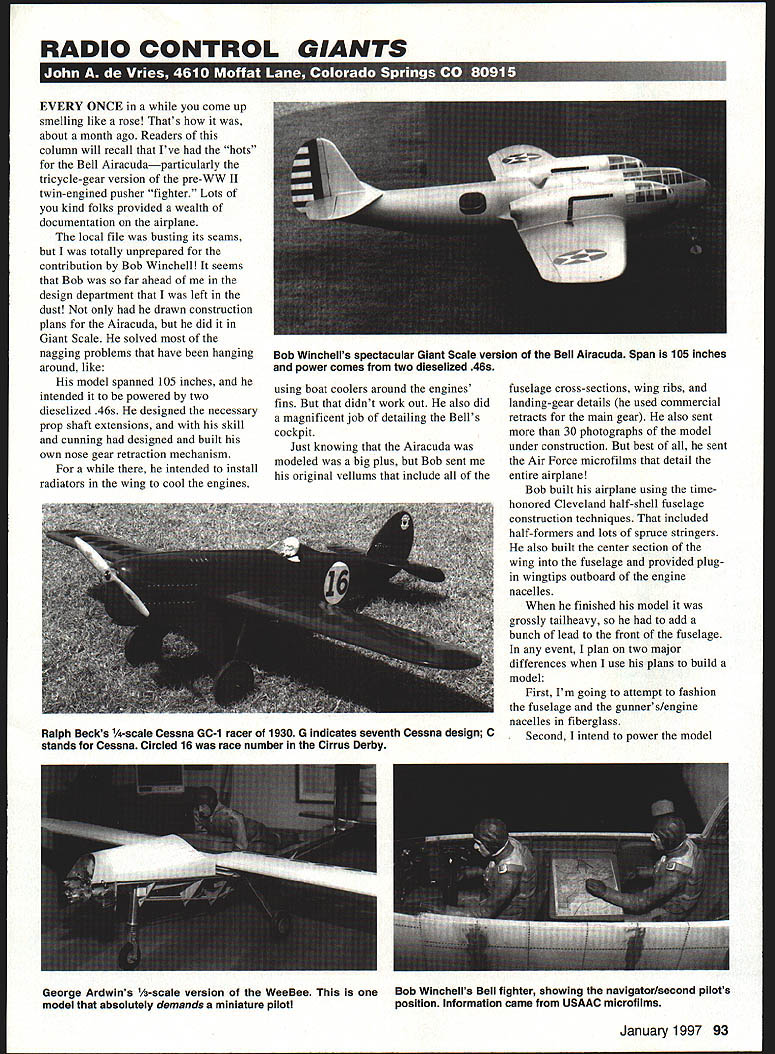
Bob Winchell's Airacuda
Bob was so far ahead of me in the design department that I was left in the dust. Not only had he drawn construction plans for the Airacuda, but he did it in Giant Scale and solved most of the nagging problems that have been hanging around, such as:
- The model spanned 105 inches and was intended to be powered by two dieselized .46s.
- He designed the necessary prop-shaft extensions and, with skill and cunning, built his own nose-gear retraction mechanism.
- For a while he intended to install radiators in the wings to cool the engines, using boat coolers around the engines' fins, but that didn't work out.
- He did a magnificent job of detailing the Bell's cockpit.
Bob sent his original vellums that include all fuselage cross-sections, wing ribs, and landing-gear details (he used commercial retracts for the main gear). He also sent more than 30 photographs of the model under construction and, best of all, the Air Force microfilms that detail the entire airplane!
Bob built his airplane using the time-honored Cleveland half-shell fuselage construction techniques, which included half-formers and lots of spruce stringers. He built the center section of the wing into the fuselage and provided plug-in wingtips outboard of the engine nacelles.
When he finished his model it was grossly tail-heavy, so he had to add a bunch of lead to the front of the fuselage. In any event, I plan on two major differences when I use his plans to build a model:
- I'll attempt to fashion the fuselage and the gunner's/engine nacelles in fiberglass.
- I intend to power the model with electric motors, if the battery supply will provide the necessary balance so I won't have to resort to extra weight.
Bob has yet to fly his XFM-1A, but I'll bet it will fly. Talk about smelling like a rose—the air around here is pungent with the odor of a whole florist's shop!
Ralph Beck's Cessna GC-1 "Miss Blackwell"
Still on the subject of master model designers and builders, Ralph Beck of Beloit, Wisconsin is right up there among the very best. Ralph's current jewel is a Cessna GC-1 racer, Miss Blackwell. The 1930 aircraft was designed to compete in the Cirrus Derby and was powered by a Cirrus 310-cubic-inch engine.
Ralph's version is 1/4 scale and spans 81 inches. Power for the model is an O.S. 120 four-stroke—more sizzle than the 10-1/2-pound aircraft needs. It's dead-on scale—Elden Cessna (one of the designers of the prototype) provided documentation. Mr. Beck worked for Cessna in the 1950s and collected even more documentation.
Transcribed from original scans by AI. Minor OCR errors may remain.

