
RADIO CONTROL: GIANTS
John A. de Vries, 4610 Moffat Lane, Colorado Springs, CO 80915
Fowler flaps and the Viper
In the January 1989 Model Aviation, this column featured the outstanding design work of Charles Fowler of Annapolis, Maryland. Charles devised a clever system for operating Fowler flaps on scale model aircraft. The mechanism was designed for use on a giant-scale Lockheed P-38. Although Charles is not related to the Fowler who invented the Fowler flap for full-sized aircraft, he solved the problems associated with applying them to models.
Fowler flaps are particularly effective — in addition to slowing an aircraft on its landing approach, they provide an increased wing area. They provide additional lift as well as drag for lowered angles of up to 40°. They are more aerodynamically efficient than simple or split flaps.
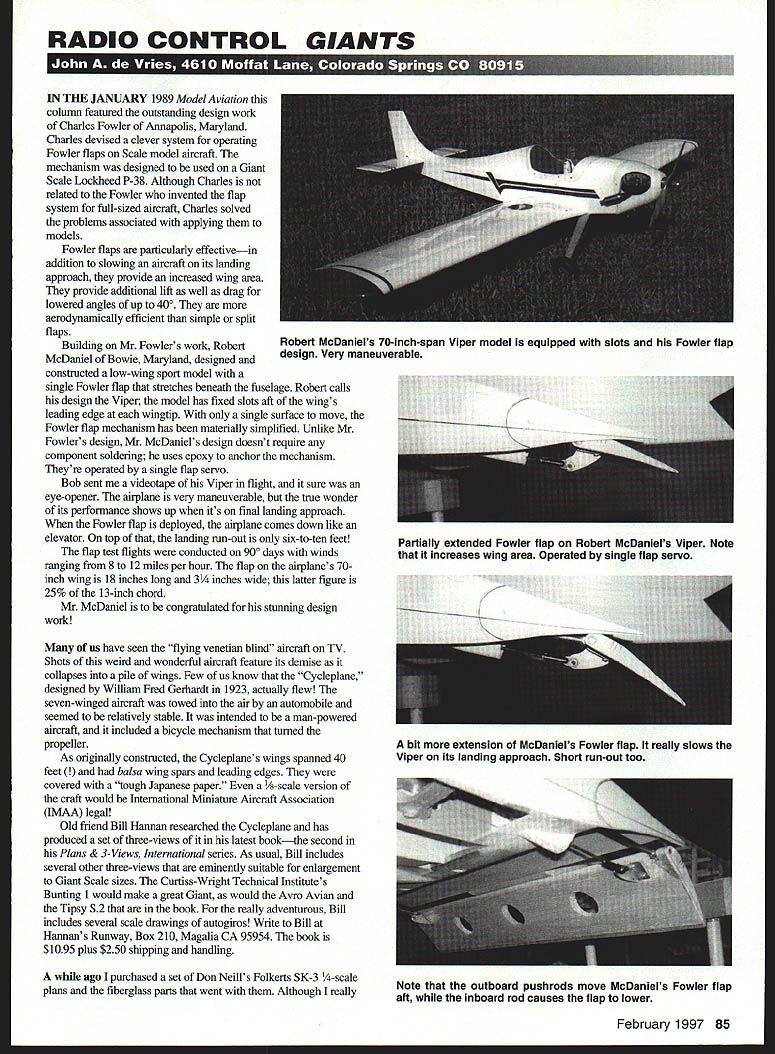
Building on Mr. Fowler's work, Robert McDaniel of Bowie, Maryland, designed and constructed a low-wing sport model with a single Fowler flap that stretches beneath the fuselage. Robert calls his design the Viper; the model has fixed slots aft of the wing's leading edge at each wingtip. With only a single surface to move, the Fowler flap mechanism is materially simplified. Unlike Mr. Fowler's design, Mr. McDaniel's does not require any component soldering; he uses epoxy to anchor the mechanism. The flaps are operated by a single flap servo.
Bob sent me a videotape of his Viper in flight, and it was an eye-opener. The airplane is very maneuverable, but the true wonder of its performance shows up on final landing approach. When the Fowler flap is deployed, the airplane comes down like an elevator. On top of that, the landing run-out is only six to ten feet!
The flap test flights were conducted on 90° days with winds ranging from 8 to 12 miles per hour. The flap on the airplane's 70-inch wing was 18 inches long and 3-1/4 inches wide; this latter figure is 25% of the 13-inch chord.
Mr. McDaniel is to be congratulated for his stunning design work!
The Cycleplane and three-views
Many of us have seen the "flying venetian blind" aircraft on TV. Shots of this weird and wonderful craft often show its demise as it collapses into a pile of wings. Few of us know that the Cycleplane, designed by William Fred Gerhardt in 1923, actually flew! The seven-winged aircraft was towed into the air by an automobile and seemed relatively stable. It was intended to be a man-powered aircraft and included a bicycle mechanism that turned the propeller.
As originally constructed, the Cycleplane's wings spanned 40 feet and had balsa wing spars and leading edges. They were covered with a "tough Japanese paper." Even a 1/8-scale version of the craft would be International Miniature Aircraft Association (IMAA) legal!
Old friend Bill Hannan researched the Cycleplane and has produced a set of three-views of it in his latest book — the second in his Plans & 3-Views International series. As usual, Bill includes several other three-views that are eminently suitable for enlargement to giant scale sizes. The Curtiss-Wright Technical Institute's Bunting 1 would make a great giant, as would the Avro Avian and the Tipsy S2 that are in the book. For the really adventurous, Bill includes several scale drawings of autogiros.
Contact:
- Hannan's Runway, Box 210, Magalia, CA 95954
- Book price: $10.95 plus $2.50 shipping and handling
Don Neill's Folkerts and Reid's catalog
A while ago I purchased a set of Don Neill's Folkerts SK-3 quarter-scale plans and the fiberglass parts that went with them. Although I really admire Rudy Kling's Thompson Trophy winner of 1937, I never got around to cutting any balsa for the model. Recently, old friend Dave Reid advertised a quarter-scale kit for the Folkerts — and it was for the Don Neill version! Not only that, but he had one kit that lacked both drawings and fiberglass parts. I went online and purchased the kit.
The big package UPS delivered contained not only the Folkerts parts but also Dave's latest catalog. He runs Reid's Quality Model Products and has some truly spectacular drawings and kits for giant scale models. Dave's catalog includes quarter-scale kits for:
- J-3 Kitten
- Ercoupe
- Tomahawk
- Kinner Sportster
- Clipped-wing Taylorcraft
- Quartermaster biplane
- Don Godfrey's Stearman biplane
Dave's quarter-scale drawings list includes:
- Funk B-85-C (it resembles a Rearwin Speedster)
- Stits Playboy
- Davis Parasol monoplane
- Concept Model's 1930 Fleet biplane
He also offers 1/3-scale plans for the Taylorcraft and Bob Nelitz's J-3 Cub. Fiberglass cowls and wheel pants are available for most of the drawings.
Contact:
- Reid's Quality Model Products, 16 Main St., Phelps, NY 14532
- Phone: (315) 548-3779
- E-mail: DREID@EPIX.NET
Weldbond adhesive
It looks a lot like the usual white glue we've been using for years — but it isn't the same by a long shot. It's Weldbond catalyzed polyvinyl acetate, and it sticks just about anything to anything. No fumes, and it's transparent when dry.
I used the one-ounce bottle that Sid Miller (of Weldbond) sent, and it worked beautifully. It doesn't attack foam, and it's water-soluble before it dries. Once it sets, it is water- and fuel-resistant; a second coat makes a joint fuelproof. It's great stuff and should be available at your local hobby shop or through model airplane mail-order houses.
Contact:
- HST Materials, Inc., 815 Bonnie Lane, Elk Grove Village, IL 60007
- Tel.: (847) 228-9848
- Fax: (847) 228-9764
Video: How To Paint Pilot Figures
I'll close this column with a rave review for a commercial videotape. Robin's View Productions sent me a tape titled How To Paint Pilot Figures. My first reaction was skepticism, but once I watched I was impressed — it's the best modeling tape I've seen. It's very professional, tightly edited, intelligently narrated, and uses music tastefully. The tape is instructional and entertaining. Don Tyond does the painting; he and Bob Hunt (former editor of Flying Models) have joined forces to produce a winner.
Ordering:
- Robin's View Productions, L.L.C., 205 E. Center Street, Box 68, Stockertown, PA 18083
- Price: $19.95 plus $3 shipping and handling
- For Visa and MasterCard orders: (610) 746-0106
Next month: a "Tale of Two Giant Scale Modelers." Until then, lots of luck with your current giant scale project!
Transcribed from original scans by AI. Minor OCR errors may remain.

