
RADIO CONTROL GIANTS
John A. de Vries 4610 Moffat Lane, Colorado Springs, CO 80915
There are literally thousands of Giant Scale modelers who are never recognized. Their names don’t appear on the rolls of Top Gun, the Masters, or as winners of regional or national contests, yet their skill in designing, building, and flying Giants equals that of the great names that appear in the model airplane magazines. Their hobby satisfaction comes from Giant Scale fly-ins and rallies. Their Special Interest Group (SIG) is the International Miniature Aircraft Association (IMAA)—an organization whose fundamental tenet is to bring Giant Scale modelers together for the fun and camaraderie that participating in the hobby provides.
In last month’s column, we promised a “Tale of Two Modelers.” In the interim, however, a third modeler has joined the story. This month we’ll feature the outstanding efforts of Dick Smith of Hemet, California; Lawrence Klingberg of Canyon Lake, California; and Hermon Lowery of Pekin, Illinois.
Dick Smith
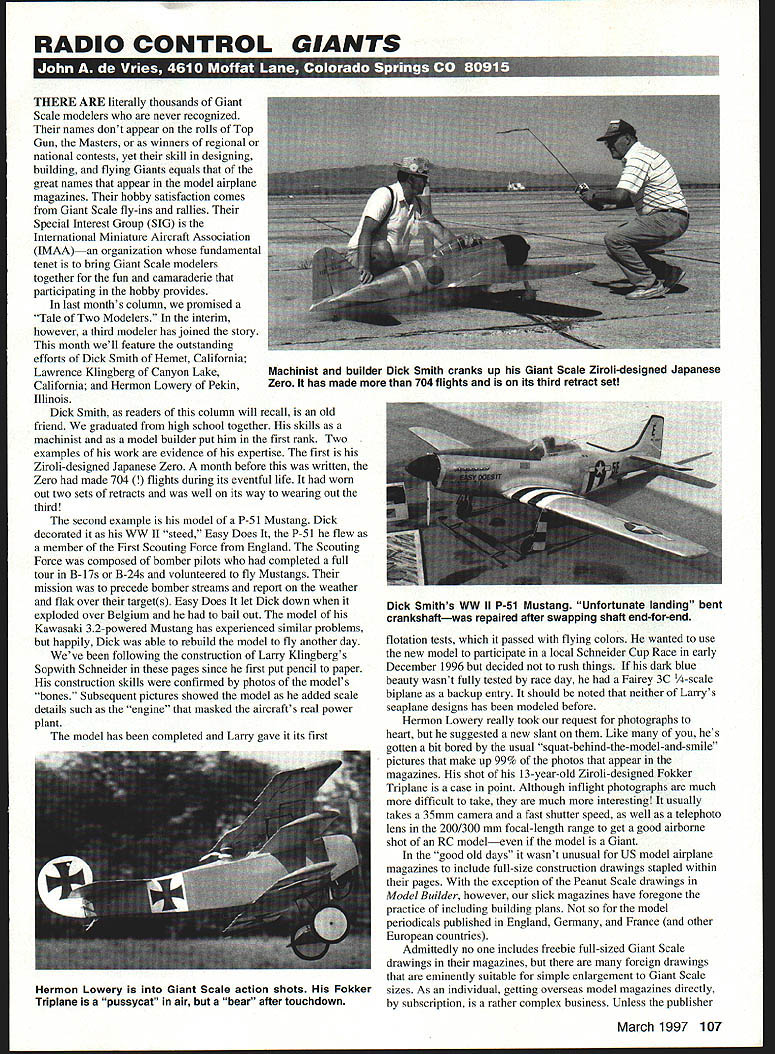
Dick Smith, as readers of this column will recall, is an old friend. We graduated from high school together. His skills as a machinist and as a model builder put him in the first rank. Two examples of his work are evidence of his expertise.
The first is his Ziroli-designed Japanese Zero. A month before this was written, the Zero had made 704 (!) flights during its eventful life. It had worn out two sets of retracts and was well on its way to wearing out the third.
The second example is his model of a P-51 Mustang. Dick decorated it as his WWII “steed,” Easy Does It. The P-51 he flew as a member of the First Scouting Force from England. The Scouting Force was composed of bomber pilots who had completed a full tour in B-17s or B-24s and volunteered to fly Mustangs. Their mission was to precede bomber streams and report on the weather and flak over their targets. Easy Does It let Dick down when it exploded over Belgium and he had to bail out. The model of his Kawasaki 32-powered Mustang has experienced similar problems, but happily Dick was able to rebuild the model to fly another day.
Lawrence Klingberg
We’ve been following the construction of Larry Klingberg’s Sopwith Schneider in these pages since he first put pencil to paper. His construction skills were confirmed by photos of the model’s “bones.” Subsequent pictures showed the model as he added scale details such as the “engine” that masked the aircraft’s real power plant.
The model has been completed and Larry gave it its first flotation tests, which it passed with flying colors. He wanted to use the new model to participate in a local Schneider Cup Race in early December 1996 but decided not to rush things. Its dark blue beauty wasn’t fully tested by race day; he had a Fairey 3C 1/4-scale biplane as a backup entry. It should be noted that neither of Larry’s seaplane designs has been modeled before.
Hermon Lowery
Hermon Lowery really took our request for photographs to heart, but he suggested a new slant on them. Like many of you, he’s gotten a bit bored by the usual “squat-behind-the-model-and-smile” pictures that make up 99% of the photos that appear in magazines. His shot of his 13-year-old Ziroli-designed Fokker Triplane is a case in point.
Although inflight photographs are much more difficult to take, they are much more interesting. It usually takes a 35mm camera and a fast shutter speed, as well as a telephoto lens in the 200–300 mm focal-length range to get a good airborne shot of an RC model—even if the model is a Giant.
Foreign magazines and full-size drawings
In the “good old days” it wasn’t unusual for U.S. model airplane magazines to include full-size construction drawings stapled within their pages. With the exception of the Peanut Scale drawings in Model Builder, however, our slick magazines have foregone the practice of including building plans. Not so for the model periodicals published in England, Germany, and France (and other European countries).
Admittedly no one includes freebie full-sized Giant Scale drawings in their magazines, but there are many foreign drawings that are eminently suitable for simple enlargement to Giant Scale sizes. As an individual, getting overseas model magazines directly, by subscription, is a rather complex business. Unless the publisher accepts universal credit cards, the problem of currency conversion rears its ugly head.
Happily, acquisition of subscriptions to several really great British model airplane magazines has been simplified. Wise Owl Worldwide Publications lists practically every British magazine of interest to modelers and provides yearly subscriptions in U.S. dollars. You can order by credit card.
- Wise Owl Worldwide Publications
4314 West 238th St., Torrance, CA 90505-4509 Phone: (310) 375-6258 Fax: (310) 375-0548
Decals, MonoKote, and markings
I’m sitting contemplating putting decals on a 1/5-scale plastic Republic P-47N model; it’s too darn cold out in the garage to do any real model building.
When MonoKote appeared on the market, the marking job got a bit easier, although it took three layers of the trim film (blue, white, and red) to produce a simple U.S. red-center star on a military airplane's yellow wing covering. About the same time the Air Force began to decorate their subsonic prop-driven aircraft with sticky-backed insignia. Talk about your big decals! They took two or three skillful mechanics just to get ’em stuck down in the right places on the aircraft. Of course, today's essentially colorless military insignia are produced by the old methods—spray painting through an appropriate mask. We sure can't have any decals blowing off the wings of our supersonic fighters and bombers!
All this discussion has led me to a relatively firm conclusion: within reason, as far as costs are concerned, the Giant Scale modeler's life would be a heck of a lot easier if he or she takes the plunge and has one of the custom decal outfits produce the decorations for his or her models. Springing for two sets of markings (in case you goop up the application) will substantially lower your blood pressure. And your model will look super-nifty!
I’m sure going to go that route with the Bell Airacuda and Folkerts SK-3 that are aching to be built around here. Hope your winter's Giant Scale project is coming along famously!
Transcribed from original scans by AI. Minor OCR errors may remain.

