
RADIO CONTROL: GIANTS
John A. de Vries 4610 Moffat Lane, Colorado Springs, CO 80915
Twin-electric-powered Giants
Although I don't like to admit it, I knew little about twin-electric-powered RC airplanes until recently—thanks to a letter from Tyler West of Hadley, MA. I got smart real fast. He read that I intended to electrically power my Giant Scale Bell Airacuda, and there is a host of Giant Scale model builders who will be "going Electric."
"As an electric modeler, I'm delighted to see that you plan to power your next Giant project with an electric power system. While the largest plane I've built has only been a 7.5-lb. sport aerobatic ship, I have seen many Giant Scale planes fly at various electric meets. I would like to offer some basic information about large electrics and twins because I'd like everybody who tries electric to be successful. There are a few basic 'rules of thumb' that apply to a successful flying electric.
- Rule 1: The weight of the battery and motor(s) should be about half of the all-up weight of the aircraft. I've seen the actual value vary, with the motor and battery between 40–60% of the all-up weight."
Sizing cells, motors, and expected weight
Electrics can be of any size—you just need to have more cells (or cells of larger capacity) for larger planes. Right now the most cells that can be charged by a single charger (the Astro 112D or the SR Smart Charger) is 36. How big an airplane can 36 cells fly?
A 1,700 mAh cell weighs about 1.8 ounces and a geared Astro 40 weighs 14.5 ounces. To account for the weight of the wiring (in a Giant Scale twin) I assume that each cell weighs 1.9 ounces. Figuring 36 cells and two motors, the weight of the model's power supply will be about 97.4 ounces. This means that your plane should weigh about 250 ounces (15.6 lb.). This "rule of thumb" is tailored to sport flying (loops, rolls, and some vertical maneuvers). For scale flying of an aircraft like the Airacuda, I'm sure that less power will be needed (your plane can weigh more).
Power loading
Perhaps a better method of calculating the power that a model needs is that of "power loading." This method of calculation says that most planes need at least 50 input watts per pound to take off from grass and achieve a good climbout.
How do you calculate watts? If you assume 1 volt per cell under load, you can multiply the number of cells by the current draw to get the input watts. Thirty-six cells at 30 amps gives you about 1,080 watts (this is a conservative estimate because today's cells give about 1.1 volts at 30 amp draw). If your model's weight is 16 lb., you will have 67.5 watts/lb., which is more than enough power to fly simple aerobatics. If your model weighs 20 lb., you'll have 54 watts/lb., which will still fly the type of model.
I suggest two Astro geared 40s because they are the most readily available motors that will be happy at 18 cells each while drawing 30 amps. Why 30 amps? That's just a common value for the amount of current drawn at full throttle for a large sport plane. The actual value will depend on the size and type of prop chosen.
How long will a plane fly at full throttle? Assuming 30 amps and 1,700 mAh cells you will get a motor run of a little less than three and a half minutes. Reserving full power for takeoffs and maneuver entries, a flight of eight minutes will be no problem.
Example: de Havilland Mosquito
I have seen a 14.5 lb. de Havilland Mosquito fly with two Astro 40s, using 14 x 8 Zinger props (to draw 30 amps) and a wing area of 1,000 sq. in. It only flew for five-and-a-half minutes but it was flown in a very exciting manner—lots of fast, low-level strafing runs. It had retracts and used clear MonoKote for covering. The finish was airbrushed Floquil brand paint.
Components and costs
Tyler also provides a comprehensive source list for the various power components suggested for the Airacuda. The costs are daunting, but substantially less than a gas- or glow-powered Giant twin. He notes approximate costs as follows:
- Battery pack charger: about $160
- Motors: about $143 each
- Speed control: about $95
- Cells: about $45.00 per 1,700 mAh cell
He also recommends building up your own power packs using copper braid.
Prop shafts and balance
The only subject that Tyler's letter didn't address was the need for extended prop shafts to have the scale shape of the Airacuda's nacelles. The prop shafts will probably have to be machined and aligned with ball bearings, but they shouldn't add much to the motors' load. With 36 cells in the fuselage, there certainly isn't going to be a balance problem.
Jesse Mitchell's models
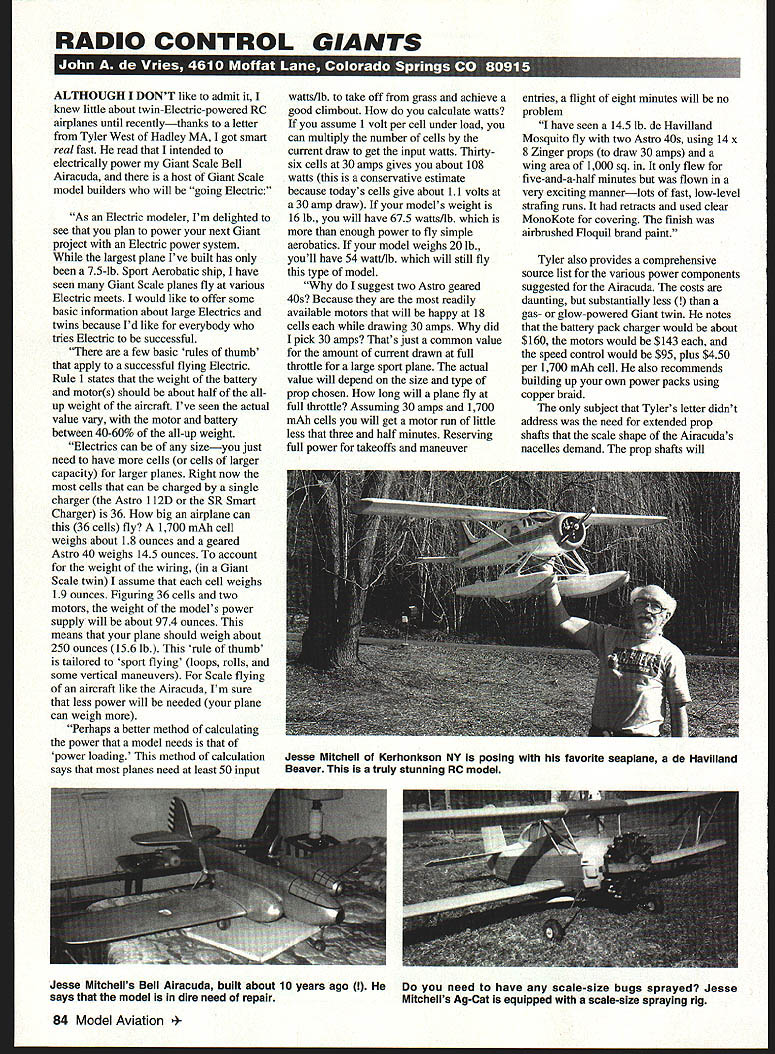
Jesse Mitchell of Kerhonkson, NY has also built an Airacuda model! I've included photos of his YFM-1A and a couple of his other beautiful RC models. He's been retired for about 15 years and has his own RC flying field—with three grass runways! Jesse has taught four students to fly RC in the past two years; two of his students are in the Air Force and a third is an air-traffic controller.
On Giant Scale Texans (AT-6)
Among the more popular Giant Scale subjects is the North American AT-6 Texan, which (along with Harvards) is conspicuous on most Giant Scale flightlines. They fly well, the retracts are easy to install, and the tail wheel is fixed.
However, most available AT-6 kits and scratch drawings don't reproduce one of the full-scale's prominent external features—a .30-caliber synchronized machine gun to be mounted to the right of the instrument panel. Gun installation required a flat fairing between the front of the windshield and the cowling. The fairing had rounded edges and a "hump" to clear the machine gun's receiver and barrel, and sprouting from the fairing, the radio antenna's support stuck out like a sore thumb (before the advent of VHF radios, the AT-6 had an HF set that required a long aerial). Most scale Texans don't duplicate the gun fairing or the early-style radio antenna—many take a "straight shot" from windshield to cowl. With 1,200 hours or more (including a session at fixed-gunnery school) behind the stick of a Texan, the lack of provisions for a "synchronized forward-firing machine gun" on many models is most disquieting.
Days are getting longer and the flying season is upon us. See you at the club field.
Transcribed from original scans by AI. Minor OCR errors may remain.

