
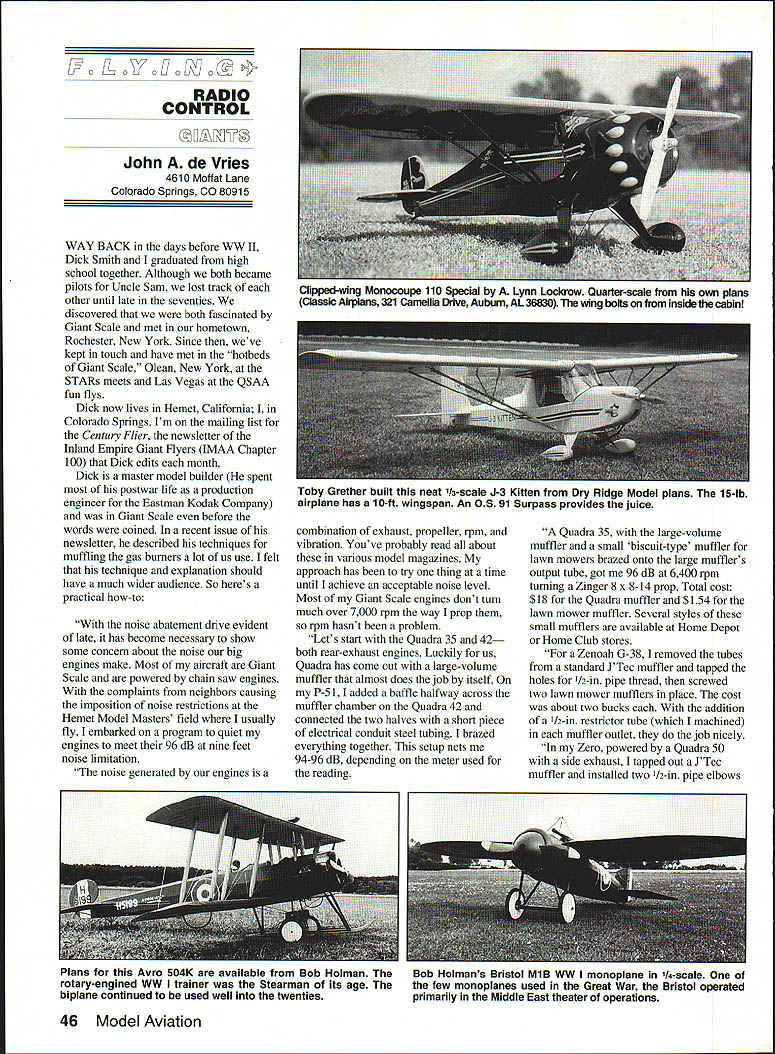
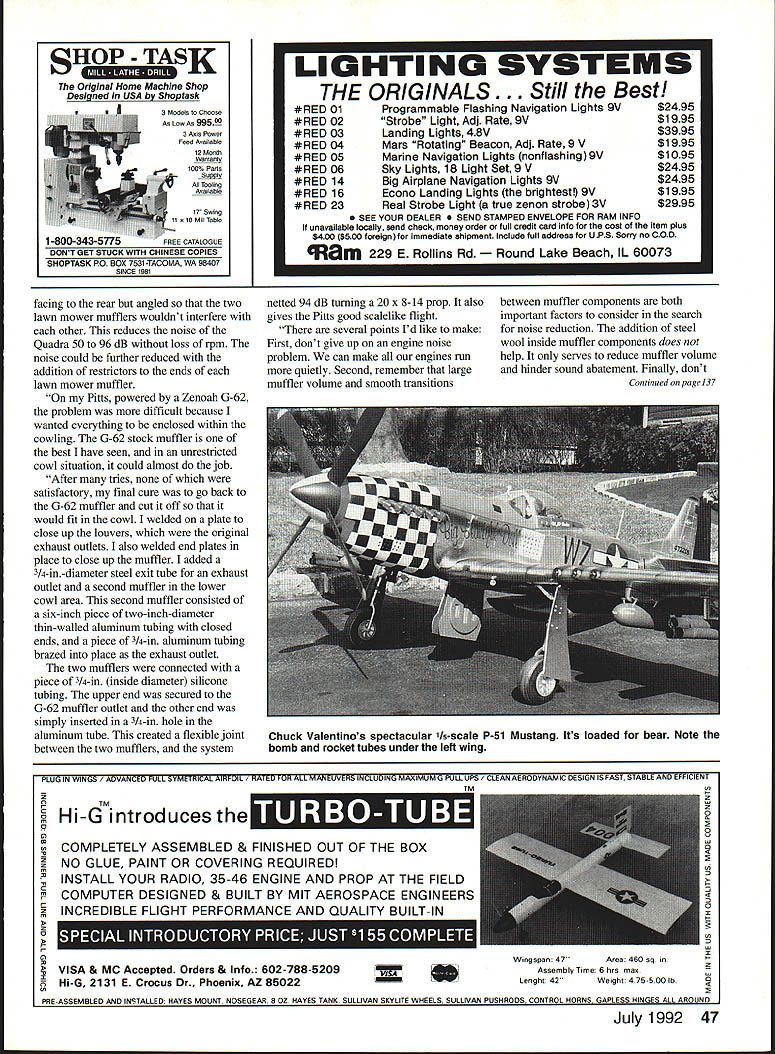
Radio Control: Giants
John A. de Vries
4610 Moffat Lane Colorado Springs, CO 80915
Way back, before World War II, Dick Smith and I graduated from high school together. Although we both became pilots for Uncle Sam, we lost track of each other until the late 1970s. We rediscovered our mutual fascination with Giant Scale modeling in our hometown, Rochester, New York, and since then we've kept in touch and met at the hotbeds of Giant Scale — Olean, New York (STARS meets), and Las Vegas (QSAA fun flys). Dick now lives in Hemet, California; I live in Colorado Springs. I'm on his mailing list — the Century Flier, the newsletter of the Inland Empire Giant Flyers (IMAA Chapter 100) — which Dick edits each month.
Dick is a master model builder and spent most of his postwar career as a production engineer for Eastman Kodak. He was into Giant Scale before the term was coined. In a recent issue of his newsletter he described techniques for muffling the gas engines many of us use. His methods and explanations are practical and worth a wider audience, so here they are.
Muffling techniques and approach
With the recent emphasis on noise abatement, it's become necessary to control the noise our big engines make. Most Giant Scale aircraft are powered by chain-saw-type engines, and neighbor complaints have triggered noise restrictions at the Hemet Model Masters' field, which enforces a 96 dB limit measured at nine feet.
Noise from these engines is a combination of exhaust noise, propeller noise (rpm), and vibration. My (Dick's) approach has been to try one modification at a time until an acceptable level is achieved. Most Giant Scale setups don't exceed about 7,000 rpm with the props typically used, so prop rpm often isn't the main problem.
A few general principles:
- Large muffler volume and smooth transitions between muffler components are important for sound reduction.
- Adding steel wool or similar packing inside muffler components is counterproductive: it reduces effective muffler volume and hinders sound abatement.
- Reduce prop noise by avoiding setups that spin props over ~7,200 rpm — increase prop pitch and/or diameter to reduce rpm while maintaining performance.
Specific installations and examples
- Quadra 35 and 42 (rear-exhaust):
- Quadra makes a large-volume muffler that almost meets requirements by itself.
- On a P-51 with a Quadra 42, Dick added a baffle halfway across the muffler chamber, connected the two muffler halves with a short piece of electrical conduit (steel tubing), and brazed everything together. This setup produced about 94–96 dB, depending on the meter.
- On a Quadra 35, he brazed a small "biscuit-type" lawn-mower muffler onto the large-volume muffler's output tube, yielding 96 dB at 6,400 rpm while turning a Zinger 8 x 8-1/4 prop. Cost: about $18 for the Quadra muffler and $1.54 for the lawn-mower muffler. Small mufflers like these are available at Home Depot and Home Club stores.
- Zenoah G-38:
- Removed the internal tubes from a standard J-Tec muffler, tapped the holes for 1/2-inch pipe thread, and screwed two lawn-mower mufflers into place (about $2 each).
- Added a machined 1/2-inch restrictor tube in each muffler outlet. The result met the noise goals.
- Quadra 50 (side exhaust) — installation in a Zero:
- Tapped out a J-Tec muffler and welded two 1/2-inch pipe elbows to it.
- Welded a plate to close the louvers at the original exhaust outlets and welded end plates to close the muffler; added a 3/4-inch-diameter steel exit tube at the exhaust outlet.
- Pitts with Zenoah G-62 (restricted-cowl installation):
- The G-62 stock muffler is very effective, but fitting everything within the cowling required modification.
- Cut the G-62 muffler to fit the cowl, welded a plate to close the original louvers, welded end plates, and added a 3/4-inch steel exit tube.
- Added a secondary muffler in the lower-cowl area: a 6-inch piece of 2-inch-diameter thin-walled aluminum tubing closed at both ends, with a 3/4-inch aluminum exhaust outlet brazed in place.
- Connected the two mufflers with 3/4-inch inside-diameter silicone tubing for a flexible joint (upper end secured to the G-62 muffler outlet; lower end inserted into the hole in the aluminum tube).
- This system produced about 94 dB while turning a 20 x 8-1/4 prop and also yielded good, scale-like flight characteristics.
Key recommendations
- Don't give up on muffling an engine — measurable noise reductions are achievable.
- Focus on muffler volume and smooth internal transitions; larger volume with unobstructed flow helps.
- Avoid stuffing mufflers with steel wool or similar packing — it reduces effective volume and worsens noise control.
- Keep prop rpm down (avoid prop speeds above ~7,200 rpm); use larger diameter or higher-pitch props to maintain performance with lower rpm.
Quiet is the name of the game. If you lack the tools or welding skills to modify mufflers, find someone with the necessary torches and equipment to do the work.
Suppliers, resources, and other notes
- D.W. Aircraft
409 Mid Pines Way, Modesto, CA 95354 Tel: 209/522-7597
- D.W. offers a complete line of semikits for Giant Scale models, many including epoxy/fiberglass fuselages and foam-core wings, stabs, and fins. Prices are often around $225. Catalog available for $1.
- Frank Zaic — "Frankly Speaking"
- A collection of reminiscences (near-autobiographical). Available for $6.95 plus P&H from Hannan's Runway, P.O. Box 210, Magalia, CA 95954. Bill Hannan carries Frank's books.
- Bob Holman
P.O. Box 741, San Bernardino, CA 92402
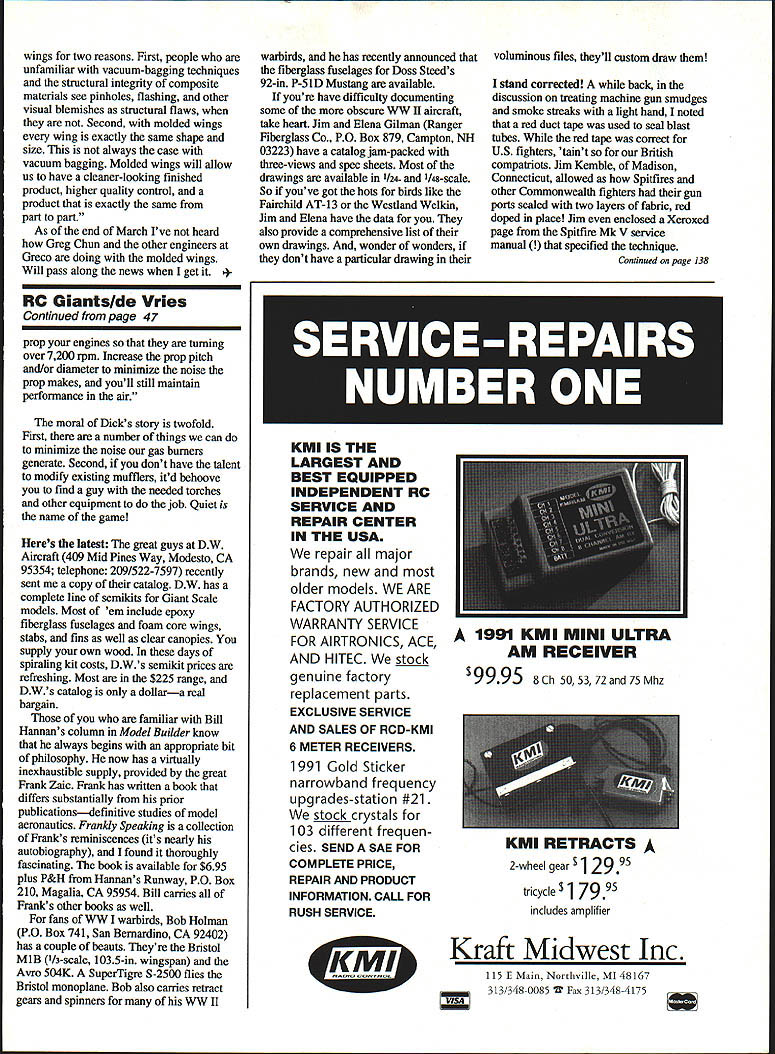
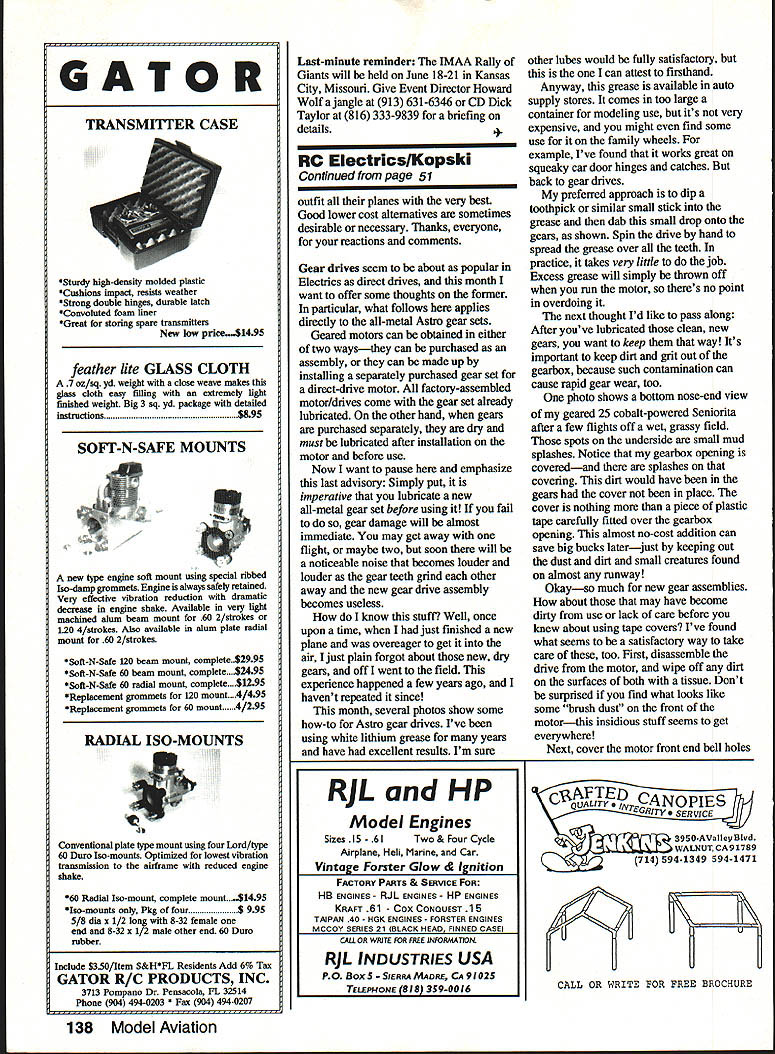
- Offers kits including the Bristol M1B (1/3-scale, 103.5-inch span) and the Avro 504K. The Bristol is powered with a SuperTiger S-2500 in the kit; Bob also supplies retracts and spinners and sells fiberglass fuselages for the Doss Steed 92-inch P-51D Mustang.
- Ranger Fiberglass Co. (Jim and Elena Gilman)
P.O. Box 879, Campton, NH 03223
- Catalog contains three-views and spec sheets, mostly in 1/24 and 1/48 scales. They stock drawings for obscure WWII types and will custom-draw plans if a drawing isn't on file.
Correction about gun-port sealing
I previously mentioned that red duct tape was used to seal blast tubes on some fighters. That was incorrect for British/Commonwealth aircraft. Jim Kemble of Madison, Connecticut, pointed out that Spitfires and other Commonwealth fighters had red gun ports sealed with two layers of fabric, red-doped in place. Jim even enclosed a Xeroxed page from the Spitfire Mk V service manual specifying the technique.
Transcribed from original scans by AI. Minor OCR errors may remain.

