
RADIO CONTROL GIANTS
John A. de Vries 4610 Moffat Lane, Colorado Springs, CO 80915
Balsa: the builder's choice
Although spruce, plywood, and fiberglass play their parts as RC Giant Scale construction materials, balsa — the good old standby — is the wood of choice for most builders. It's light, strong, easily formed, and has served modelers since the days of the five-cent Megow and Comet rubber-powered scale kits. Balsa tail surfaces help balance even the most sophisticated Giants.
Model builders have had to compete with a host of other users for the limited supply of balsa. Examples of non-model uses include:
- In 1927, Ryan used balsa to streamline the struts of Charles Lindbergh's NYP.
- During WWII, flying model kits were limited to pine, spruce, and cardboard because balsa went to insulate the hulls of oil tankers.
- The rounded aluminum wingtips of P-51D Mustangs were filled with beautifully rounded slabs of balsa to minimize denting. (My first model design, a CL trainer, was built with Mustang wingtip balsa salvaged from a P-51.)
- Balsa's insulating and sound-deadening properties are used in the floorboards of the 1997 Chevrolet Corvette.
If balsa is being used in cars that cost $40,000 or more, modelers are lucky to get it!
Giant Scale variety and craftsmanship
There are thousands of Giant Scale models, ranging in quality from "stand-off" scale to exquisite museum-quality miniatures. A Giant model that looks good and flies well is a cooperative effort between the designer and the builder/flier.
The Fokker D.VII — Jackson/Kaser build
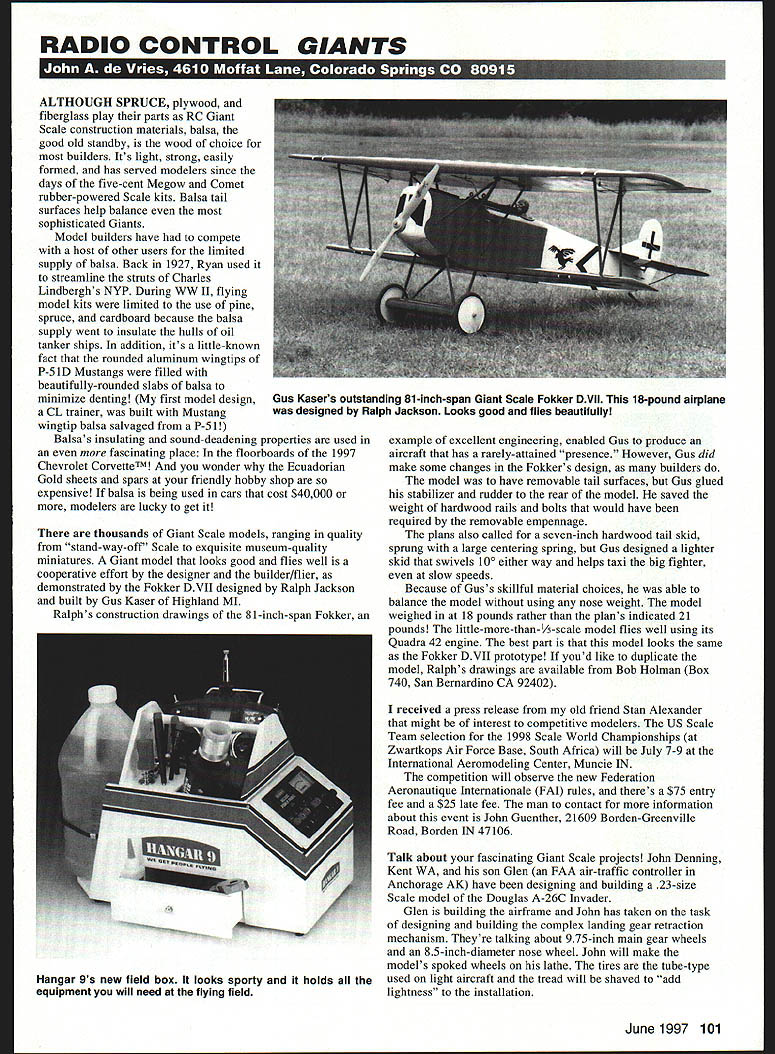
A fine example is the Fokker D.VII designed by Ralph Jackson and built by Gus Kaser of Highland, MI. Ralph's construction drawings for the 81-inch-span Fokker, an example of excellent engineering, enabled Gus to produce an aircraft with a rarely attained "presence." As is common, Gus made a few changes during construction:
- The plans called for removable tail surfaces, but Gus glued the stabilizer and rudder to the rear to save the weight of hardwood rails and bolts needed for a removable empennage.
- Instead of the plans' seven-inch hardwood tail skid sprung with a large centering spring, Gus designed a lighter skid that swivels 100° either way and helps taxi the fighter at slow speeds.
Because of skillful material choices, Gus was able to balance the model without nose weight. The finished model weighed 18 pounds rather than the plans' indicated 21 pounds and flies well on a Quadra 42 engine. Best of all, the model closely resembles the Fokker D.VII prototype. Ralph's drawings are available from Bob Holman, Box 740, San Bernardino, CA 92402.
US Scale Team selection (1998)
I received a press release from Stan Alexander that may interest competitive modelers. The US Scale Team selection for the 1998 Scale World Championships (at Zwartkops Air Force Base, South Africa) will be held July 7–9 at the International Aeromodeling Center, Muncie, IN.
- The competition will follow the new Fédération Aéronautique Internationale (FAI) rules.
- Entry fee: $75; late fee: $25.
- Contact for more information: John Guenther, 21609 Borden-Greenville Road, Borden, IN 47106.
Douglas A-26C Invader project — John and Glen Denning
Talk about fascinating Giant Scale projects! John Denning (Kent, WA) and his son Glen (an FAA air-traffic controller in Anchorage, AK) are designing and building a .23-size scale model of the Douglas A-26C Invader.
Project highlights:
- Glen is building the airframe; John is designing and building the complex landing gear retraction mechanism.
- Proposed wheels: 9.75-inch main gear wheels and an 8.5-inch-diameter nose wheel. John will make the spoked wheels on his lathe.
- Tires are tube-type used on light aircraft; tread will be shaved to "add lightness."
- The A-26's nose gear rotates 90° so the retracted wheel lays flat in the bottom of the nose (à la Curtiss P-40 / Grumman Hellcat), complicating the gear design.
- The nose wheel will be full-castering; taxiing will be by differential main wheel braking and throttle application.
- Brakes will duplicate automotive practice, with two expanding brake shoes in each wheel.
The completed model will span a gigantic 16.1 feet. According to John, the documentation they've collected makes a stack four inches thick. I hope they keep me advised of the A-26's progress and send photographs of the airframe and its retract system as they go.
Hangar 9 flight box
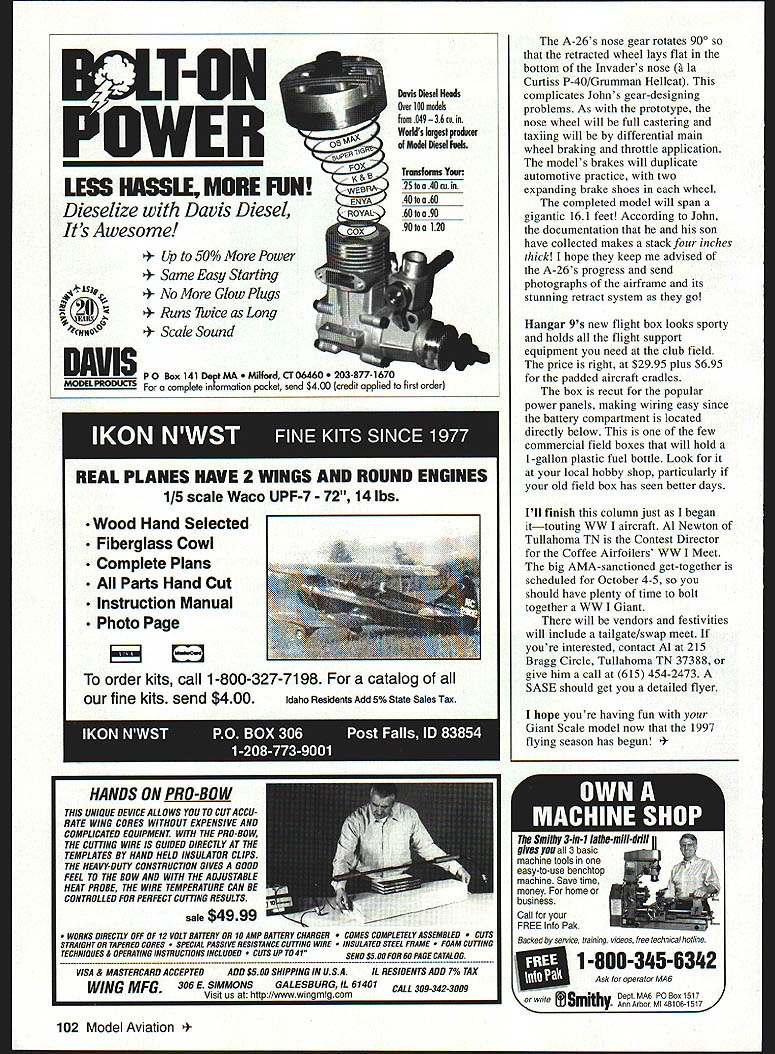
Hangar 9's new flight box looks sporty and holds all the flight support equipment you need at the club field.
- Price: $29.95 plus $6.95 for padded aircraft cradles.
- The box is recut for popular power panels, making wiring easy because the battery compartment is located directly below.
- This is one of the few commercial field boxes that will hold a one-gallon plastic fuel bottle.
Look for it at your local hobby shop, especially if your old field box has seen better days.
WW I Meet — Coffee Airfoilers
I'll finish this column as I began it — touting WW I aircraft. Al Newton of Tullahoma, TN is the Contest Director for the Coffee Airfoilers' WW I Meet. The AMA-sanctioned event is scheduled for October 4–5, so you should have plenty of time to bolt together a WW I Giant.
- There will be vendors and festivities, including a tailgate/swap meet.
- Contact: Al Newton, 215 Bragg Circle, Tullahoma, TN 37388. Phone: (615) 454-4273.
- A SASE should get you a detailed flyer.
Closing
I hope you're having fun with your Giant Scale model now that the 1997 flying season has begun!
Transcribed from original scans by AI. Minor OCR errors may remain.

