
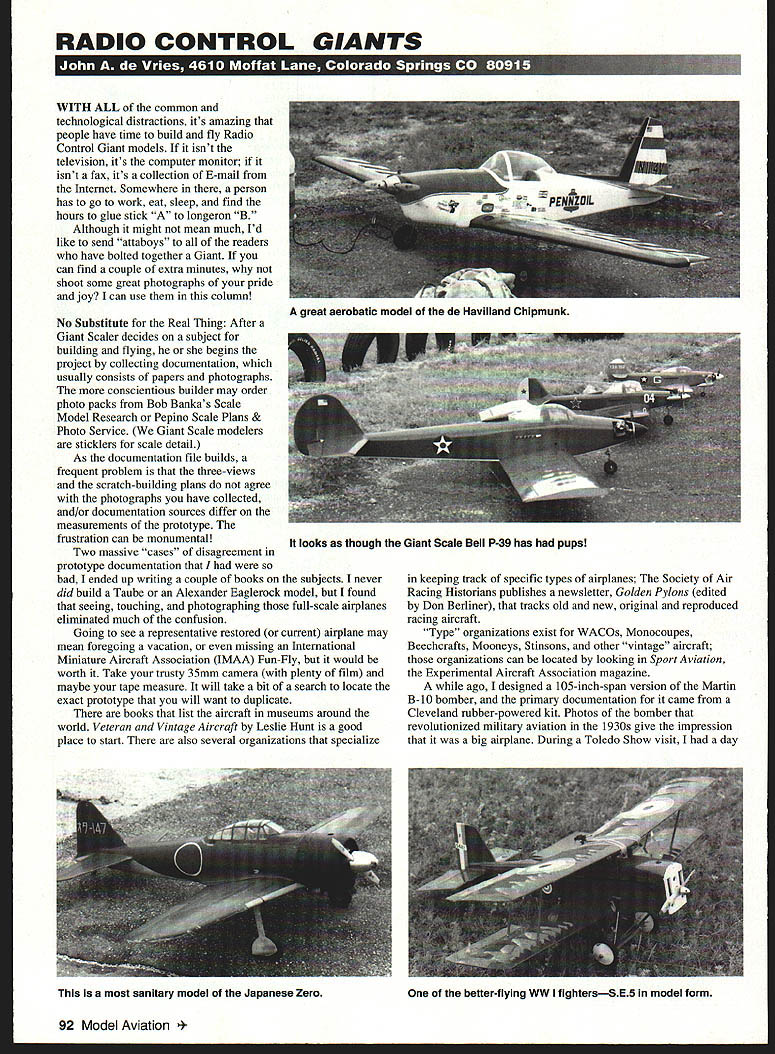
RADIO CONTROL GIANTS
John A. de Vries 4610 Moffat Lane, Colorado Springs, CO 80915
WITH ALL of the common and technological distractions, it's amazing that people have time to build and fly radio-control Giant models. If it isn't the television, it's the computer monitor; if it isn't a fax, it's a collection of e-mail from the Internet. Somewhere in there, a person has to go to work, eat, sleep, and find the hours to glue stick "A" to longeron "B".
Although it might not mean much, I'd like to send "attaboys" to all of the readers who have bolted together a Giant. If you can find a couple of extra minutes, why not shoot some great photographs of your pride and joy? I can use them in this column!
No Substitute for the Real Thing
After a Giant-scale builder decides on a subject for building and flying, he or she begins the project by collecting documentation, which usually consists of papers and photographs. The more conscientious builder may order photo packs from Bob Banka's Scale Model Research or Pepino Scale Plans & Photo Service. (We Giant Scale modelers are sticklers for scale detail.)
As the documentation file builds, a frequent problem is that the three-views and the scratch-building plans do not agree with the photographs you have collected, and/or documentation sources differ on the measurements of the prototype. The frustration can be monumental!
Two massive "cases" of disagreement in prototype documentation that I had were so bad, I ended up writing a couple of books on the subjects. I never did build a Taube or an Alexander Eaglerock model, but I found that seeing, touching, and photographing those full-scale airplanes eliminated much of the confusion.
Going to see a representative restored (or current) airplane may mean foregoing a vacation, or even missing an International Miniature Aircraft Association (IMAA) Fun-Fly, but it would be worth it. Take your trusty 35mm camera (with plenty of film) and maybe your tape measure. It will take a bit of a search to locate the exact prototype that you will want to duplicate.
There are books that list the aircraft in museums around the world. Veteran and Vintage Aircraft by Leslie Hunt is a good place to start. There are also several organizations that specialize in keeping track of specific types of airplanes; The Society of Air Racing Historians publishes a newsletter, Golden Pylons (edited by Don Berliner), that tracks old and new, original and reproduced racing aircraft.
- "Type" organizations exist for WACOs, Monocoupes, Beechcrafts, Mooneys, Stinsons, and other vintage aircraft; those organizations can be located by looking in Sport Aviation, the Experimental Aircraft Association magazine.
A while ago, I designed a 105-inch-span version of the Martin B-10 bomber, and the primary documentation for it came from a Cleveland rubber-powered kit. Photos of the bomber that revolutionized military aviation in the 1930s give the impression that it was a big airplane. During a visit to the Toledo Show, I went to the Air Force Museum at Wright-Patterson Air Force Base in Dayton, Ohio, and was happy to learn the museum had a fully restored Martin B-10 on display. It was much smaller than I had believed — the pilot could almost lean out of the cockpit and touch the engine nacelles.
However, I did find out something that my documentation had omitted: the engine instruments were mounted inboard in the sections of the two engine nacelles. Checking instruments during night flight would have been dicey; I never would have known had I not seen the full-scale B-10. Super-conscientious Giant Scale builder/flier — no substitute for the real thing.
Locating the prototype of your desire may require extensive research, which may require an extensive trip to get to the airplane. If your model's full-scale version is in a museum, it's a good idea to write to the curator prior to your visit, particularly if the museum is not near your home. You may be pleasantly surprised when you arrive!
With a lack of modesty, but a bunch of pride, I'd like to announce the latest book published by ViP Publishers, Inc., the publishing company that Dick Phillips and I started in 1985. Curtiss Hawk 75 is by Gerry Beauchamp and Jean Cuny. It's a big book (352 pages, soft-bound) that tells the entire Curtiss P-36/Hawk 75 story and the story of the airplane's offspring (the XP-37, XP-42, and the prototype P-40). The book includes many photographs, 11 pages of color profiles, and extensive documentation for the model builder. The cost is $49.95 (plus $4 postage and handling) from ViP Publishers, Inc., Box 16103, Colorado Springs, CO 80935. It's worth every penny!
The flying season is here. I trust that your winter efforts produced a beautiful new Giant Scale model that flies as good as it looks!
No primary article text appears on this scanned page — the page contains only an advertisement.
Transcribed from original scans by AI. Minor OCR errors may remain.

