
RADIO CONTROL GIANTS
John A. de Vries, 4610 Moffat Lane, Colorado Springs, CO 80915
Those of you who have followed my column throughout the years may remember that I'm not all that thrilled with computer radio control (RC) radios. Although there are a couple of computer transmitters in the local inventory, they're only set up for single-model applications.
Part of my aversion results from the confusing instruction manuals that come with the transmitters. Some instructions are the product of foreign manufacturers, and the translations leave much to be desired. Setting up an RC computer transmitter for three or more models can also become frustrating.
It's not that I dislike computers—this column is being written on the local IBM-compatible 486DX266. It's just that I prefer RC systems designed for single models. Servo reversing and output mixing don't have to be complicated with the button-pushing required if a computer isn't involved.
Guide to Computer Radio Control Systems
However, all of these opinions may be reversed by a book that I received. Guide to Computer Radio Control Systems is Don Edberg's latest work. He's a rocket scientist, but he doesn't write as if he is! This is the definitive book on the subject, and the subtitle, All You Need to Program Any Computer Radio, sets the tone.
After a fascinating history of radios and computer radios, Don delves into a discussion of commands and menus; then he gives a comprehensive how-to on programming transmitters. Being a modeler of note (he writes the soaring column for R/C Modeler), Don continues into the vagaries of model trimming and provides 21 different programmable mixer examples.
If you have a transmitter with a liquid crystal display, the book's $17.95 price is a justified expense. In the U.S., postage and handling is free (and reasonable for mailings to Canadian and overseas readers).
- Make checks payable to Dynamic Modelling and mail to:
Dynamic Modelling Computer Book 4922-C Rochelle Ave. Irvine, CA 92714-2941
John C. Fredriksen — warbird kit and plan guides
John C. Fredriksen has five great books listing kits and plans for model warplanes, covering in detail warbirds from 1914 to 1996. Even superficially, the books provide definitive source information valuable to the scale builder. On closer examination, many of the individual aircraft type entries list not only all of the kits and plans available, and their sources and cost, but direct references to prototype photo packs provided by Bob Banka (Scale Model Research), Doc Pepino (Scale Plans and Photo Service), and other suppliers.
Basic documentation for everything from Taubes to jets is defined in the Fredriksen series.
- To order: John C. Fredriksen, 461 Loring Ave., Salem, MA 01970
- Tel.: (508) 745-9849
- Each volume is $15 postage paid, with a $20 discount if you order all five volumes.
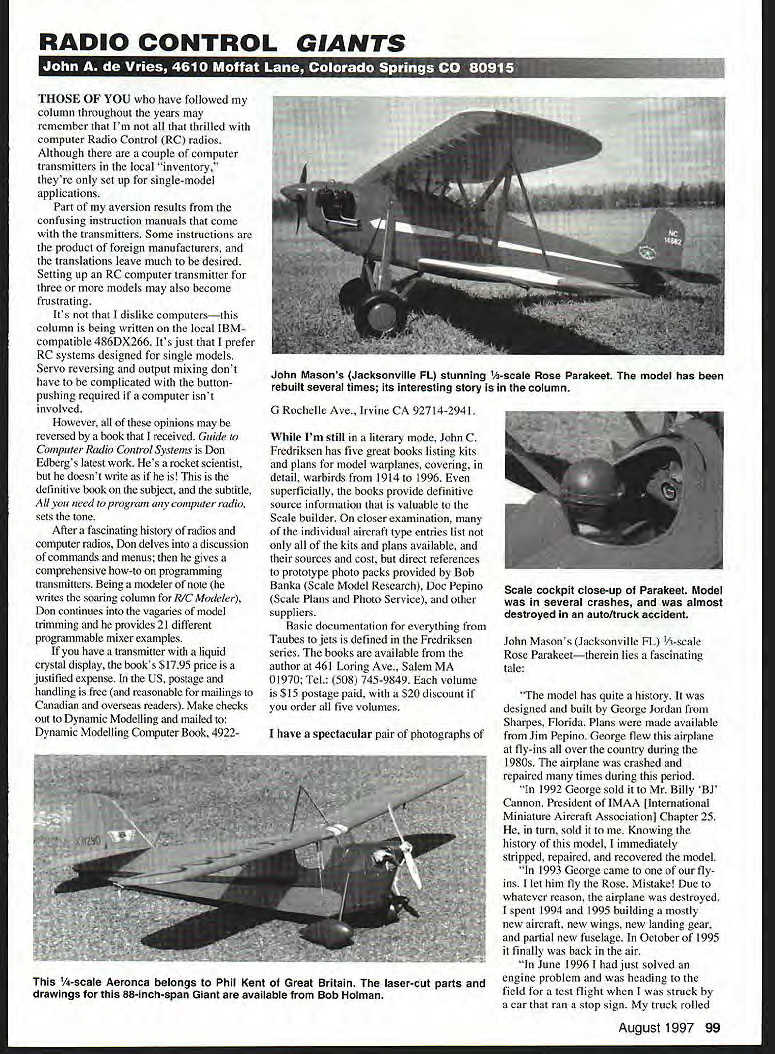
John Mason's 1/2-scale Rose Parakeet
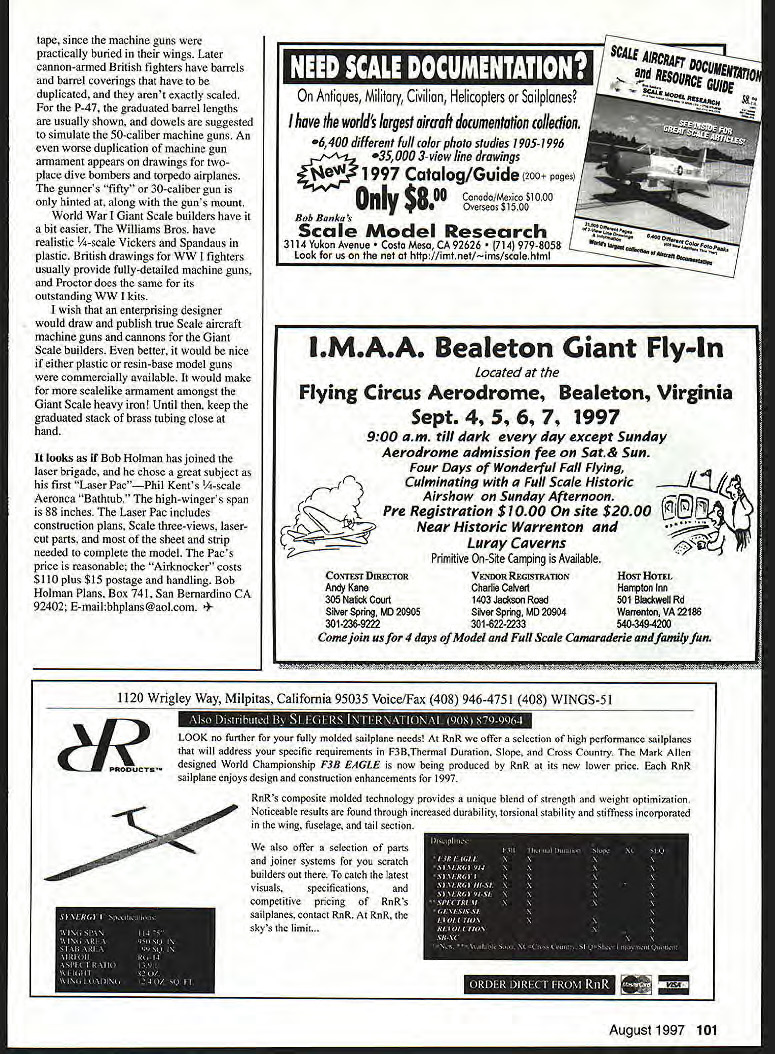
I have a spectacular pair of photographs of John Mason's (Jacksonville, FL) stunning 1/2-scale Rose Parakeet. The model has been rebuilt several times; its interesting story is below.
John Mason (Jacksonville, FL) — 1/2-scale Rose Parakeet — therein lies a fascinating tale:
"The model has quite a history. It was designed and built by George Jordan from Sharps, Florida. Plans were made available from Jim Pepino. George flew this airplane at fly-ins all over the country during the 1980s. The airplane was crashed and repaired many times during this period.
"In 1992 George sold it to Mr. Billy 'BJ' Cannon, President of IMAA (International Miniature Aircraft Association) Chapter 25. He, in turn, sold it to me. Knowing the history of this model, I immediately stripped, repaired, and recovered the model.
"In 1993 George came to one of our fly-ins. I let him fly the Rose. Mistake! Due to whatever reason, the airplane was destroyed. I spent 1994 and 1995 building a mostly new aircraft: new wings, new landing gear, and a partial new fuselage. In October of 1995 it finally was back in the air.
"In June 1996 I had just solved an engine problem and was heading to the field for a test flight when I was struck by a car that ran a stop sign. My truck rolled over a couple of times. I was not seriously hurt (hard head and seat belts), but the Rose was. The truck was a total loss and was replaced. I spent three months repairing the Rose.
"I finally flew it again in October 1996 at our fall fly-in, and I have flown it weekly since."
It seems as though John has outstanding dedication and persistence. May his Rose Parakeet continue to fly, unhindered by even the least of the Figure Nine Virus.
Figure Nine Virus
Thrashing through the local library and examining many World War II "heavy iron" scratch drawings, there's something lacking. There are few, if any, definitive model plans for truly scale WWII aircraft machine guns and cannons. Most designs show some brass tubing "representations" of bullet-spitting armament, but the usual drawings don't provide more than jutting barrels. You're lucky if you're building early marks of Spitfires and Hurricanes; all you have to do is drill four holes in each wing panel leading edge and cover them with red tape, since the machine guns were practically buried in their wings. Later cannon-armed British fighters have barrels and barrel coverings that have to be duplicated, and they aren't exactly scaled. For the P-47, the graduated barrel lengths are usually shown, and dowels are suggested to simulate the .50-caliber machine guns. An even worse duplication of machine gun armament appears on drawings for two-place dive bombers and torpedo airplanes. The gunner's "fifty" or .30-caliber barrels are only hinted at, along with the gun's mount.
World War I giant-scale builders have it a bit easier. The Williams Bros. have realistic 1/4-scale Vickers and Spandaus in plastic. British drawings for WWI fighters usually provide fully detailed machine guns, and Proctor does the same for its outstanding WWI kits.
I wish that an enterprising designer would draw and publish true scale aircraft machine guns and cannons for the giant-scale builders. Even better, it would be nice if either plastic or resin-based model guns were commercially available. It would make for more scale-like armament among the giant-scale heavy iron! Until then, keep the graduated stack of brass tubing close at hand.
Bob Holman — Laser Pac: Phil Kent's 1/4-scale Aeronca "Bathtub"
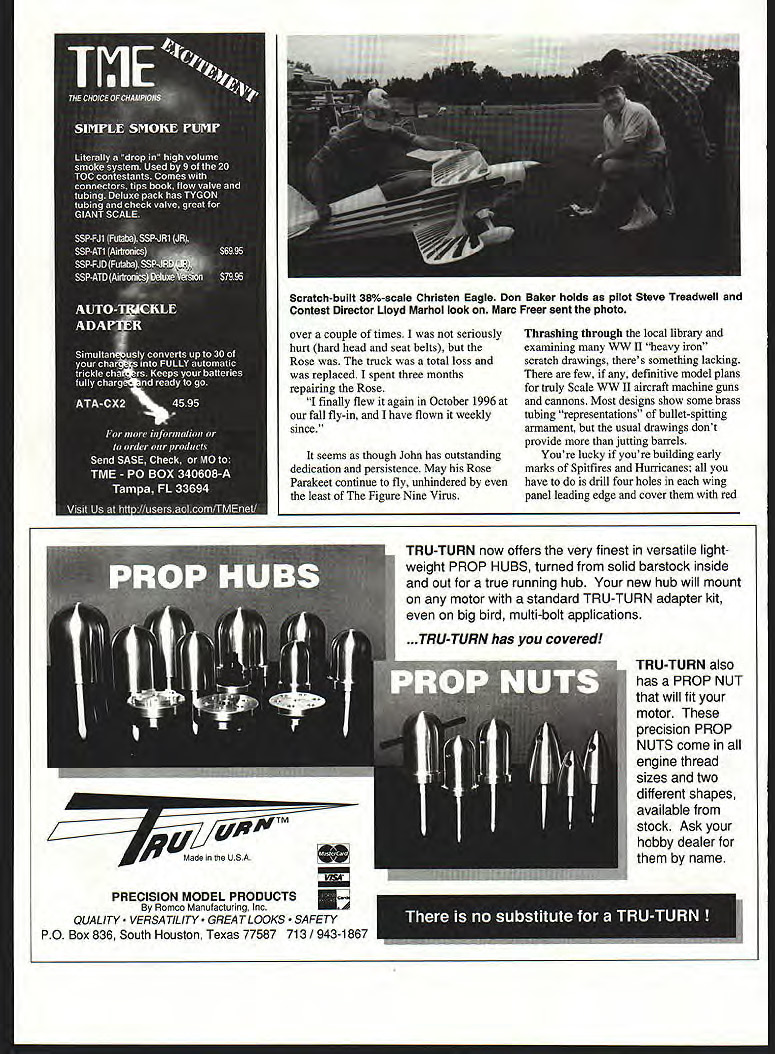
It looks as if Bob Holman has joined the laser brigade, and he chose a great subject as his first "Laser Pac" — Phil Kent's 1/4-scale Aeronca "Bathtub." The high-winger's span is 88 inches. The Laser Pac includes construction plans, scale three-views, laser-cut parts, and most of the sheet and strip needed to complete the model.
- Price: $110 plus $15 postage and handling
- To order: Bob Holman Plans, Box 741, San Bernardino, CA 92402
- E-mail: bhplans@aol.com
Transcribed from original scans by AI. Minor OCR errors may remain.

