
RADIO CONTROL GIANTS
By John A. de Vries
4610 Moffat Lane, Colorado Springs, CO 80915
Prototypes and preferences
Giant scale modelers have strong opinions when it comes to the models they build. Although the number of potential prototypes is vast, builders narrow the field to subjects that please them. If World War I aircraft are preferred, Fokker products (the D.VII or the triplane Dr.I), Sopwiths (the Pup), or Nieuports (the 28) are usually chosen. Good giant drawings or kits are available for all of them.
If modelers prefer between-the-wars aircraft, the field is wide open: Curtiss Robins, Boeing biplane fighters, and a host of great Golden Age racers (Gee Bees, Folkerts, and others) have been drafted in giant-scale sizes. Then there is my favorite—the Bell YFM-1A Airacuda.
The World War II era provides the widest variety of scale subjects: everything from the ubiquitous Mustangs and Thunderbolts to B-29s, B-24s, and B-17s are available as kits or plans for the "heavy iron" fan. Recently, however, an interesting set of drawings was offered by the old master Nick Ziroli for a big-model version of the fascinating Northrop Black Widow, the twin-engined P-61.
The P-61 Black Widow
The P-61 was unique in several ways. Its ailerons were only vestigial; rolling the airplane was accomplished by spoilers. It was heavily armed, with four forward-firing 20mm cannons and four .50-caliber machine guns mounted in a fuselage-top turret. It carried a crew of three, one of whom was the radar operator. The two-engined craft was designated as a night fighter and preyed on dark skies in the Pacific and European theaters—to good effect. Despite its weight and size, the P-61 was an extremely maneuverable aircraft, particularly at lower altitudes.
I watched a fascinating encounter between a P-61 and a P-51D; the latter was flown by Bill Hook, operations officer of the 40th Fighter Squadron. Bill and the pilot of the Widow from the 339th Night Fighter Squadron squared off above Johnson Air Force Base, Japan, one bright morning. It wasn't much of a contest.
After a couple of head-on passes, the Widow was on the Mustang's tail, and nothing that Captain Hook could do would shake it. He was an acknowledged master of the Mustang and could have broken off the ring-around-the-rosy exercise by bending the throttle around the front quadrant and streaking away at high speed, but as long as he stayed in the Lufbery circle, the P-61 was glued to its tail feathers.
Marty Young's P-61 model
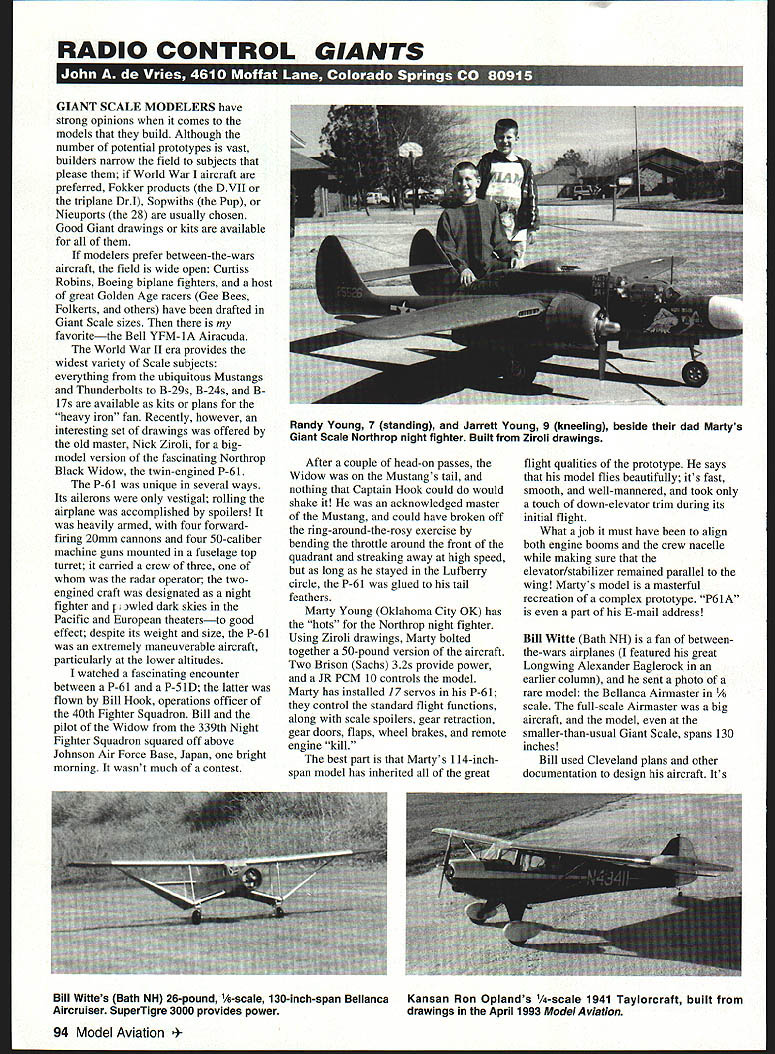
Marty Young (Oklahoma City, OK) has the "hots" for the Northrop night fighter. Using Ziroli drawings, Marty bolted together a 50-pound version of the aircraft. Two Brison (Sachs) 3.2s provide power, and a JR PCM 10 controls the model. Marty has installed 17 servos in his P-61; they control the standard flight functions along with scale spoilers, gear retraction, gear doors, flaps, wheel brakes, and remote engine "kill."
The best part is that Marty's 114-inch-span model has inherited all of the great flight qualities of the prototype. He says that his model flies beautifully; it's fast, smooth, and well-mannered, and took only a touch of down-elevator trim during its initial flight.
What a job it must have been to align both engine booms and the crew nacelle, making sure the elevator/stabilizer remained parallel to the wing. Marty's model is a masterful recreation of a complex prototype. "P61A" is even a part of his e-mail address.
Bill Witte's Bellanca Airmaster
Bill Witte (Bath, NH) is a fan of between-the-wars airplanes (I featured his great Longwing Alexander Eaglerock in an earlier column), and he sent a photo of a rare model: the Bellanca Airmaster in 1/6 scale. The full-scale Airmaster was a big aircraft, and the model, even at the smaller-than-usual giant scale, spans 130 inches. Bill used Cleveland plans and other documentation to design his aircraft.
Note: No continuing article text appears on this scanned page — it contains a photograph caption and advertisements only.
1/4-scale 1941 Taylorcraft by Ron Opland
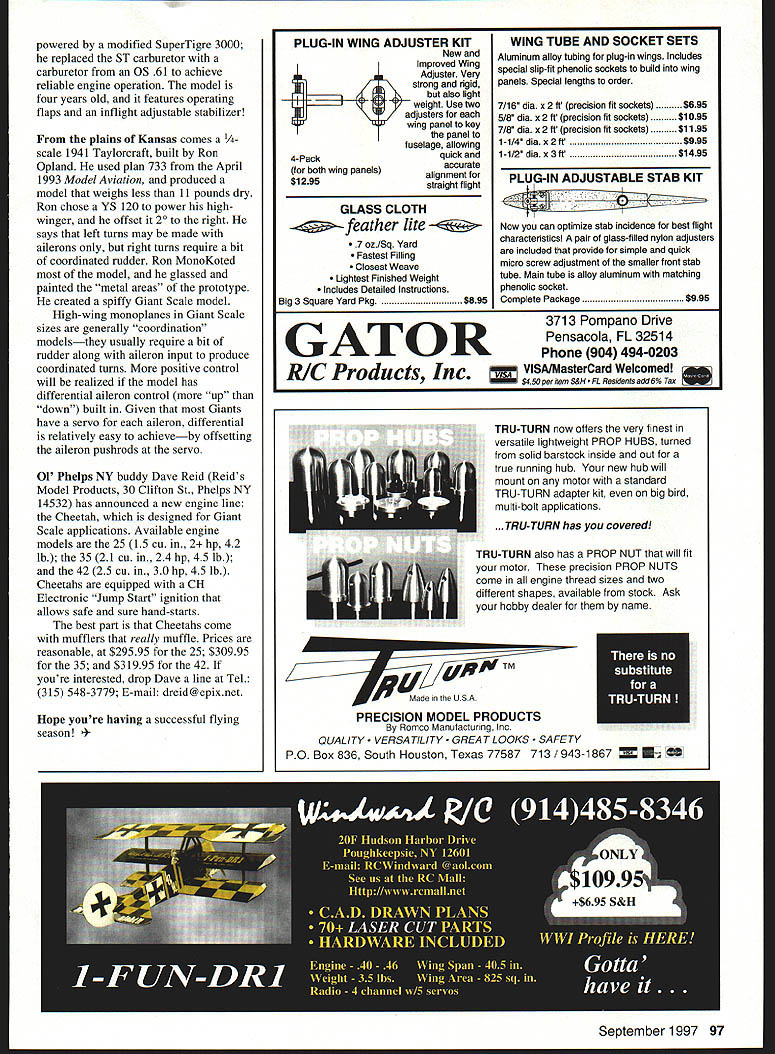
From the plains of Kansas comes a 1/4-scale 1941 Taylorcraft, built by Ron Opland. He used plan 733 from the April 1993 Model Aviation and produced a model that weighs less than 11 pounds dry. Ron chose a YS 120 to power his high-winger and he offset it 2° to the right. He says that left turns may be made with ailerons only, but right turns require a bit of coordinated rudder. Ron MonoKoted most of the model, and he glassed and painted the "metal areas" of the prototype. He created a spiffy giant-scale model.
Giant-scale tips
High-wing monoplanes in giant-scale sizes are generally "coordination" models—they usually require a bit of rudder along with aileron input to produce coordinated turns. More positive control will be realized if the model has differential aileron control (more "up" than "down") built in. Given that most giants have a servo for each aileron, differential is relatively easy to achieve by offsetting the aileron pushrods at the servo.
New engine line: Cheetah (Dave Reid)
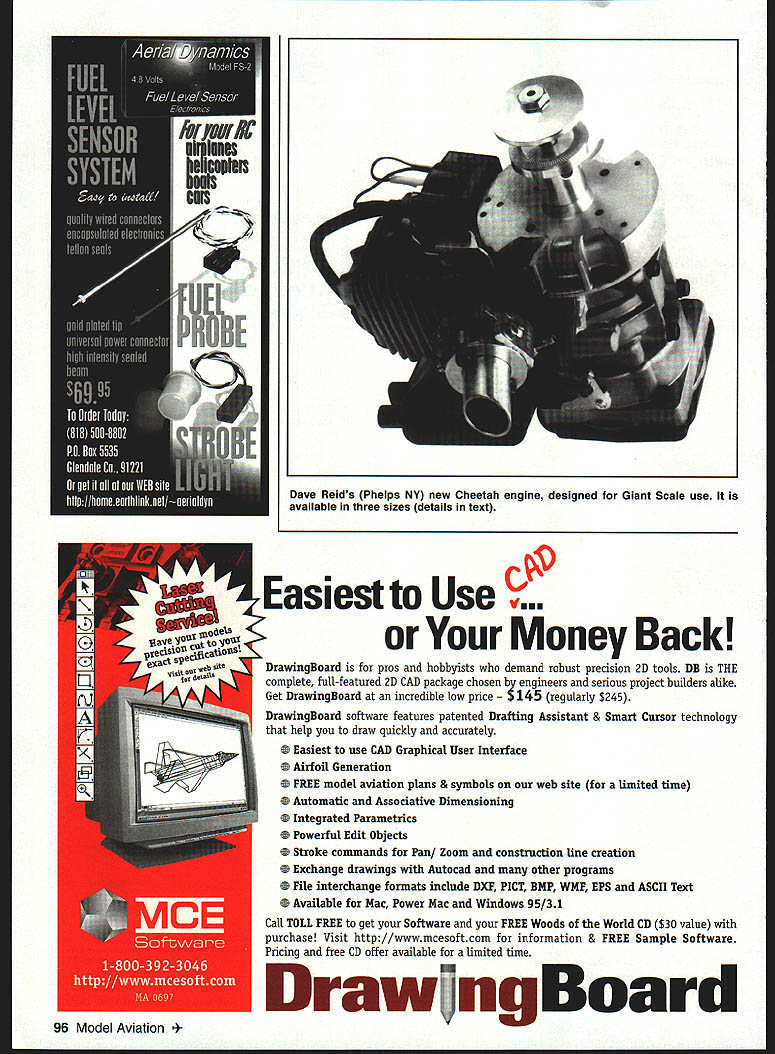
Ol' Phelps, NY buddy Dave Reid (Reid's Model Products, 30 Clifton St., Phelps, NY 14532) has announced a new engine line: the Cheetah, which is designed for giant-scale applications. Available engine models are:
- Cheetah 25 — 1.5 cu. in., 2.4 hp, 4.2 lb. Price: $295.95
- Cheetah 35 — 2.1 cu. in., 2.4 hp, 4.5 lb. Price: $309.95
- Cheetah 42 — 2.5 cu. in., 3.0 hp, 4.5 lb. Price: $319.95
Cheetahs are equipped with a CH Electronic "Jump Start" ignition that allows safe and sure hand-starts. The best part is that Cheetahs come with mufflers that really muffle.
If you're interested, drop Dave a line:
- Tel.: (315) 548-3779
- E-mail: dreid@epix.net
Closing
Hope you're having a successful flying season!
Transcribed from original scans by AI. Minor OCR errors may remain.

