
RADIO CONTROL: GIANTS
John A. de Vries 4610 Moffat Lane, Colorado Springs, CO 80915
Scale designs and the "no‑flightitis" problem
In articles by model designers, the old cliché "It flew right off the drawing board" appears with agonizing regularity. The models do not always do that well, but the models that don't fly as planned never make it to the pages of the magazines.
Scale designs are more frequently the victims of "no‑flightitis" than their freelance brethren, often because their prototypes weren't world‑beating aircraft. Also, shrinking a full‑scale airplane to model size often presents balance, airfoil, wing area, angle‑of‑incidence, and decalage problems that are impossible to overcome. The tradeoffs in producing a true scale replica often produce a "dog" when flight is attempted.
Following are a couple of scale models that didn't make it to the pages of the model airplane press—they did not fly right off the drawing board.
Henschel Hs 121 — M.A. Fallandy
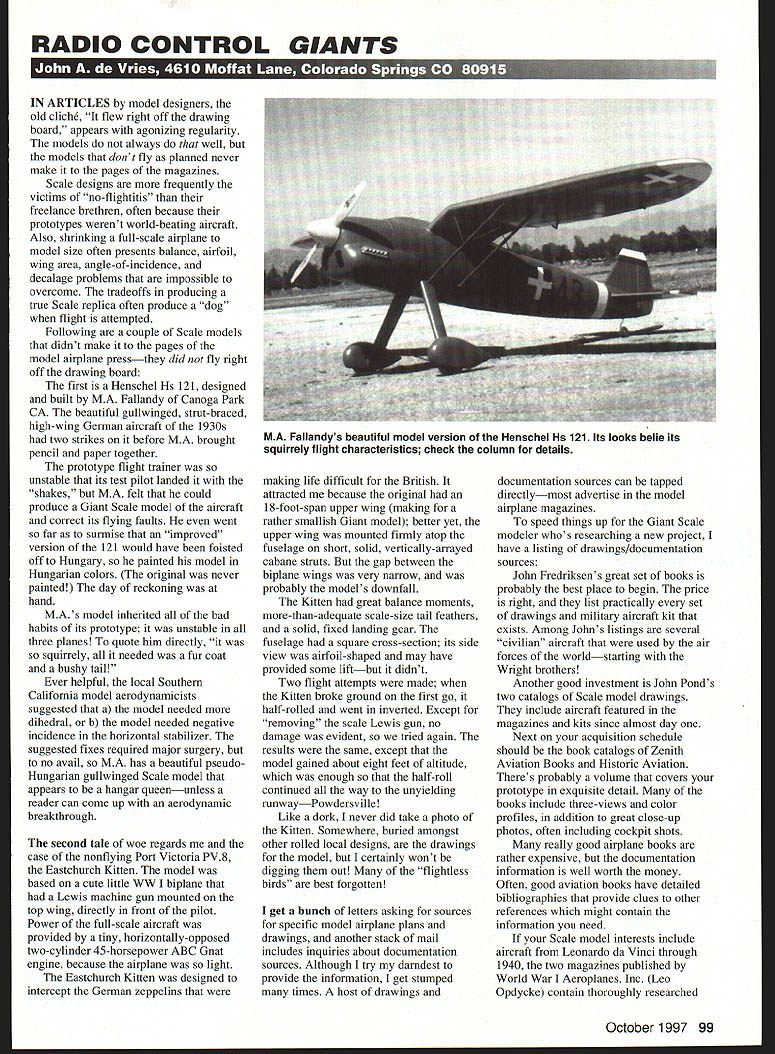
The first is a Henschel Hs 121, designed and built by M.A. Fallandy of Canoga Park, CA. The beautiful gull‑winged, strut‑braced high‑wing German aircraft of the 1930s had two strikes on it before M.A. brought pencil and paper together.
The prototype flight trainer was so unstable that its test pilot landed it with the "shakes," but M.A. felt that he could produce a giant‑scale model of the aircraft and correct its flying faults. He even went so far as to surmise that an "improved" version of the 121 would have been foisted off to Hungary, so he painted his model in Hungarian colors (the original was never painted). The day of reckoning was at hand.
M.A.'s model inherited all of the bad habits of its prototype; it was unstable in all three axes. To quote him directly, "it was so squirrely, all it needed was a fur coat and a bushy tail!"
Ever helpful, the local Southern California model aerodynamicists suggested that a) the model needed more dihedral, or b) the model needed negative incidence in the horizontal stabilizer. The suggested fixes required major surgery, but to no avail, so M.A. has a beautiful pseudo‑Hungarian gull‑winged scale model that appears to be a hangar queen—unless a reader can come up with an aerodynamic breakthrough.
Port Victoria PV.8 (Eastchurch Kitten) — the author
The second tale of woe regards me and the case of the nonflying Port Victoria PV.8, the Eastchurch Kitten. The model was based on a cute little World War I biplane that had a Lewis machine gun mounted on the top wing, directly in front of the pilot. Power of the full‑scale aircraft was provided by a tiny, horizontally opposed two‑cylinder 45‑horsepower ABC Gnat engine, because the airplane was so light.
The Eastchurch Kitten was designed to intercept the German zeppelins that were making life difficult for the British. It had an 18‑foot‑span upper wing (making for a rather smallish giant model); better yet, the upper wing was mounted firmly atop the fuselage on short, solid, vertically arrayed cabane struts. But the gap between the biplane wings was very narrow, and was probably the model's downfall.
The Kitten had good balance moments, more‑than‑adequate scale‑size tail feathers, and a solid, fixed landing gear. The fuselage had a square cross‑section; its side view was airfoil‑shaped and may have provided some lift—but it didn't.
Two flight attempts were made. When the Kitten broke ground on the first go, it half‑rolled and went inverted. Except for removing the scale Lewis gun, no damage was evident, so we tried again. The results were the same, except that the model gained about eight feet of altitude, which was enough so that the half‑roll continued all the way to the unyielding runway—Powdersville!
Like a dork, I never did take a photo of the Kitten. Somewhere, buried amongst other rolled local designs, are the drawings for the model, but I certainly won't be digging them out! Many of the "flightless birds" are best forgotten.
Documentation and drawing sources
I get a bunch of letters asking for sources for specific model airplane plans and drawings, and another stack of mail includes inquiries about documentation sources. Although I try my darnedest to provide the information, I get stumped many times. A host of drawings and documentation sources can be tapped directly—most advertise in the model airplane magazines.
To speed things up for the giant‑scale modeler who's researching a new project, here is a listing of drawings/documentation sources:
- John Fredriksen's books — A great place to begin. The price is right, and they list practically every set of drawings and military aircraft kit that exists. Among John's listings are several civilian aircraft that were used by the air forces of the world—starting with the Wright brothers.
- John Pond's two catalogs of scale model drawings — They include aircraft featured in the magazines and kits since almost day one.
- Book catalogs from Zenith Aviation Books and Historic Aviation — There's probably a volume that covers your prototype in exquisite detail. Many of the books include three‑views and color profiles, in addition to great close‑up photos, often including cockpit shots. Many really good airplane books are rather expensive, but the documentation information is well worth the money.
- Bibliographies in good aviation books — These often lead to other references which might contain the information you need.
- World War I Aeroplanes, Inc. (Leo Opdycke) magazines — If your scale model interests include aircraft from Leonardo da Vinci through 1940, the two magazines published by World War I Aeroplanes, Inc. contain thoroughly researched information and articles. Skyways and WWI Aero feature prototype plans, photographs, and scale‑model airplane columns by Lou Bufardi that provide fascinating information concerning the state of the art for models of those time periods.
- Model airplane magazines (domestic and foreign) — Many publish documentation information.
- NASA (National Association of Scale Aeromodellers) — Membership provides a particularly succinct scale source document that is updated regularly and is available free to new members. The NASA newsletter Replica (also mailed to members) features a "planes worth modeling" column, which includes a description of aircraft, a source listing of documentation information, and often a great full‑page three‑view.
For photographs to provide scale detail after you have the drawings (and have had them enlarged to giant scale sizes), consider:
- Bob Banka (Scale Model Research) — Large library of prototype photographs. Catalog price: $8.
- Doc (Anne) Pepino (Scale Plans and Photo Service) — Scale Documentation catalog price: $5.
Equipment note: JR 642 radio
I've included a photo of the new six‑channel JR 642 RC radio. It has dual capabilities—conventional aircraft and helicopters. The servos in the set are ball‑bearing equipped, and the transmitter has a four‑aircraft memory. One of the 642's main features is that it allows programmable channel/servo mixing. From the giant‑scale viewpoint, however, there are differences between the aircraft and helicopter versions.
In the helicopter version the setup is the same as the conventional setup, except that the set includes five (instead of four) servos and a 1,000 mAh flight battery. The price difference is only $20—for the fifth servo and the higher‑capacity Sanyo flight battery pack. It looks as though it's a particularly sporty radio.
I trust that you're having a pleasant summer, filled with gentle winds and satisfying flying days!
J+
Transcribed from original scans by AI. Minor OCR errors may remain.

