
Radio Control Giants
John A. de Vries — 4610 Moffat Lane, Colorado Springs, CO 80915
It is with the greatest degree of regret that I announce the “passing” of a valiant warrior: Dick Smith’s Ziroli Zero is no longer among us. Pictured earlier in this column and in Robart’s retract ads, “Spider” Smith’s giant set some sort of record for longevity. When it “went West,” it had 729 flights; its final flight was recorded in the Barnstormer (the newsletter of the Hemet, CA, Model Masters).
Dick Smith reported the demise of his Ziroli Zero after 729 flights. He was diving on the Elsinore (CA) field to make an inverted low pass. When down elevator was applied to recover from the dive, the wing broke at the center and the airplane went into a violent roll. The wreckage was spread over 100 feet and the spark plug was torn from the engine—threads and all.
Sincere sympathies to ol’ buddy Dick Smith — but enough of this sadness!
I was surprised and delighted by the response to my October 1997 column about failed Giant Scale designs—specifically a Henschel Hs 121 designed and built by M. A. Fallandy of Canoga Park, CA. I asked for readers’ suggestions about how to “cure” the model’s squirrelly flight antics. The mail poured in and the consensus was that moving the center of gravity a bunch should help tame the Henschel. One writer went so far as to suggest the model be balanced at 13% of the mean aerodynamic chord (as opposed to the rule-of-thumb 24–25%). I’ve shipped all of the letters to Mr. Fallandy for his consideration.
I really miss Model Builder, which quit publication about a year ago. One of the modeling high points of the month was reading Bill Hannan’s column; old friend Bill is still vertical and taking nourishment, and even better news is that he is continuing to publish his very professional series of books.
Even though the books feature Peanut models, the scale three-views included can be enlarged to Giant size. They’re accurate, and Bill usually includes prototype specifics that document his drawings.
His latest effort, Modelers & International Modelers, features a variety of drawings of the Farman Moustique and his 1910 Nieuport logo airplane. Bill’s modeling autobiography is also included. The book costs $10.95 plus $2.50 postage and handling from Hannan’s Runway, Box 210, Magalia, CA 95954.
As do many modelers, I use a considerable amount of cyanoacrylate (CyA) glue. It’s fast and strong—two important factors when building balsa-and-plywood model airplanes. There are times, however, when maximum strength of glued joints is important (such as around plywood firewalls and landing gear mounts) and calls for strong and waterproof adhesives. I’ve never been a big fan of epoxies for the purpose, primarily because they require mixing equal parts glue and hardener. Getting the amounts out of the tube in equal portions is a delaying tactic, particularly if you need glue immediately.
Lately I’ve been using Weldbond Adhesive for critical joints. It’s a catalyzed polyvinyl acetate glue that goes on white but dries crystal clear. It does require setting overnight for a complete cure, but it’s strong—especially for plywood-to-plywood joints. It has no smell, and it’s easy to peel from your fingers. Good stuff!
FMA Direct (9607 Dr. Perry Rd. #109, Ijamsville, MD 21754) has come up with a unique item as far as radio-control installations are concerned: a series of shock-mounted switch harnesses compatible with radios from Futaba, JR, and Airtronics.
Many of us shock-mount servos with rubber grommets and protect receivers and batteries in foam rubber, but the ubiquitous switch/charging harness is usually bolted directly to the model’s structure and is subjected to every squiggle and quiver transmitted by our engines’ vibration.
FMA Direct harnesses isolate the switch from vibration and also provide redundant multiple power paths should the switch assembly itself fail. The four models of FMA harnesses specifically designed for Giant Scale models will handle quarter-scale servos and can be used in big models—and some. Whatta deal!
John Fredriksen is in the process of compiling a new edition of his detail-packed Model Warplanes series. As part of the exercise he wants to reduce his inventory of the 1996 volumes. He offers all five books for the attractive price of $25 plus $3 postage and handling — a 50% savings. The Fredriksen books are a great starting point for documenting military aircraft, from the beginnings of aviation to the present.
I was really fortunate when it came to flying North American Company Mustangs, including four versions of the great P-51. There was the P-51D with its Hamilton Standard propeller, which was plagued by oil on the windshield that affected forward visibility.
My Mustang was a P-51K with an Aeroproducts propeller. It was slightly faster (about three mph) than the usual D and much easier to see out of; no oil on the windshield of old No. 56 from leaky propellers. Then there was the TP-51D, which had the fuselage fuel tank removed and a second seat installed behind the pilot; eighty gallons less fuel and the backseater effectively moved the center of gravity to the rear so that aerobatics were essentially a no-no.
Although the D and K versions of the Mustangs were capable of high speed with their Merlins at full song, normal indicated cross-country airspeed was about 200 mph. A totally different airplane was the F/P-51H. It was a full 600 pounds lighter than the D and K; it had a straight wing leading edge and was much more maneuverable. It “cross-countryed” at about 220 mph, although it was much faster with the throttle bent around the quadrant.
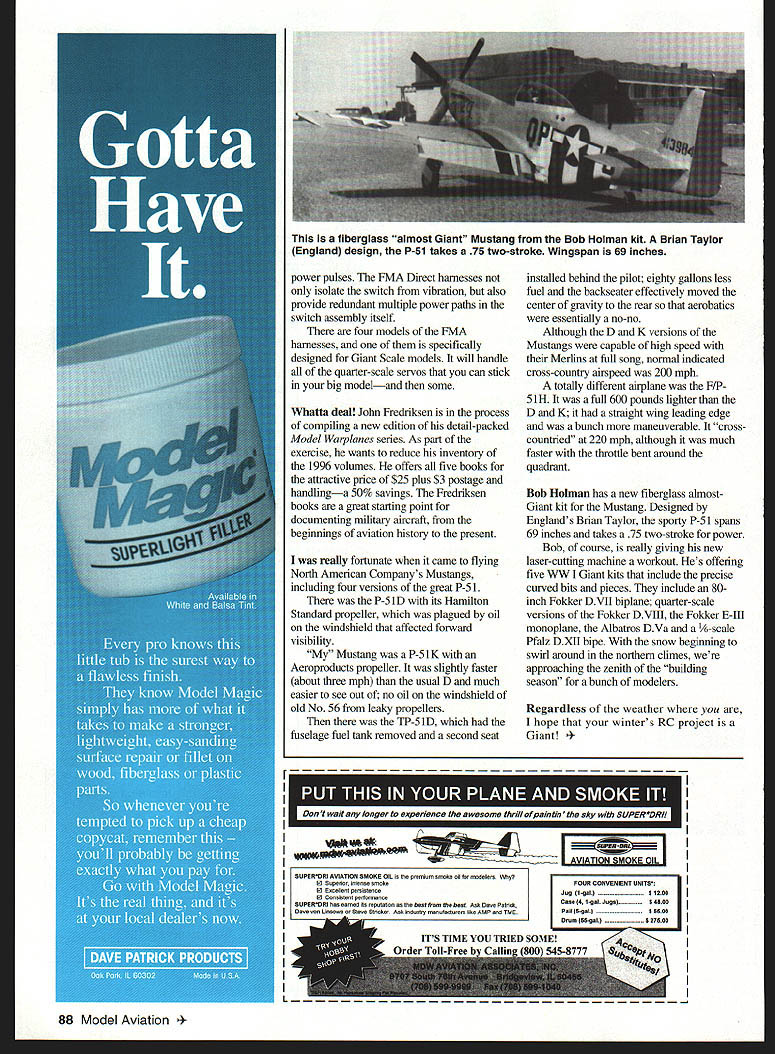
Bob Holman has a new fiberglass almost-giant kit for the Mustang. Designed by England’s Brian Taylor, the sporty P-51 spans 69 inches and takes a .75 two-stroke for power. Bob, of course, is really giving his new laser-cutting machine a workout. He’s offering five World War I Giant kits that include the precise laser-cut parts:
- 80-inch Fokker D.VII biplane
- Quarter-scale Fokker D.VIII
- Quarter-scale Fokker E-III monoplane
- Quarter-scale Albatros D.Va
- 1/6-scale Pfalz D.XII biplane
With the snow beginning to swirl around in the northern climes, we’re approaching the zenith of the building season for a bunch of modelers.
Regardless of the weather where you are, I hope that your winter RC project is a Giant!
Transcribed from original scans by AI. Minor OCR errors may remain.

