
RADIO CONTROL GIANTS
John A. de Vries 4610 Moffat Lane, Colorado Springs, CO 80915
Once in a while I thumb through my library. I found an interesting book that I had long forgotten, but that's not too surprising since it was first published during WWII: Air Age Gas Models was published by Model Airplane News.
The point of greatest fascination is the introductory screed, which recalls that balsa was in short supply during the war. It was being used for life vests and insulation for oil tankers. The book's authors recommended using pine, bass, and spruce in lieu of the lighter wood, but in smaller cross-sections than plans called for. That was good advice, because the 60-powered free-flight models of the era were almost as large as today's "Giant" size models.
These days modelers often start out with spruce for many Giant Scale projects and think nothing of it. Things sure have changed! Still, the old pylon free flights, with their undercambered wings and Autoknips ignition timers, are fascinating.
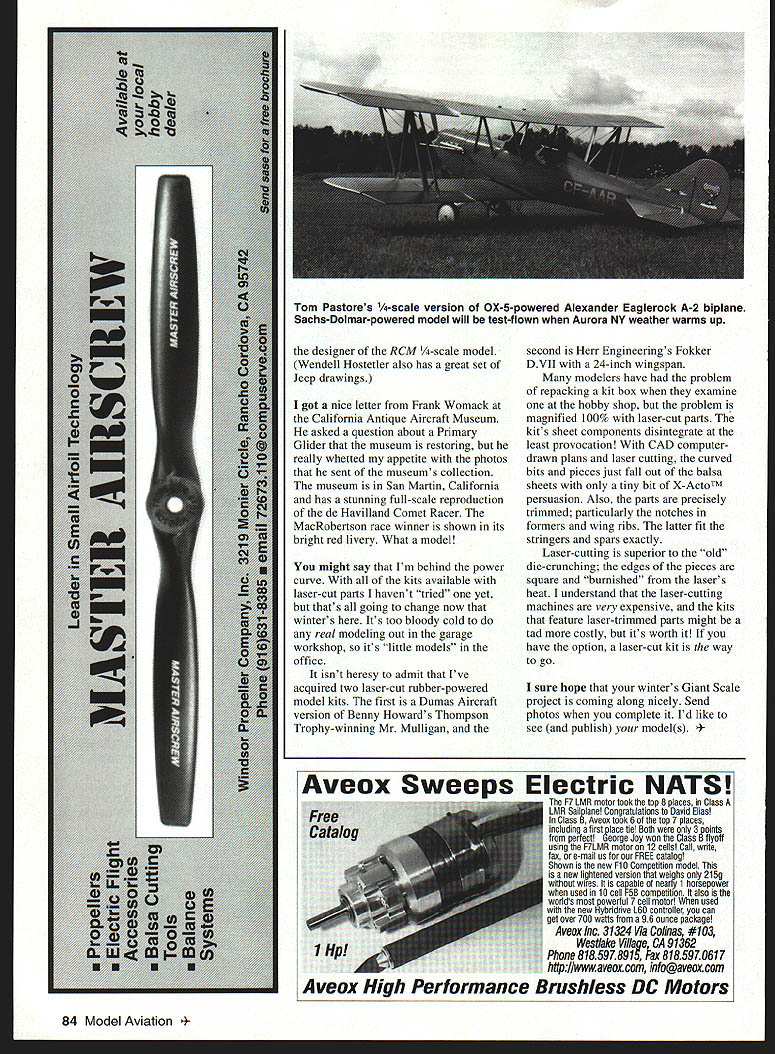
Tom Pastore's 1/4-scale Alexander Eaglerock
Speaking of fascinating, Tom Pastore of East Aurora, New York has come up with a 1/4-scaler that really fits the designation. He bolted together an Alexander Eaglerock A-2 biplane with a nine-foot upper wing (the lower wing spans a foot less), and used a 4.2 Sachs/Dolmar engine that spins a 24 x 10 propeller. He chose a Canadian aircraft to model, covered it with Super Coverite, and duplicated the scale color scheme (Alexander blue for the fuselage and vertical surfaces with aluminum-doped wings and horizontal tail surfaces).
When Tom wrote in October, he hadn't flown his masterpiece; he was going to wait until the 1998 flying season for the initial tests. The 6-foot, 2-3/4-inch-long model weighs a reasonable 33-1/4 pounds.
Charles Reeves and the Art Chester Jeep
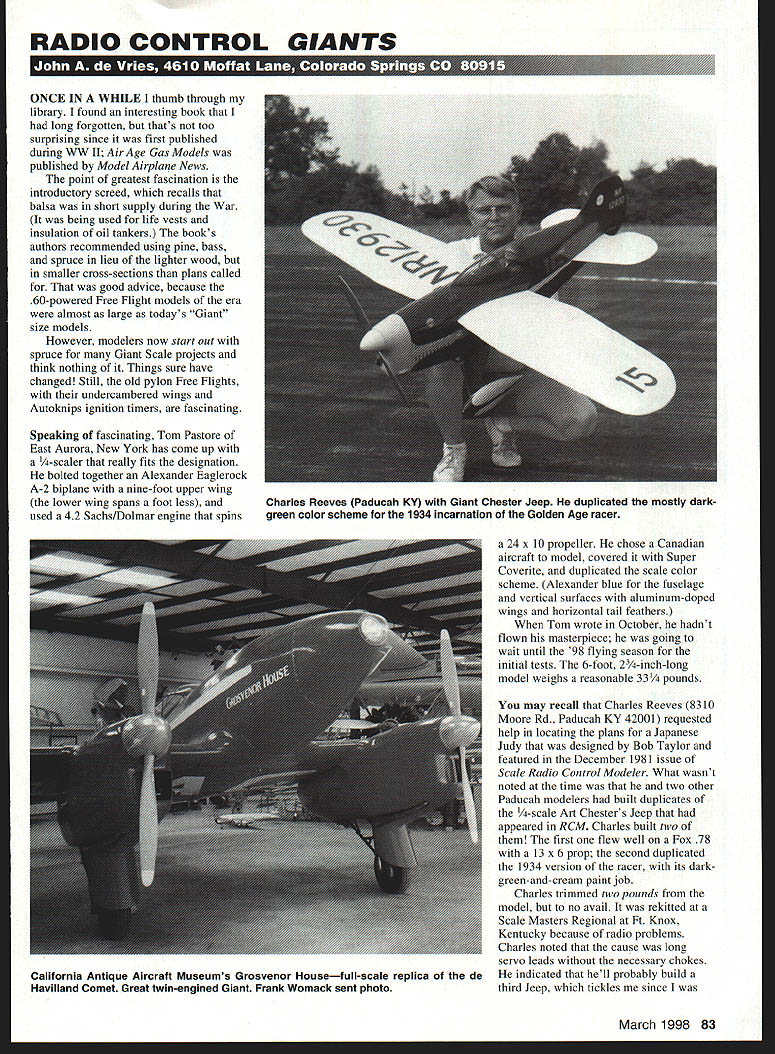
You may recall that Charles Reeves (8310 Moore Rd., Paducah, KY 42001) requested help in locating the plans for a Japanese Judy that was designed by Bob Taylor and featured in the December 1981 issue of Scale Radio Control Modeler. What wasn't noted at the time was that he and two other Paducah modelers had built duplicates of the 1/4-scale Art Chester's Jeep that had appeared in RCM. Charles built two of them!
The first one flew well on a Fox .78 with a 13 x 6 prop; the second duplicated the 1934 version of the racer, with its dark-green-and-cream paint job. Charles trimmed two pounds from the model, but to no avail. It was re-kitted at a Scale Masters Regional at Ft. Knox, Kentucky, because of radio problems. Charles noted that the cause was long servo leads without the necessary chokes.
California Antique Aircraft Museum
I got a nice letter from Frank Womack at the California Antique Aircraft Museum. He asked a question about a primary glider that the museum is restoring, but he really whetted my appetite with the photos that he sent of the museum's collection.
The museum is in San Martin, California and has a stunning full-scale reproduction of the de Havilland Comet Racer. The MacRobertson race winner is shown in its bright red livery. What a model!
Laser-cut kits and winter modeling
You might say that I'm behind the power curve. With all of the kits available with laser-cut parts I haven't "tried" one yet, but that's all going to change now that winter's here. It's too bloody cold to do any real modeling out in the garage workshop, so it's "little models" in the office.
It isn't heresy to admit that I've acquired two laser-cut rubber-powered model kits:
- Dumas Aircraft version of Benny Howard's Thompson Trophy-winning Mr. Mulligan
- Herr Engineering's Fokker DVII with a 24-inch wingspan
Many modelers have had the problem of repacking a kit box when they examine one at the hobby shop, but the problem is magnified 100% with laser-cut parts. The kit's sheet components disintegrate at the least provocation! With CAD computer-drawn plans and laser cutting, the curved bits and pieces just fall out of the balsa sheets with only a tiny bit of X-Acto persuasion. Also, parts are precisely trimmed—particularly the notches in the formers and wing ribs. The latter fit the stringers and spars exactly.
Laser-cutting is superior to the "old" die-crunching; the edges of the pieces are square and "burnished" from the laser's heat. I understand that the laser-cutting machines are very expensive, and the kits that feature laser-trimmed parts might be a tad more costly, but it's worth it. If you have the option, a laser-cut kit is the way to go.
I sure hope that your winter's Giant Scale project is coming along nicely. Send photos when you complete it. I'd like to see (and publish) your model(s).
Transcribed from original scans by AI. Minor OCR errors may remain.

