
RADIO CONTROL: GIANTS
John A. de Vries 4610 Moffat Lane, Colorado Springs, CO 80915
DO YOU GET the feeling that every other Giant Scale model is a J-3 Cub? There are many of the yellow highwingers around, and they are available in every size for almost any engine displacement, from .049s to the biggest gas-burner. Cub kits and Cub drawings are available up to and including 1/3-scale. The reason for all of these Pipers is that J-3 models fly beautifully.
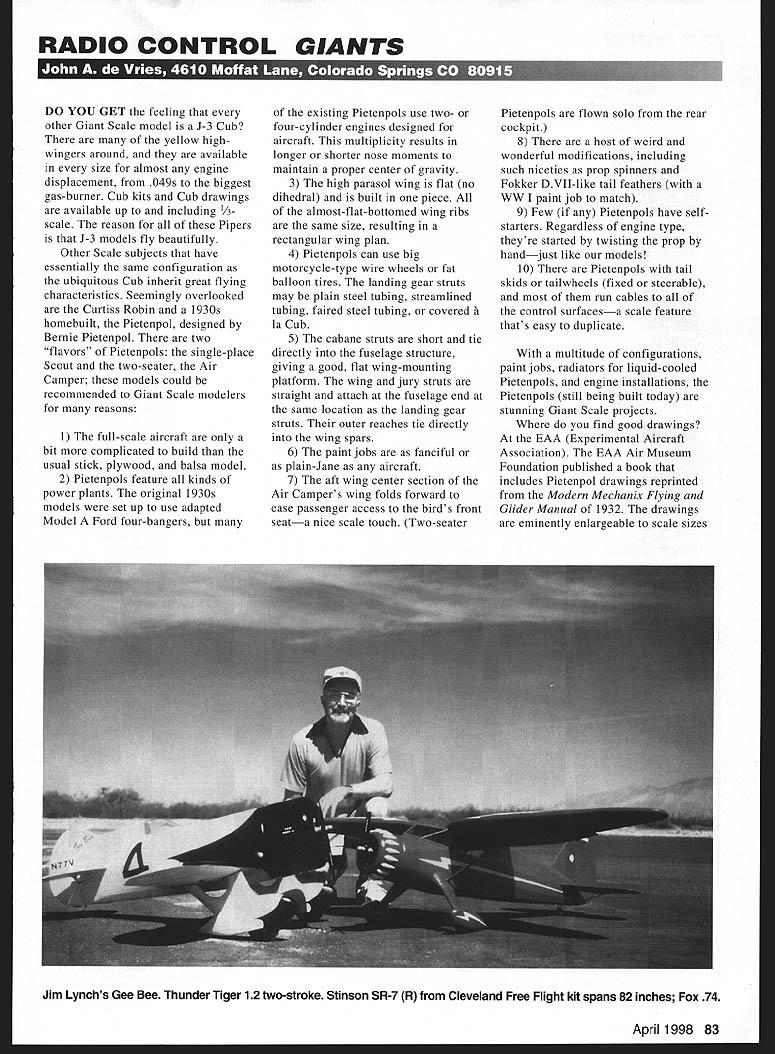
Other scale subjects that have essentially the same configuration as the ubiquitous Cub inherit great flying characteristics. Seemingly overlooked are the Curtiss Robin and a 1930s homebuilt, the Pietenpol, designed by Bernie Pietenpol. There are two "flavors" of Pietenpol: the single-place Scout and the two-seater, the Air Camper. These models could be recommended to Giant Scale modelers for many reasons:
- The full-scale aircraft are only a bit more complicated to build than the usual stick, plywood, and balsa model.
- Pietenpols feature all kinds of powerplants. The original 1930s models were set up to use adapted Model A Ford four-bangers, but many of the existing Pietenpols use two- or four-cylinder aircraft engines. This multiplicity results in longer or shorter nose moments to maintain a proper center of gravity.
- The high parasol wing is flat (no dihedral) and is built in one piece. All of the almost-flat-bottomed wing ribs are the same size, resulting in a rectangular wing plan.
- Pietenpols can use big motorcycle-type wire wheels or fat balloon tires. The landing gear struts may be plain steel tubing, streamlined tubing, faired steel tubing, or covered a la Cub.
- The cabane struts are short and tie directly into the fuselage structure, giving a good, flat wing-mounting platform. The wing and jury struts are straight and attach at the fuselage end at the same location as the landing gear struts. Their outer reaches tie directly into the wing spars.
- The paint jobs are as fanciful or as plain-Jane as any aircraft.
- The aft wing center section of the Air Camper's wing folds forward to ease passenger access to the bird's front seat — a nice scale touch. (Two-seater Pietenpols are flown solo from the rear cockpit.)
- There are a host of weird and wonderful modifications, including such niceties as prop spinners and Fokker D.VII–like tail feathers (with a WWI paint job to match).
- Few (if any) Pietenpols have self-starters. Regardless of engine type, they're started by twisting the prop by hand — just like our models!
- There are Pietenpols with tail skids or tailwheels (fixed or steerable), and most of them run cables to all of the control surfaces — a scale feature that's easy to duplicate.
With a multitude of configurations, paint jobs, radiators for liquid-cooled Pietenpols, and engine installations, the Pietenpols (still being built today) are stunning Giant Scale projects.
Where to find drawings and documentation
- The EAA (Experimental Aircraft Association) Air Museum Foundation published a book that includes Pietenpol drawings reprinted from the Modern Mechanix Flying and Glider Manual of 1932. The drawings are eminently enlargeable to scale sizes while retaining prototype construction. The book is available from Historic Aviation (Stock #46430), 1401 Kings Wood Rd., Eagan, MN 55122; Tel.: (800) 225-5575. It costs $8.85 plus $4.95 postage and handling.
- Super Pietenpol documentation is available from:
- Bob Banka, Scale Model Research, 3114 Yukon Ave., Costa Mesa, CA 92626. Bob offers 20 different Air Camper Foto Paaks (four pages of documentation and three-views) and one Sky Scout Foto Paak with 16 pages of documentation.
- Anne Pepino, Scale Plans & Photo Service, 3209 Madison Ave., Greensboro, NC 27403. Anne lists two photo packs of Air Campers and one of the Sky Scout, featuring Model A Ford engine configurations.
If you're ever in the vicinity of Brodhead, WI in the summertime, check the local airport — it collects a host of Pietenpols at their annual get-together fly-in.
Aircraft of the World cards
I don't usually respond to bulk-rate advertising mail, but about a year ago I tried a mailing from Aircraft of the World (Box 7295, Pasadena, CA 91109) that included several attractive "cards." They're four-page descriptions of individual aircraft designed to fit in loose-leaf notebooks. The series consists of 16 subdivisions and includes many airplanes. Everything is in color on the first three pages (page four has black-and-white photos). Each aircraft is shown in full-color side view, with size and performance statistics. For most aircraft, there's also a section that compares range, armament, or speed with similar contemporaneous aircraft. Three aircraft card packets that arrive each month cost $18.80 including postage and handling. My collection fills almost three of the free loose-leaf notebooks and continues to build. If you're interested, check with Aircraft of the World: (800) 261-0604.
Workshop tip
I found some nifty tools at my local supermarket: bamboo skewers (for shish kabobs or lacing up turkeys). Each skewer is 7-3/4 inches long and comes in a multi-pack for less than two bucks. They're ideal for transferring epoxy or slow-drying CyA (cyanoacrylate) into interior nooks and crannies you might have missed while building your model, and they make great reinforcements across butt joints in balsa or spruce. The best part is that the skewers can be disposed of if they become too caked with glue. I got my first packet more than a year ago, and there's still a handful wrapped in a rubber band on my workbench.
Upcoming event
Hooray for Jim Lynch of Tucson, AZ! He and his compadres of the Tucson Radio Control Club (TRCC) are holding their ninth annual Wings Over The Desert IMAA Fly-In the weekend of April 4–5. The event is AMA (Academy of Model Aeronautics) and IMAA (International Miniature Aeronautical Association) sanctioned, and it will be flown from TRCC's 110 x 600-foot paved runway. If you're interested, contact Jim at 6270 E. 2nd St., Tucson, AZ; Tel.: (520) 745-0854.
Back atcha next month!
Transcribed from original scans by AI. Minor OCR errors may remain.

