
RADIO CONTROL GIANTS
John A. de Vries 4610 Moffat Lane, Colorado Springs, CO 80915
A day at the flying field
It's a beautiful, warm spring day at the Radio Control (RC) flying field. Only a couple of models are tracing filmy exhaust trails in the blue sky. One of the airplanes heads for the runway for a low pass, and the scream of the engine grabs everyone's attention as the model dives earthward. Then it happens!
As the flier pulls his model sharply out of the dive, there's an ominous craaak—and the wing folds up in the middle! The fuselage, now bereft of any lift, spears into the runway and debris is scattered everywhere. Balsa, plywood, propeller, spinner, engine, and radio create a long swath of destruction. Above it all, a half-wing flutters slowly to the earth. Too many Gs (gravitational forces) is the consensus of the modelers who witnessed the crash.
Causes of wing failure
Many modelers have possibly witnessed this sort of ugly end to an RC flight. "Too many Gs" may be the immediate conclusion, but that isn't the whole story. A poorly braced wing center section might have been waiting for a high-G pull-out; maybe plywood dihedral braces weren't sufficiently epoxied to the wing spars; or the fiberglass "scab" over the center section of the wing wasn't fully adhered to the wing's planking.
Assuming earlier precise joining of the wing halves, things may have come apart because of extended vibration after many flights, or because fuel-soaked joints finally failed. Anyhow, the wing failed at its most-stressed location—the center section.
The type of wing construction most sensitive to center-section failure is where two foam sections are butt-joined, either with or without plywood dihedral braces. Most of this type of wing's strength relies on the fiberglass cloth wrapping of the center section. The fiberglass tape is fixed in place with a "bath" of CYA (cyanoacrylate) glue, resin, or epoxy. Properly done, fiberglassing a wing's center section holds things together well, but it's very important that the glue penetrates the wing sheeting.
Wings with conventional rib-and-spar construction are usually much stronger, particularly if they're sheeted with balsa or thin plywood, as foam-core wings usually are. The dihedral braces can be fully adhered to the spars before the wing center section is sheeted, and the fiberglass "scab" adds additional strength.
Composite wing construction
This leads to an interesting wing construction technique—the composite wing. Why not build the highly stressed center section conventionally and add the less-stressed outer wing panels using foam? This technique is particularly attractive for Giant Scale subjects with flat, rectangular (in plan view) wing middles.
For other wing plans, using conventional rib-and-spar construction outboard of the landing gear offers several advantages:
- Hardwood bearers for retracts are easier to locate.
- Pressure lines or pushrods for actuation are easier to route.
- There won't be any need to pick little round bits of foam out of the wing to provide scale wheel wells.
In multiengine models, conventional construction to just outboard of the engines facilitates mounting them along with their throttle control runs. If the main upper and lower wing spars are extended to the wing tips (in slots cut into the foam wing ends), a monolithic wing can be constructed. Adding a strip of carbon fiber to each spar will be icing on the cake—you can pry a Jeep out of the mud with such a wing!
Special Interest Groups (SIGs)
There are several interesting and important Special Interest Groups (SIGs) in the AMA. I belong to two of them, one of which is the IMAA (International Miniature Aircraft Association). I've been in it since before it began in April 1980 (I was the 13th member to sign up).
The other group, in which I found many kindred spirits, is NASA (National Association of Scale Aeromodelers). I was a Johnny-come-lately to this organization (#577), but I'm glad that I joined. The current president is Bob Underwood, a Scale competitor in the classic sense (including several visits to the Scale Internats as a member of the US Scale team).
Cliff Tacie, another longtime Scale expert, is the editor of Replica, the NASA newsletter, which is included with membership. Cliff's bimonthly efforts are well worth reading. NASA membership also includes a copy of the Scale Data Source List, a truly inspired publication kept up to date by Claude McCullough. It's worth the yearly $10 dues.
One of NASA's prime missions is to standardize Scale contest judging, and progress is being made in fulfilling this admirable task. If you want to join, contact: Cathy Burnstine, NASA Secretary/Treasurer 303 Finch St. Sandusky, OH 44870
Events and notices
If you're contest-oriented, don't forget the 1998 AMA Scale National Championships, to be held July 10–12 at the AMA National Flying Site, Muncie, IN. RC and Control Line events are scheduled and include RC Team Scale (unofficial, but fun).
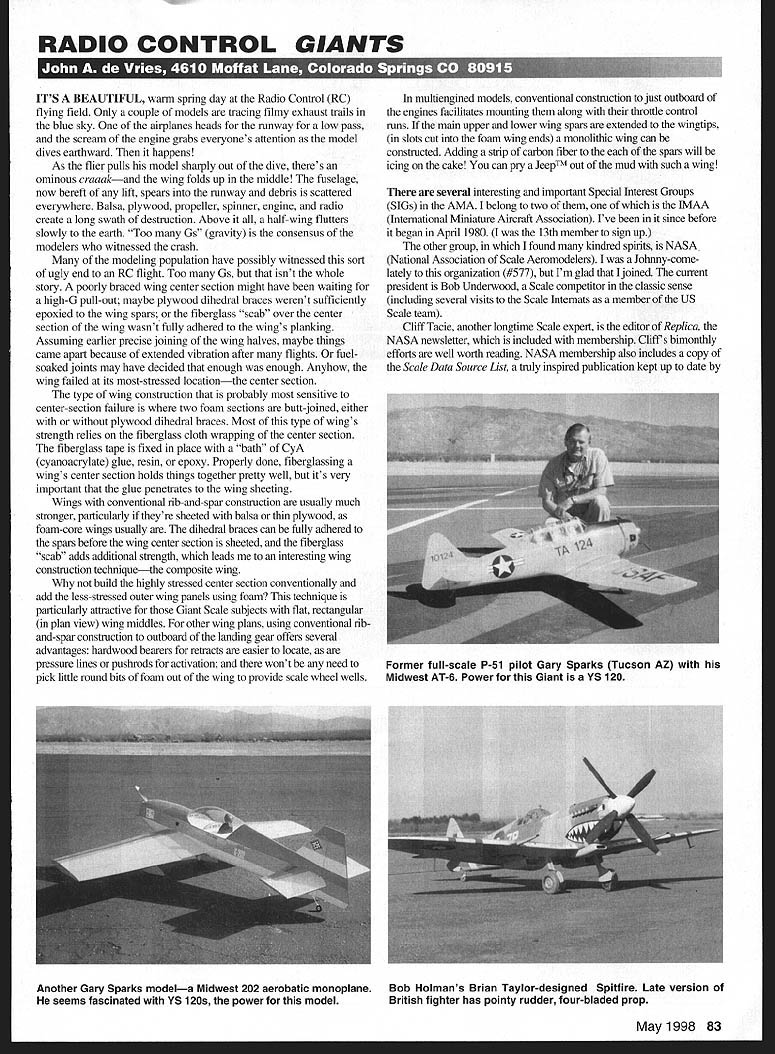
Son of a gun! Gary Sparks (Tucson, AZ) let me know about NASA's April 4–5 model meet, but about a month too late. I would have liked to give the Tucson folks a plug; their springtime weather is usually great for fly-ins. Gary was kind enough to enclose some nifty model photographs. He noted that the Mustangs (P-51s) he flew were a bit faster than the ones I piloted—his models cross-country-cruised at 230–240 mph. He even checked with his Mustang buddies and they agreed. My memory must be failing. Great airplane though!
Featured model: Spitfire by Bob Holman
Bob Holman's latest offering is a true Giant, and one of the more esoteric Spitfires. Plans are by British expert Brian Taylor for an 83-inch version of the Mark VII and IX. The prototype model came out at 14.5 pounds.
Bob is prepared to furnish a detailed fiberglass cowl, molded canopy, and aluminum spinner for the model, and laser-cut parts. To complete the package, Mr. Holman stocks meticulous three-views of the elliptical-winged bird. The plans are $45 plus $5 postage and handling, and are shipped rolled. It's one pretty airplane!
I sure hope that April showers bring out your May flowers and your new Giant Scale model. Much luck with your test flights!
Transcribed from original scans by AI. Minor OCR errors may remain.

