
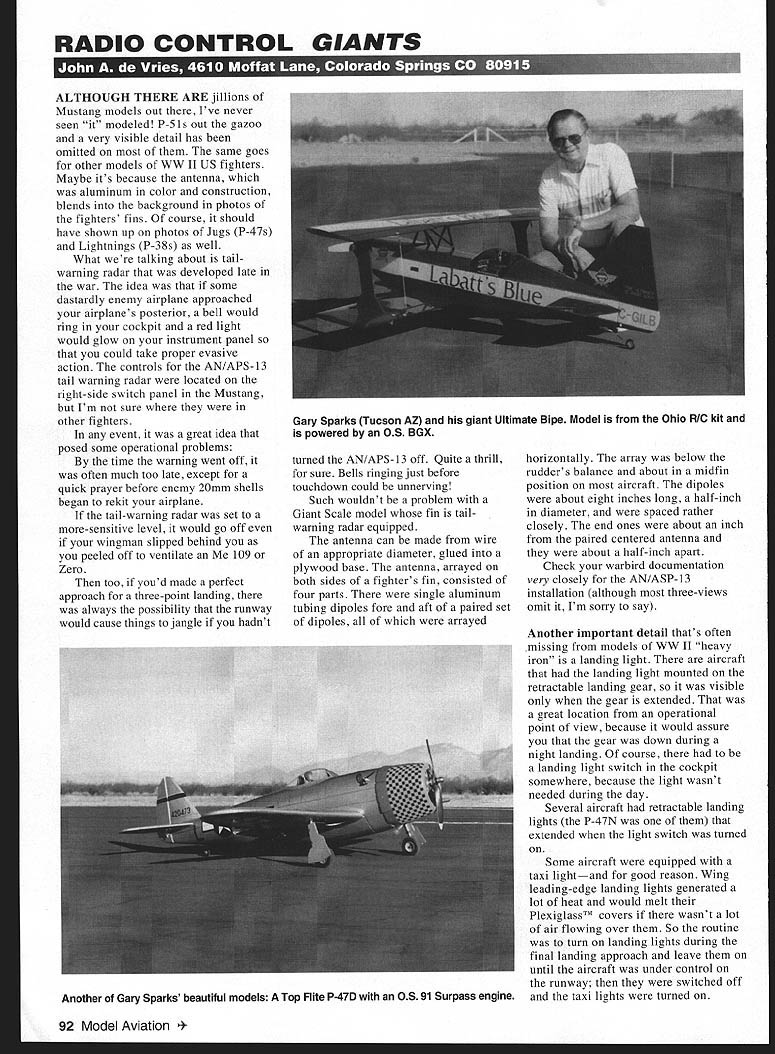


RADIO CONTROL GIANTS
John A. de Vries, 4610 Moffat Lane, Colorado Springs, CO 80915
Although there are zillions of Mustang models out there, I've never seen "it" modeled: the tail-warning radar. This very visible detail has been omitted on most WWII U.S. fighter models. Maybe it's because the aluminum-colored antenna blends into the background of photos of the fighters' fins. Of course it should have shown up on photos of Jugs (P-47s), Lightnings (P-38s), and other types.
Tail-warning radar (AN/APS-13)
The tail-warning radar was developed late in the war. The idea was simple: if an enemy airplane approached from astern, a bell would ring in the cockpit and a red light would glow on the instrument panel so the pilot could take evasive action. In the P-51 the AN/APS-13 controls were on the right-side switch panel; other fighters had similar installations.
Operational problems:
- By the time the warning went off it was often much too late, except for a quick prayer before enemy 20mm shells began to riddle the airplane.
- If set to a more-sensitive level the radar would alarm when your wingman slipped in behind you during combat maneuvers.
- On a three-point landing the runway could trigger the bell if the AN/APS-13 wasn't turned off — an unnerving experience as bells rang just before touchdown.
Modeling the tail-warning antenna
On a Giant Scale model, adding the fin-mounted tail-warning antenna is straightforward and adds a lot of authenticity.
Construction notes:
- Make the antenna from wire of appropriate diameter glued into a small plywood base.
- The antenna array, mounted on both sides of the fighter fin, consisted of four elements: single aluminum-tubing dipoles fore and aft and a paired set of dipoles in the center, all arrayed horizontally.
- Typical placement was below the rudder balance, about mid-fin on most aircraft.
- Typical dimensions (check your documentation for specifics): dipoles about 8 inches long, ~1/2 inch diameter; the end dipoles were about 1 inch from the paired center antenna, and the paired elements were about 1/2 inch apart.
- Check warbird documentation carefully for the exact AN/APS-13 installation; many three-view drawings omit it.
Landing and taxi lights
Another detail often missing from models of WWII "heavy iron" is the landing light.
Operational and modeling points:
- Some aircraft had landing lights mounted on the retractable landing gear so the light was visible only when the gear was down — a great operational location because it helped assure the pilot that the gear was down during night landings.
- Several aircraft (the P-47N among them) had retractable landing lights that extended when the cockpit switch was turned on.
- Some aircraft were equipped with a separate taxi light. Wing leading-edge landing lights generated a lot of heat and could melt their Plexiglas covers when airspeed was low, so the routine was:
- Turn landing lights on during final approach and leave them on until the aircraft was under control on the runway.
- Switch off the landing lights and use taxi lights as required.
Identification lights
Many Allied aircraft carried identification lights, usually mounted below the right wing and aligned from front to rear just inside the wingtip. They could be red, yellow, green, and/or blue. There was an ID light control box in the cockpit and the pilot was given a "code of the day" telling which light or combination to display so friendly anti-aircraft gunners could recognize friendly aircraft at night.
Plans and cutting
Have you noticed that Giant Scale plans often seem drawn on drafting boards the size of banquet tables? You frequently have to slice major components free from large sheets to fit them on your workbench. If you're not careful you may cut through important dimensions or notes on the plan sheets. There is, of course, a solution to this problem — but it may cost you.
Projects and reminders
A couple of additional notes:
- The Bell Airacuda project has been on hold for family reasons. Current plans: the 105-inch Giant will be electric-powered with three-bladed, scale-like propellers.
- With the return of the flying season, don't forget your before-leaving-home checklist. Nothing is more embarrassing than arriving at the club field without your transmitter!
Transcribed from original scans by AI. Minor OCR errors may remain.

