
RADIO CONTROL GIANTS
John A. de Vries 4610 Moffat Lane, Colorado Springs CO 80915
They're all over the place — and with good reason. Almost every Giant Scale flightline has one, and maybe more; they're readily identifiable, since most of them are monoplanes with fixed landing gear, the paint jobs are stunning, and many of them carry miniaturized versions of sponsor decals. I'm talking about the proliferation of present-day aerobatic airplane scale models.
They may be Zlins, or CAPs, or Ravens, or any of a vast array of available designs. Bubble canopies and flat engines mark the breed, and models duplicate these common features. The better Giant Scale radio control (RC) fliers have taken the aerobatic models to heart, and usually (with smoke trails added) put on shows of rolls, loops, and other maneuvers that would do a professional acrobatic pilot proud.
Staudacher S-3000 plans
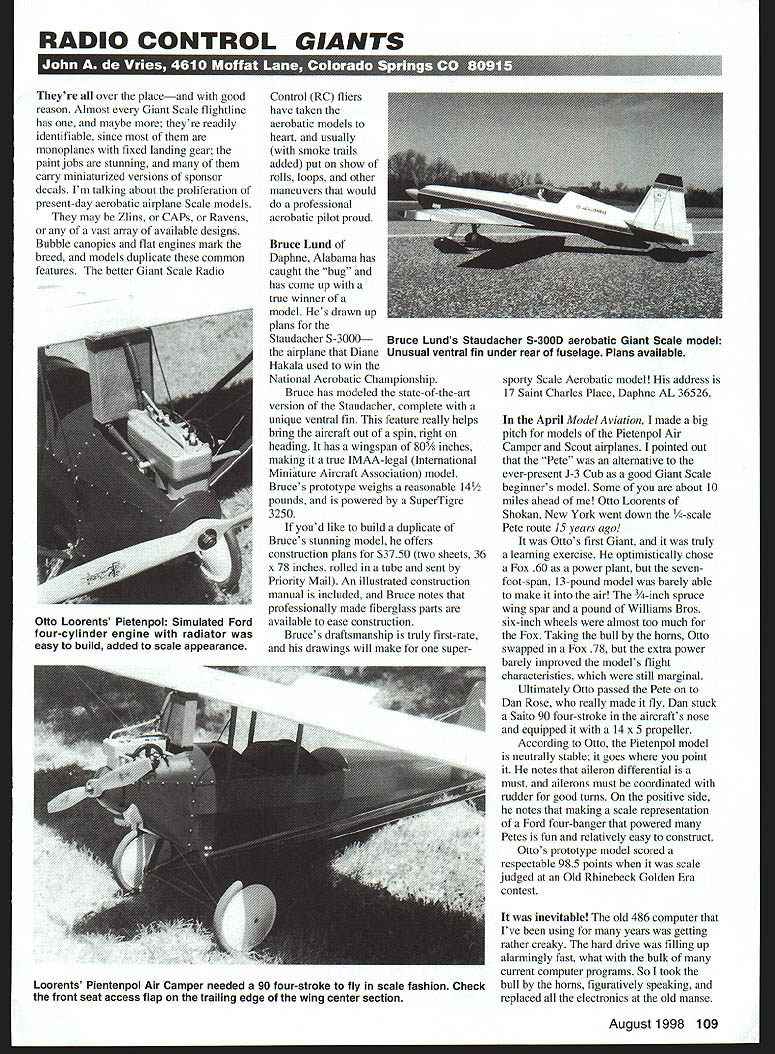
Bruce Lund of Daphne, Alabama has caught the "bug" and has come up with a true winner of a model. He's drawn up plans for the Staudacher S-3000 — the airplane that Diane Hakala used to win the National Aerobatic Championship.
Bruce has modeled the state-of-the-art version of the Staudacher, complete with a unique ventral fin. This feature really helps bring the aircraft out of a spin, right on heading. It has a wingspan of 80 5/8 inches, making it a true IMAA-legal (International Miniature Aircraft Association) model. Bruce's prototype weighs a reasonable 14 1/2 pounds and is powered by a SuperTigre 3250.
If you'd like to build a duplicate of Bruce's stunning model, he offers construction plans for $37.50 (two sheets, 36 x 78 inches, rolled in a tube and sent by Priority Mail). An illustrated construction manual is included, and Bruce notes that professionally made fiberglass parts are available to ease construction.
Bruce's draftsmanship is truly first-rate, and his drawings will make for one super-sporty scale aerobatic model! His address is: 17 Saint Charles Place, Daphne AL 36526.
Pietenpol Air Camper and Scout
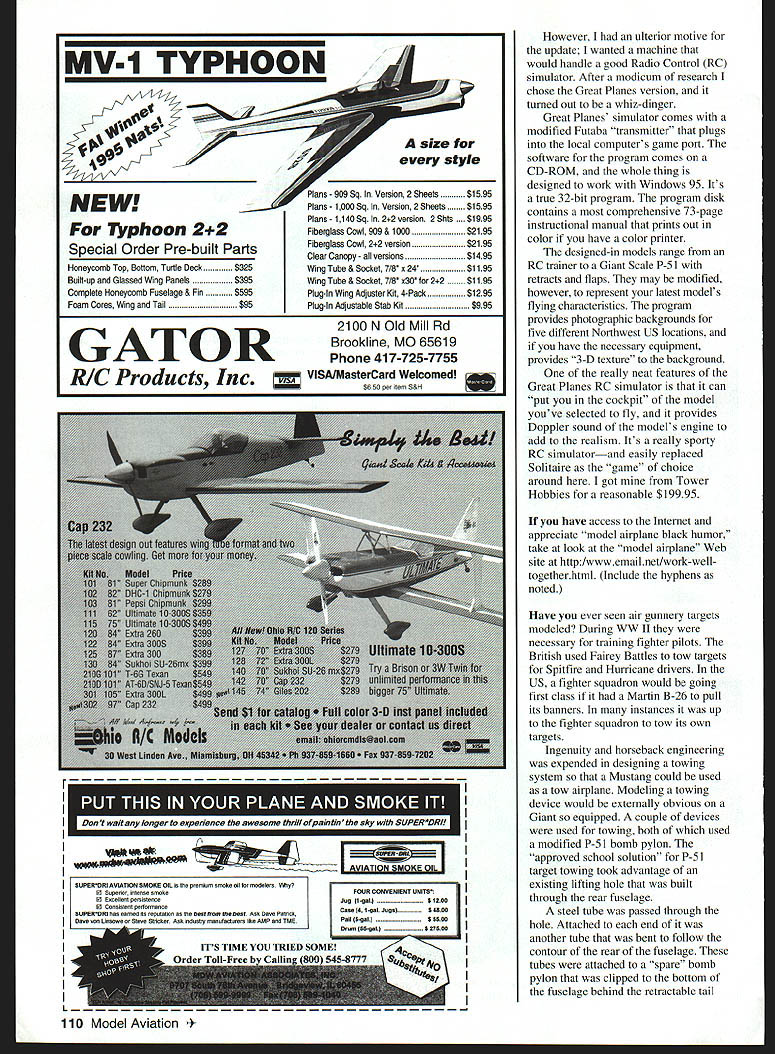
In the April Model Aviation I made a big pitch for models of the Pietenpol Air Camper and Scout airplanes. I pointed out that the "Pete" was an alternative to the ever-present J-3 Cub as a good Giant Scale beginner's model. Some of you are about 10 miles ahead of me! Otto Loorents of Shokan, New York went down the 1/4-scale Pete route 15 years ago.
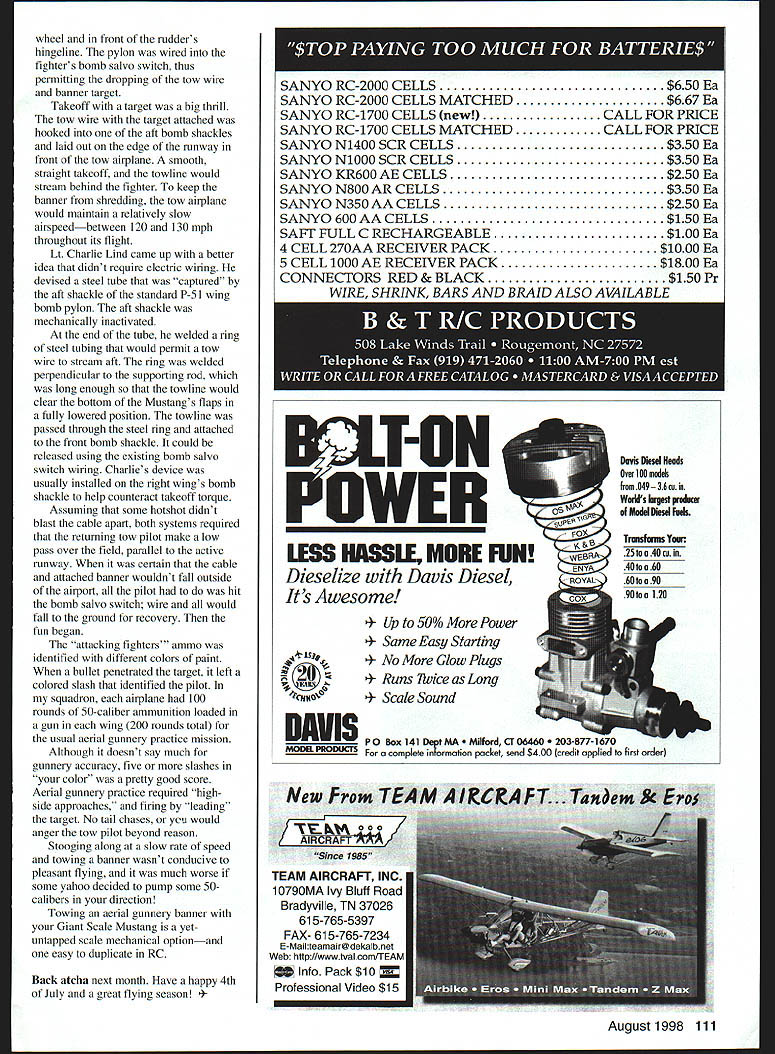
It was Otto's first Giant, and it was truly a learning exercise. He optimistically chose a Fox .60 as a power plant, but the seven-foot span, 13-pound model was barely able to make it into the air. The 3/4-inch spruce wing spar and a pound of Williams Bros. six-inch wheels were almost too much for the Fox. Taking the bull by the horns, Otto swapped in a Fox .78, but the extra power barely improved the model's flight characteristics, which were still marginal.
Ultimately Otto passed the Pete on to Dan Rose, who really made it fly. Dan stuck a Saito 90 four-stroke in the aircraft's nose and equipped it with a 14 x 5 propeller.
According to Otto, the Pietenpol model is neutrally stable; it goes where you point it. He notes that aileron differential is a must, and ailerons must be coordinated with rudder for good turns. On the positive side, he notes that making a scale representation of a Ford four-banger that powered many Petes is fun and relatively easy to construct.
Otto's prototype model scored a respectable 98.5 points when it was scale judged at an Old Rhinebeck Golden Era contest.
RC simulator upgrade
It was inevitable! The old 486 computer that I've been using for many years was getting rather creaky. The hard drive was filling up alarmingly fast, what with the bulk of many current computer programs. So I took the bull by the horns, figuratively speaking, and replaced all the electronics at the old manse.
However, I had an ulterior motive for the update; I wanted a machine that would handle a good RC simulator. After a modicum of research I chose the Great Planes version, and it turned out to be a whiz-dinger.
Great Planes' simulator comes with a modified Futaba "transmitter" that plugs into the local computer's game port. The software for the program comes on a CD-ROM, and the whole thing is designed to work with Windows 95. It's a true 32-bit program. The program disk contains a most comprehensive 73-page instructional manual that prints out in color if you have a color printer.
The designed-in models range from an RC trainer to a Giant Scale P-51 with retracts and flaps. They may be modified, however, to represent your latest model's flying characteristics. The program provides photographic backgrounds for five different Northwest U.S. locations, and if you have the necessary equipment, provides "3-D texture" to the background.
One of the really neat features of the Great Planes RC simulator is that it can "put you in the cockpit" of the model you've selected to fly, and it provides Doppler sound of the model's engine to add to the realism. It's a really sporty RC simulator — and it easily replaced Solitaire as the "game" of choice around here. I got mine from Tower Hobbies for a reasonable $199.95.
Model airplane web site
If you have access to the Internet and appreciate "model airplane black humor," take a look at the "model airplane" Web site at: http://www.email.net/work-well-together.html (Include the hyphens as noted.)
Air gunnery targets and towing devices
Have you ever seen air gunnery targets modeled? During WWII they were necessary for training fighter pilots. The British used Fairey Battles to tow targets for Spitfire and Hurricane drivers. In the U.S., a fighter squadron would be going first class if it had a Martin B-26 to pull its banners. In many instances it was up to the fighter squadron to tow its own targets.
Ingenuity and horseback engineering was expended in designing a towing system so that a Mustang could be used as a tow airplane. Modeling a towing device would be extremely obvious on a Giant so equipped. A couple of devices were used for towing, both of which used a modified P-51 bomb pylon. The "approved school solution" for P-51 target towing took advantage of an existing lifting hole that was built through the rear fuselage.
A steel tube was passed through the hole. Attached to each end of it was another tube that was bent to follow the contour of the rear fuselage. These tubes were attached to a "spare" bomb pylon that was clipped to the bottom of the fuselage behind the retractable tailwheel and in front of the rudder’s hingeline. The pylon was wired into the fighter’s bomb salvo switch, thus permitting the dropping of the tow wire and banner target.
Takeoff with a target was a big thrill. The tow wire with the target attached was hooked into one of the aft bomb shackles and laid out on the edge of the runway in front of the tow airplane. A smooth, straight takeoff, and the towline would stream behind the fighter. To keep the banner from shredding, the tow airplane would maintain a relatively slow airspeed—between 120 and 130 mph throughout its flight.
Lt. Charlie Lind came up with a better idea that didn’t require electric wiring. He devised a steel tube that was "captured" by the aft shackle of the standard P-51 wing bomb pylon. The aft shackle was mechanically inactivated.
At the end of the tube, he welded a ring of steel tubing that would permit a tow wire to stream aft. The ring was welded perpendicular to the supporting rod, which was long enough so that the towline would clear the bottom of the Mustang’s flaps in a fully lowered position. The towline was passed through the steel ring and attached to the front bomb shackle. It could be released using the existing bomb salvo switch wiring. Charlie’s device was usually installed on the right wing’s bomb shackle to help counteract takeoff torque.
Assuming that some hotshot didn’t blast the cable apart, both systems required that the returning tow pilot make a low pass over the field, parallel to the active runway. When it was certain that the cable and attached banner wouldn’t fall outside of the airport, all the pilot had to do was hit the bomb salvo switch; wire and all would fall to the ground for recovery. Then the fun began.
The "attacking fighters" ammo was identified with different colors of paint. When a bullet penetrated the target, it left a colored slash that identified the pilot. In my squadron, each airplane had 100 rounds of .50-caliber ammunition loaded in a gun in each wing (200 rounds total) for the usual aerial gunnery practice mission.
Although it doesn’t say much for gunnery accuracy, five or more slashes in "your color" was a pretty good score. Aerial gunnery practice required "high-side approaches," and firing by "leading" the target. No tail chases, or you would anger the tow pilot beyond reason.
Stooping along at a slow rate of speed and towing a banner wasn’t conducive to pleasant flying, and it was much worse if some yahoo decided to pump some .50-calibers in your direction!
Towing an aerial gunnery banner with your Giant Scale Mustang is a yet-untapped scale mechanical option — and one easy to duplicate in RC.
Back atcha next month. Have a happy 4th of July and a great flying season!
Transcribed from original scans by AI. Minor OCR errors may remain.

