
RADIO CONTROL GIANTS
John A. de Vries 4610 Moffat Lane, Colorado Springs, CO 80915
It was my good fortune to meet Dave Reid in the ’80s at one of the STAR (Southern Tier Aero Radio Society) fly-ins at Olean, New York. Dave was getting started in the radio control (RC) business, and was featuring his great rubber-like 1/4-scale pilot figures. They were (and still are) realistic and included a host of accessories, such as caps and sunglasses.
Dave and I have kept in touch through the years. I purchased a precut kit of Don Neill’s Folkerts SK-4 from him. I had a set of plans and the fiberglass components for the Thompson Trophy winner, and Dave provided the balsa parts.
Cheetah Engines
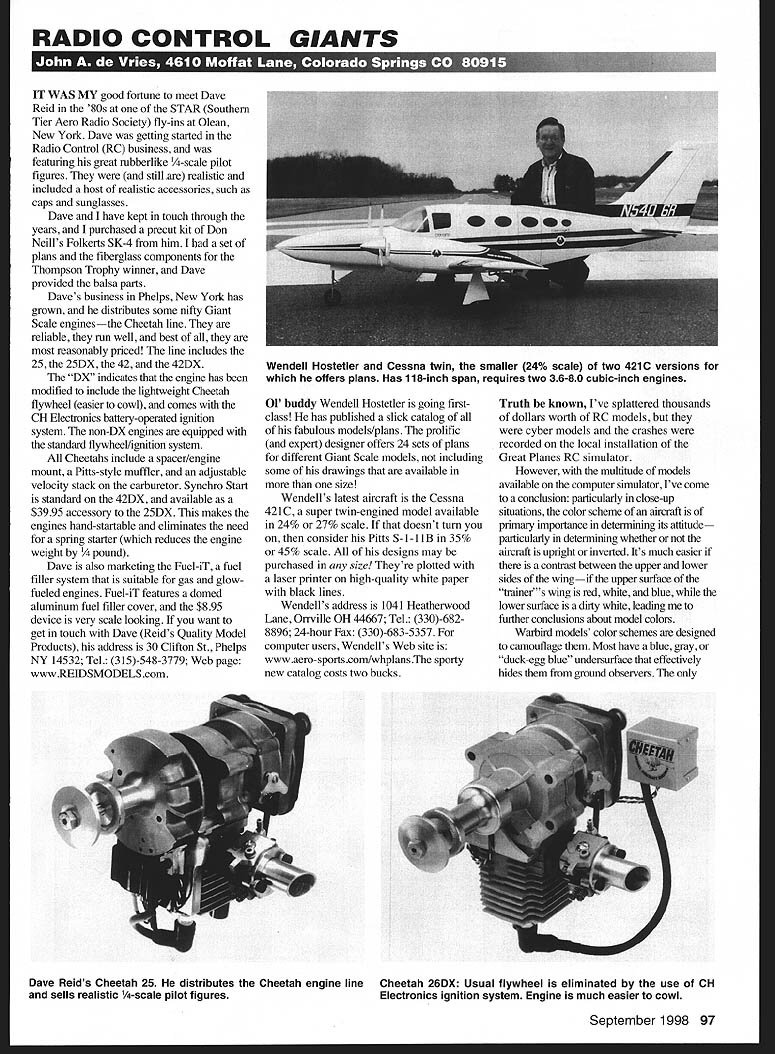
Dave’s business in Phelps, New York has grown, and he distributes a nifty line of giant-scale engines — the Cheetah line. They are reliable, run well, and are reasonably priced. The line includes:
- Cheetah 25
- Cheetah 25DX
- Cheetah 42
- Cheetah 42DX
The “DX” indicates the engine has been modified to include the lightweight Cheetah flywheel (easier to cowl) and comes with the CH Electronics battery-operated ignition system. The non-DX engines are equipped with the standard flywheel/ignition system.
All Cheetahs include a spacer/engine mount, a Pitus-style muffler, and an adjustable velocity stack on the carburetor. Synchro Start is standard on the 42DX and available as a $39.95 accessory for the 25DX. Synchro Start makes the engines hand-startable and eliminates the need for a spring starter (which reduces engine weight by about 1/4 pound).
Fuel-iT
Dave is also marketing the Fuel-iT, a fuel filler system suitable for gas and glow-fueled engines. Fuel-iT features a domed aluminum fuel filler cover. The $8.95 device is very scale-looking.
Contact for Reid’s Quality Model Products: 30 Clifton St., Phelps, NY 14532 Tel: (315) 548-3779 Web: www.reidsmodels.com
Wendell Hostetler Plans
Ol’ buddy Wendell Hostetler is going first-class! He has published a slick catalog of all of his fabulous models and plans. The prolific (and expert) designer offers 24 sets of plans for different giant-scale models, not including some drawings that are available in more than one size.
Wendell’s latest aircraft is the Cessna 421C, a super twin available in 24% or 27% scale. If that doesn’t appeal, consider his Pitts S-1-11B in 35% or 45% scale. All of his designs may be purchased in any size and are plotted with a laser printer on high-quality white paper with black lines.
Contact for Wendell Hostetler: 1041 Heatherwood Lane, Orrville, OH 44667 Tel: (330) 682-8896 24-hour Fax: (330) 683-5357 Web: www.aero-sports.com/whplans
The sporty new catalog costs two dollars.
Visibility and Color Schemes
Truth be known, I’ve splattered thousands of dollars worth of RC models, but they were cyber models and the crashes were recorded on the local installation of the Great Planes RC simulator.
With the multitude of models available on the computer simulator, I’ve come to a conclusion: in close-up situations the color scheme of an aircraft is of primary importance in determining its attitude — especially whether the aircraft is upright or inverted. It’s much easier if there is contrast between the upper and lower sides of the wing. For example, if the upper surface of a trainer wing is red, white, and blue while the lower surface is a dirty white, the leading edge is easier to see and you can determine orientation more readily.
Warbird color schemes are often designed to camouflage them. Most have a blue-gray, “duck-egg” blue undersurface that effectively hides them from ground observers. A redeeming feature on some warbirds is the use of black-and-white “invasion stripes” that circle the wings and fuselage, providing a modicum of visibility and helping attitude determination.
The best paint jobs show up on scale models. On acrobatic aircraft, sunburst designs on upper wing surfaces are particularly good at keeping track of airborne RC models. Civilian aircraft often have underwing license numbers which are much easier to see, and full-scale racing aircraft usually feature large race numbers for visibility.
Until I started using the RC simulator, my favorite model color scheme was two-tone blue, with the undersurface being the darker color. It’s a shame that on a sunny day, when trying to keep the model upright, things tend to disappear mid-roll. What all of this leads to is another factor when deciding to build a specific giant-scale model: visibility. You may have the “hots” for a particular aircraft, but if your scale documentation shows prototypes in color schemes designed to render them “invisible,” that’s bad news when it comes to flying your model.
Recommendations:
- If your desired model is a warbird, try to find one that includes invasion stripes in its color scheme.
- Better yet, choose WWII fighters converted for Reno racing; their flamboyant paint jobs make them much easier to follow.
- Consider a giant-scale model that duplicates a colorful and highly visible paint scheme — it’s worth the effort and may prevent “losing” the model in the real world.
Batteries and Charging
I’m not a fan of battery chargers (one usually comes with your radio set and plugs into a wall outlet). Two leads come out of the charger — one for your transmitter pack and the other for your airborne receiver battery. Given the reliability of today’s radios, airborne system failure is almost a thing of the past, but airborne (or transmitter) batteries remain a concern.
Giant-scale servos absorb a great amount of current and can quickly drain the 500–600 mAh airborne battery packs that often come with radios. That’s why most giant-scalers substitute a 1,200 or 1,800 mAh battery pack in their models. However, I’ll bet nine out of 10 modelers never bother to check the output voltage of their radio batteries.
Fully charged Ni-Cd cells provide about 1.2–1.4 volts. Unless you have a charger/discharger that measures battery capacity, you run the risk of midflight battery failure. An inexpensive voltmeter is a good investment to check your flight and transmitter packs before a day of flying. Since the packs are usually wired in series, the voltmeter should read approximately 1.2 volts multiplied by the number of individual cells.
Typical targets:
- Transmitters: 10.0–10.4 volts (usually 8–9 cells, check your system)
- Airborne packs: 4.8–5.0 volts (usually 4 cells)
If the numbers don’t check out, you probably have a bad cell in your battery. Replace the pack (or solder in a new cell) before flying. Even purchasing a new battery pack is inexpensive insurance compared to the investment you have in your model.
Fly-in Announcements and Timing
It’s a frustrating situation: I get many fly-in announcements from well-meaning contest directors, but 90% of them come too late to get a plug in the column. This column will be in the September issue of Model Aviation, which will arrive in your mailbox some time in July. However, I’m writing it in April, and it will be mailed to Muncie on the 25th of this month — that amounts to at least 3½ months of lead time. Unless I have the information well in advance, it’s impossible to include events in a timely fashion.
I had two fascinating announcements in this month’s mail for giant-scale fly-ins in June and July. Both were probably great events, but other than being listed in the event schedule in the back of the magazine, I couldn’t highlight them. Give me four months (or more) notice, and I’ll try to let everybody know about your giant-scale get-together. Model photographs are always welcome.
Contact
If I can help you with a modeling problem, the local e-mail address is: oliter@aol.com. With all the “spamming” that’s cluttering the web, be sure to identify your communications as model airplane-related. I delete ads for get-rich-quick schemes and “sporty photographs” without bothering to read them.
I trust that you’re having a fun time during the summer flying season!
Transcribed from original scans by AI. Minor OCR errors may remain.

