
Radio Control: Giants
John A. de Vries
4610 Moffat Lane, Colorado Springs, CO 80915
JERRY SMARTT is absolutely fascinated with big Radio Control (RC) models. He figures that aircraft with "only" 84-inch wingspans (which are certainly IMAA [International Miniature Aircraft Association]-legal) are "schoolyard scale." Nothing in his fleet spans less than nine feet. Jerry is from Warsaw, Missouri, and he builds and flies gigantic models—not to say that they're heavy monsters.
Sopwith Baby project
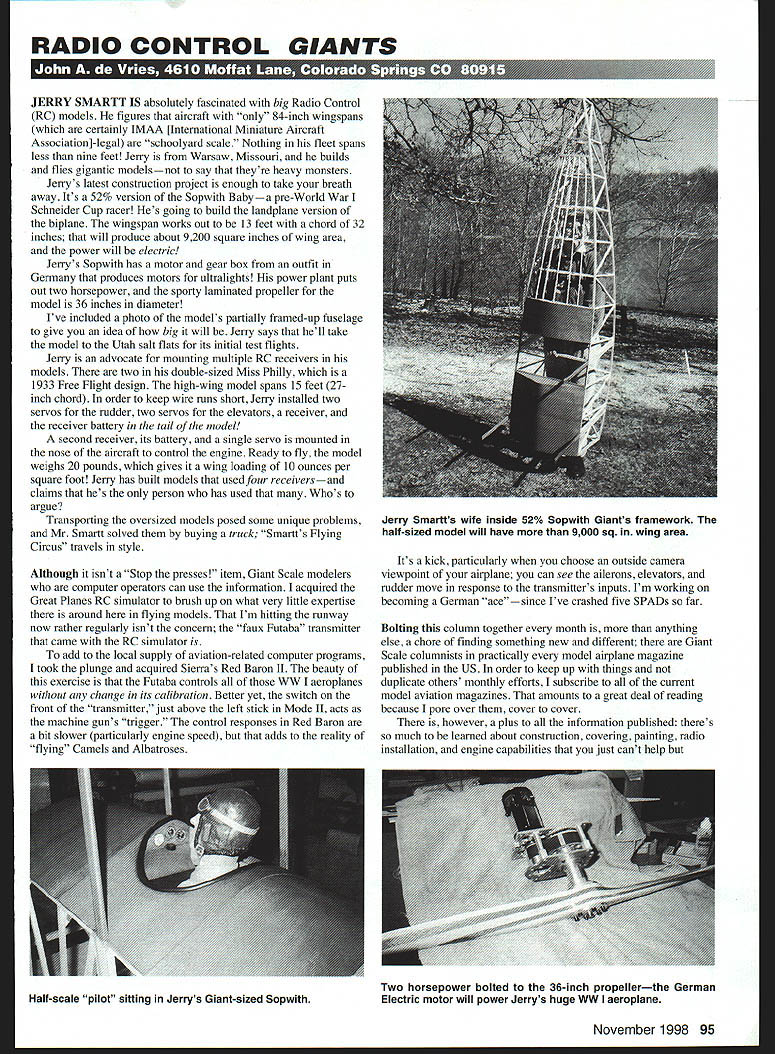
Jerry's latest construction project is enough to take your breath away. It's a 52% version of the Sopwith Baby—a pre-World War I Schneider Cup racer. He's going to build the landplane version of the biplane. The wingspan works out to be 13 feet with a chord of 32 inches; that will produce about 9,200 square inches of wing area, and the power will be electric.
Jerry's Sopwith has a motor and gearbox from an outfit in Germany that produces motors for ultralights. His powerplant puts out two horsepower, and the sporty laminated propeller for the model is 36 inches in diameter.
I've included a photo of the model's partially framed-up fuselage to give you an idea of how big it will be. Jerry says that he'll take the model to the Utah salt flats for its initial test flights.
Multiple receivers and Miss Philly
Jerry is an advocate for mounting multiple RC receivers in his models. There are two in his double-sized Miss Philly, which is a 1933 Free Flight design. The high-wing model spans 15 feet (27-inch chord). In order to keep wire runs short, Jerry installed the following in the tail of the model:
- two servos for the rudder
- two servos for the elevators
- a receiver
- the receiver battery
A second receiver, its battery, and a single servo are mounted in the nose of the aircraft to control the engine. Ready to fly, the model weighs 20 pounds, which gives it a wing loading of about 10 ounces per square foot. Jerry has built models that used four receivers—and claims that he's the only person who has used that many.
Transport
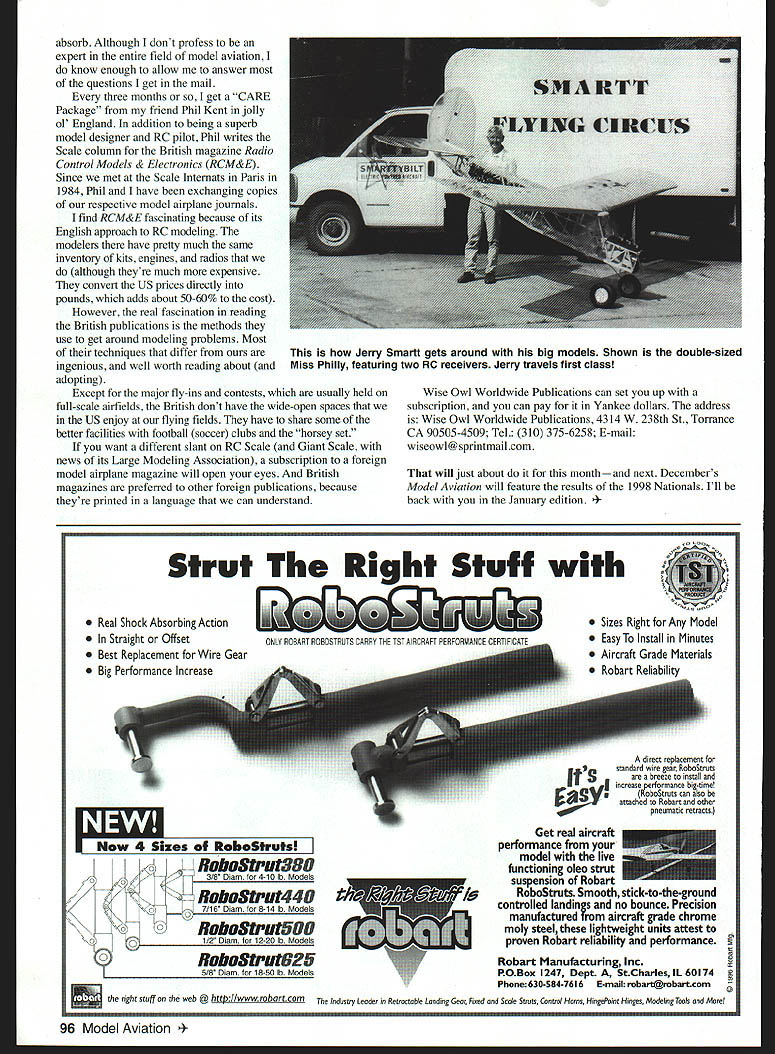
Transporting the oversized models posed some unique problems, and Mr. Smartt solved them by buying a truck. "Smartt's Flying Circus" travels in style.
Computer simulators and practice
Although it isn't a "stop the presses!" item, Giant Scale modelers who are computer operators can use the information. I acquired the Great Planes RC simulator to brush up on what very little expertise there is around here in flying models. That I'm hitting the runway now rather regularly isn't the concern; the "faux Futaba" transmitter that came with the RC simulator is.
To add to the local supply of aviation-related computer programs, I took the plunge and acquired Sierra's Red Baron II. The beauty of this exercise is that the Futaba controls all of those WW I aeroplanes without any change in its calibration. Better yet, the switch on the front of the "transmitter," just above the left stick in Mode II, acts as the machine gun's "trigger." The control responses in Red Baron are a bit slower (particularly engine speed), but that adds to the reality of "flying" Camels and Albatrosses.
It's a kick, particularly when you choose an outside camera viewpoint of your airplane; you can see the ailerons, elevators, and rudder move in response to the transmitter's inputs. I'm working on becoming a German ace—since I've crashed five SPADs so far.
Research, reading, and international magazines
Bolting this column together every month is, more than anything else, a chore of finding something new and different; there are Giant Scale columnists in practically every model airplane magazine published in the U.S. In order to keep up with things and not duplicate others' monthly efforts, I subscribe to all of the current model aviation magazines. That amounts to a great deal of reading because I pore over them, cover to cover.
There is, however, a plus to all the information published: there's so much to be learned about construction, covering, painting, radio installation, and engine capabilities that you just can't help but absorb. Although I don't profess to be an expert in the entire field of model aviation, I do know enough to allow me to answer most of the questions I get in the mail.
Every three months or so, I get a "CARE Package" from my friend Phil Kent in jolly ol' England. In addition to being a superb model designer and RC pilot, Phil writes the Scale column for the British magazine Radio Control Models & Electronics (RCM&E). Since we met at the Scale Internationals in Paris in 1984, Phil and I have been exchanging copies of our respective model airplane journals.
I find RCM&E fascinating because of its English approach to RC modeling. The modelers there have pretty much the same inventory of kits, engines, and radios that we do (although they're much more expensive—the publishers often convert U.S. prices directly into pounds, which adds about 50–60% to the cost).
The real fascination in reading the British publications is the methods they use to get around modeling problems. Most of their techniques that differ from ours are ingenious and well worth reading about (and adopting).
Except for the major fly-ins and contests, which are usually held on full-scale airfields, the British don't have the wide-open spaces that we in the U.S. enjoy at our flying fields. They have to share some of the better facilities with football (soccer) clubs and the "horsey set."
If you want a different slant on RC Scale (and Giant Scale, with news of its Large Modeling Association), a subscription to a foreign model airplane magazine will open your eyes. British magazines are preferred to other foreign publications because they're printed in a language that we can understand.
Wise Owl Worldwide Publications can set you up with a subscription, and you can pay for it in Yankee dollars. The address is:
- Wise Owl Worldwide Publications
- 4314 W. 238th St., Torrance, CA 90505-4509
- Tel.: (310) 375-6258
- E-mail: wiseowl@sprimalink.com
That will just about do it for this month—and next. December's Model Aviation will feature the results of the 1998 Nationals. I'll be back with you in the January edition.
Transcribed from original scans by AI. Minor OCR errors may remain.

