
RADIO CONTROL GIANTS
John A. de Vries 4610 Moffat Lane, Colorado Springs, CO 80915
Mail and opening
It sure has piled up—the mail, that is. Since I had a month off (because the December Model Aviation was devoted to the Nationals) the mailbox has been clogged, so let's get at it.
Brian Allen — Interstate L-6 Cadet giant
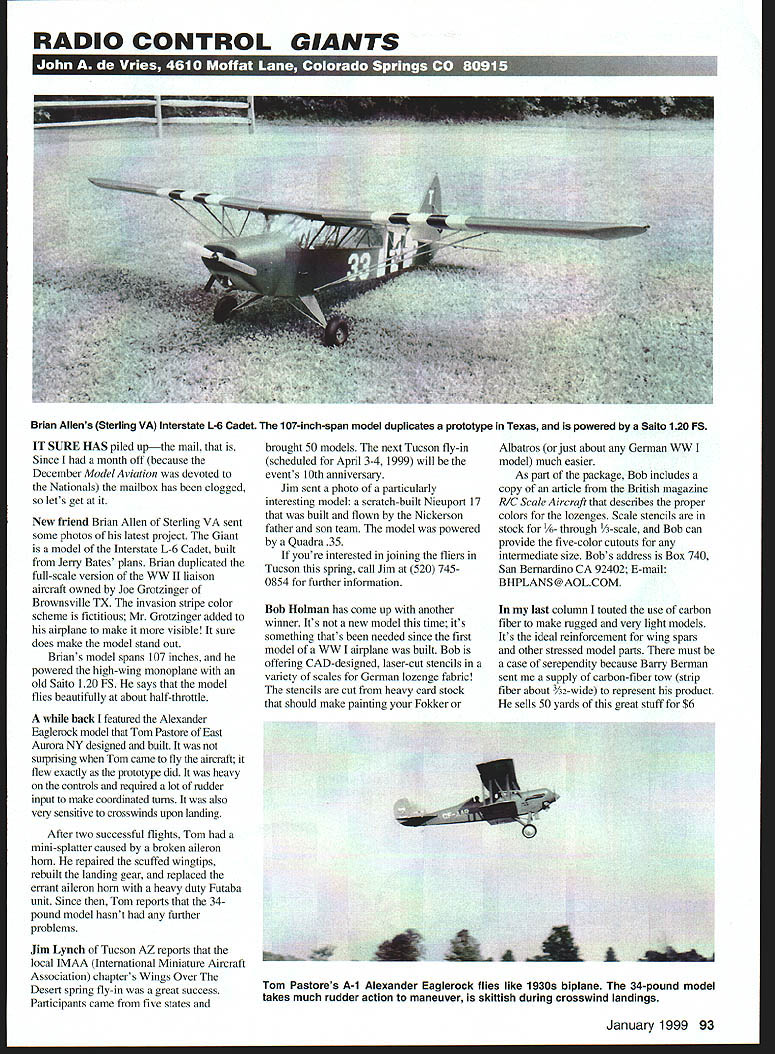
New friend Brian Allen of Sterling, VA, sent photos of his latest project. The Giant is a model of the Interstate L-6 Cadet, built from Jerry Bates' plans. Brian duplicated the full-scale WWII liaison aircraft owned by Joe Grotzinger of Brownsville, TX. The invasion-stripe color scheme is fictitious; Mr. Grotzinger added it to make the airplane more visible. It sure does make the model stand out.
Brian's model spans 107 inches, and he powered the high-wing monoplane with an old Saito 1.20 FS. He says the model flies beautifully at about half-throttle.
Alexander Eaglerock — Tom Pastore
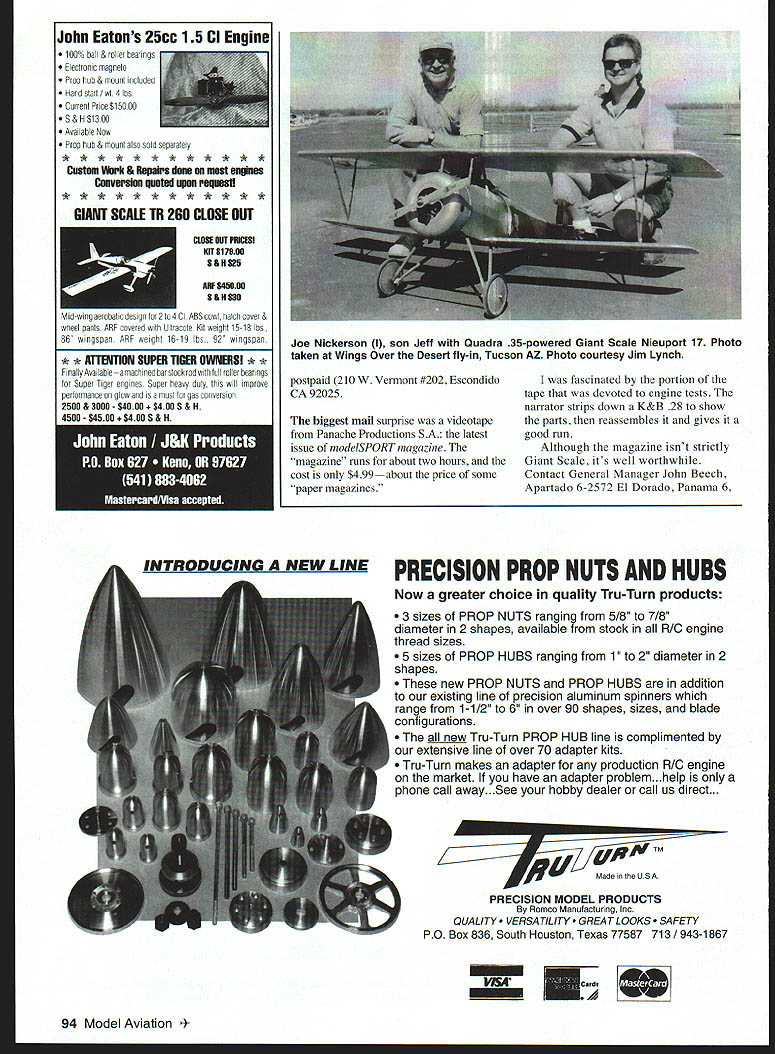
A while back I featured the Alexander Eaglerock model that Tom Pastore of East Aurora, NY, designed and built. It flew exactly as the prototype did: heavy on the controls and requiring a lot of rudder input to make coordinated turns. It was also very sensitive to crosswinds on landing.
After two successful flights, Tom had a mini-splatter caused by a broken aileron horn. He repaired the scuffed wingtips, rebuilt the landing gear, and replaced the errant aileron horn with a heavy-duty Futaba unit. Since then, Tom reports that the 34-pound model hasn't had any further problems.
Wings Over The Desert — Jim Lynch
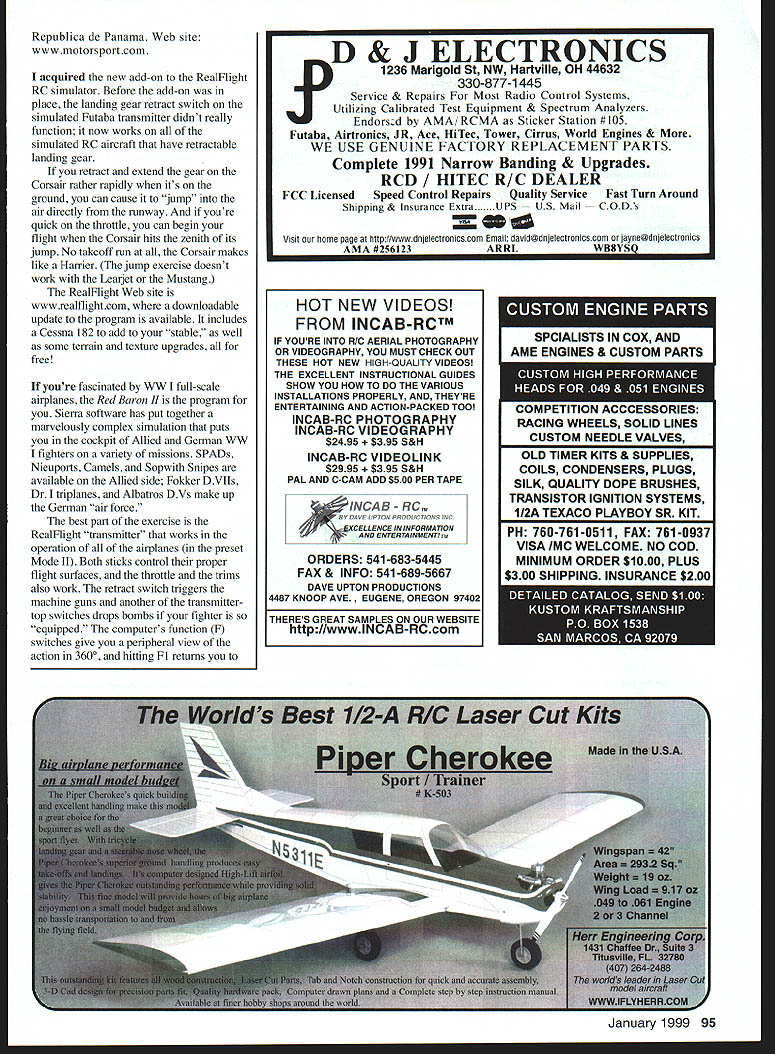
Jim Lynch of Tucson, AZ reports that the local IMAA (International Miniature Aircraft Association) chapter's Wings Over The Desert spring fly-in was a great success. Participants came from five states and brought 50 models. The next Tucson fly-in (scheduled for April 3–4, 1999) will be the event's 10th anniversary.
Jim sent a photo of an interesting scratch-built Nieuport 17, built and flown by the Nickerson father-and-son team. The model was powered by a Quadra .35.
If you're interested in joining the fliers in Tucson this spring, call Jim at (520) 745-0854 for further information.
German lozenge stencils — Bob Holman
Bob Holman has come up with another winner. It's not a new model this time; it's something that's been needed since the first WW I models were built. Bob is offering CAD-designed, laser-cut stencils in a variety of scales for German lozenge fabric. The stencils are cut from heavy card stock, which should make painting your Fokker or Albatros (or just about any German WW I model) much easier.
As part of the package, Bob includes a copy of an article from the British magazine R/C Scale Aircraft that describes the proper colors for the lozenges. Scale stencils are in stock for 1/2- through 1/4-scale, and Bob can provide five-color cutouts for any intermediate size.
Bob Holman Box 740, San Bernardino, CA 92402 E-mail: BHPLANS@AOL.COM
Carbon-fiber tow — Barry Berman
In my last column I touted the use of carbon fiber to make rugged and very light models. It's ideal reinforcement for wing spars and other stressed parts. Barry Berman sent a supply of carbon-fiber tow (a strip of fiber about 3/32 inch wide) to represent the product he sells—50 yards of this great stuff for $6.
modelSPORT videotape — Panache Productions
The biggest mail surprise was a videotape from Panache Productions S.A.: the latest issue of modelSPORT magazine. The "magazine" runs for about two hours, and the cost is only $4.99—about the price of some paper magazines. I was fascinated by the portion devoted to engine tests. The narrator strips down a K&B .28 to show the parts, then reassembles it and gives it a good run.
Although the magazine isn't strictly Giant Scale, it's well worthwhile.
Contact: General Manager John Beech, Apartado 6-2572 El Dorado, Panama 6.
RealFlight RC simulator add-on
I acquired the new add-on to the RealFlight RC simulator. Before the add-on, the landing-gear-retract switch on the simulated Futaba transmitter didn't really function; it now works on all simulated RC aircraft that have retractable landing gear.
If you retract and extend the gear on the Corsair rather rapidly while it's on the ground, you can cause it to "jump" into the air directly from the runway. If you're quick on the throttle, you can begin your flight when the Corsair hits the zenith of its jump. No takeoff run at all—the Corsair makes like a Harrier. (The jump exercise doesn't work with the Learjet or the Mustang.)
The RealFlight Web site is www.realflight.com, where a downloadable update to the program is available. It includes a Cessna 182 to add to your "stable," as well as terrain and texture upgrades, all for free!
Red Baron II — Sierra software
If you're fascinated by WW I full-scale airplanes, Red Baron II is the program for you. Sierra has put together a complex simulation that puts you in the cockpit of Allied and German WW I fighters on a variety of missions.
Available aircraft include:
- Allied: SPADs, Nieuports, Camels, Sopwith Snipes
- German: Fokker D.VIIs, Dr. I triplanes, Albatros D.Vs
The best part is the RealFlight-style "transmitter" that works in the operation of all of the airplanes (presently in Mode II). Both sticks control their proper flight surfaces, and the throttle and trims also work. The retract switch triggers the machine guns, and another transmitter-top switch drops bombs if your fighter is so equipped. The computer function (F) switches give you a peripheral view of the action in 360°, and hitting F1 returns you to the cockpit where all of the instruments function. Lots of fun!
Fuel-tank location and CG considerations
It would be nifty if you could position your model's fuel tank on the center of gravity (CG), but that's usually where the radio installation ends up. Things become even more complicated if you've installed a smoke-liquid tank; the fuel supply is usually tucked up somewhere just behind the firewall.
Their precise position isn't of great consequence if you're using a gas burner to motivate your model; the built-in carburetor's fuel pump allows for the "random" positioning of the fuel tank.
However, that's not so if your model is glow-plug-engine equipped. That demands that the middle of the fuel tank be approximately the same level as the needle valve (unless you have a glow fuel pump).
The location of your fuel tank (which might contain 16 to 32 ounces of fuel) has a major effect on your model's CG. Since your fuel supply will be pretty well depleted at the end of your flight, it's mandatory that you balance your model with the fuel (and smoke) tanks empty. If they're full when you set up your model's CG, you run the chance that the landing CG will be well behind its ideal position.
You can live with a forward CG for takeoff and for most maneuvers, but an aft balance might cause a snap or spin on final approach. Bad news!
Coming next month
I'll have great photos of three extra-special Giant Scale models owned by Don Hooper of Albuquerque, NM. I'll also have some interesting information concerning modifications to your digital voltmeter that will make your flight- and transmitter-battery checks much more accurate.
'Till then, keep 'em flying!
Transcribed from original scans by AI. Minor OCR errors may remain.

