

RADIO CONTROL GIANTS
John A. de Vries 4610 Moffat Lane, Colorado Springs, CO 80915
New Year Greeting
A very happy New Year to all you Giant Scalers! We may be a bit behind the power curve, but since this issue of Model Aviation will arrive in January, it's the first chance we've had to wish you the pleasantries of the season.
Don Hopper's Giant Air Force
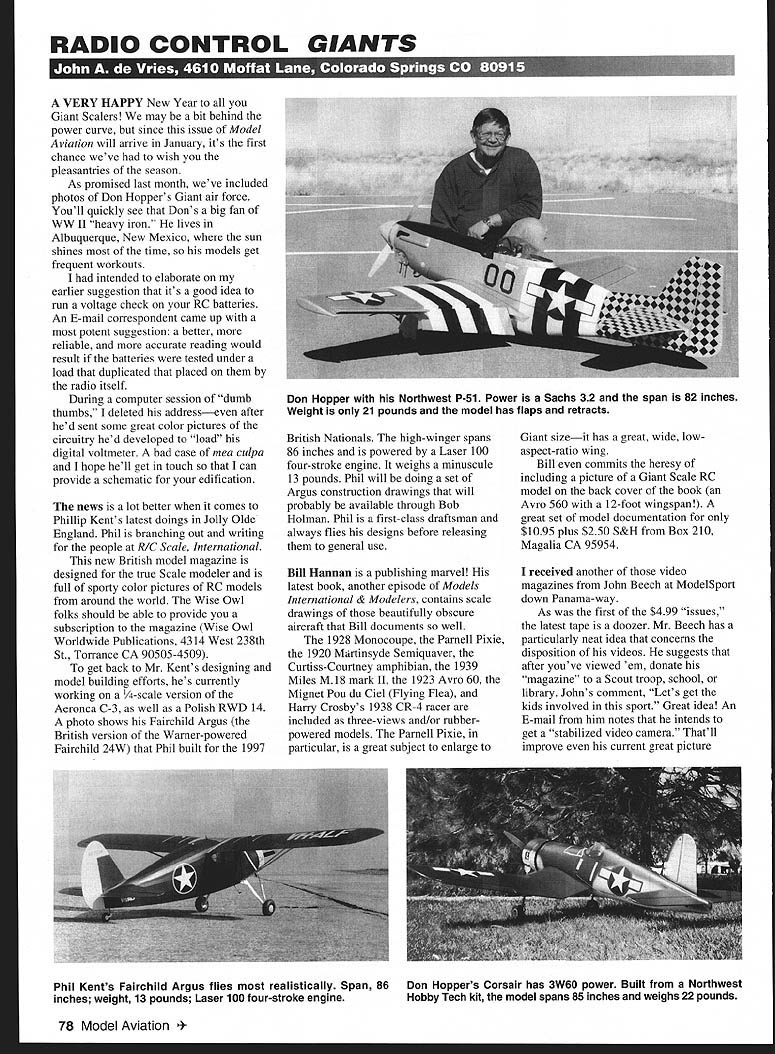
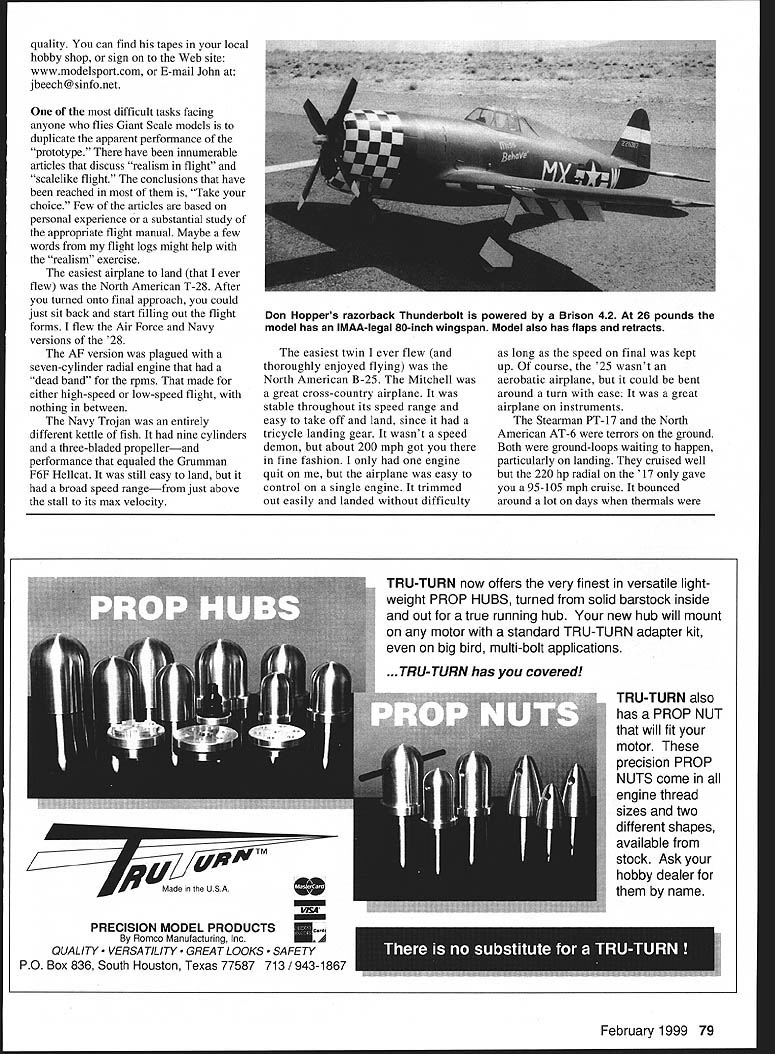
As promised last month, we've included photos of Don Hopper's Giant air force. You'll quickly see that Don's a big fan of WWII "heavy iron." He lives in Albuquerque, New Mexico, where the sun shines most of the time, so his models get frequent workouts.
Battery Voltage Testing
I had intended to elaborate on my earlier suggestion that it's a good idea to run a voltage check on your RC batteries. An e-mail correspondent came up with a most potent suggestion: a better, more reliable, and more accurate reading would result if the batteries were tested under a load that duplicated that placed on them by the radio itself.
During a computer session of "dumb thumbs," I deleted his address—even after he'd sent some great color pictures of the circuitry he'd developed to "load" his digital voltmeter. Mea culpa. I hope he'll get in touch so that I can provide a schematic for your edification.
Phil Kent and R/C Scale International
The news is a lot better when it comes to Phil Kent's latest doings in Jolly Olde England. Phil is branching out and writing for the people at R/C Scale International.
This new British model magazine is designed for the true scale modeler and is full of sporty color pictures of R/C models from around the world. The Wise Owl folks should be able to provide you a subscription to the magazine (Wise Owl Worldwide Publications, 4314 West 238th St., Torrance, CA 90505-4509).
Phil is currently working on a 1/4-scale version of the Aeronca C-3, as well as a Polish RWD 14. A photo shows his Fairchild Argus (the British version of the Warner-powered Fairchild 24W) that Phil built for the 1997 British Nationals. The high-winger spans 86 inches and is powered by a Laser 100 four-stroke engine. It weighs a minuscule 13 pounds. Phil will be doing a set of Argus construction drawings that will probably be available through Bob Holman. Phil is a first-class draftsman and always flies his designs before releasing them to general use.
Bill Hannan's Book
Bill Hannan is a publishing marvel! His latest book, another episode of Models International & Modelers, contains scale drawings of those beautifully obscure aircraft that Bill documents so well.
Included subjects (as three-views and/or rubber-powered models) are:
- 1928 Monocoupe
- Parnell Pixie
- 1920 Martinsyde Semiquaver
- Curtiss-Courtney amphibian
- 1939 Miles M.18 mark II
- 1923 Avro 60
- Mignet Pou du Ciel (Flying Flea)
- Harry Crosby's 1938 CR-4 racer
The Parnell Pixie, in particular, is a great subject to enlarge to Giant size — it has a great, wide, low-aspect-ratio wing. Bill even commits the heresy of including a picture of a Giant Scale RC model on the back cover of the book (an Avro 560 with a 12-foot wingspan!). A great set of model documentation for $109.95 plus $25.00 S&H from Box 210, Magalia, CA 95954.
ModelSport Video Magazine
I received another of those video magazines from John Beech at ModelSport down Panama-way. As was the first of the $4.99 issues, the latest tape is a doozie. Mr. Beech has a particularly neat idea that concerns the disposition of his videos: he suggests that after you've viewed them, donate his "magazine" to a Scout troop, school, or library. John's comment, "Let's get the kids involved in the sport," is a great idea! An e-mail from him notes that he intends to get a stabilized video camera. That'll improve an already great picture.
Flight Log Notes
Difficult tasks facing anyone who flies Giant Scale models is to duplicate the apparent performance of the prototype. There have been innumerable articles discussing realism and scale-like flight; conclusions have varied. Few articles are based on personal experience and substantial study of the appropriate flight manual. Maybe a few words from flight logs might help.
- North American T-28
The easiest airplane to land I ever flew was the North American T-28. After being turned onto final approach I could just sit back and start filling out flight forms. The Air Force T-28 AF version was plagued with a seven-cylinder radial engine dead band of rpms that made either high-speed or low-speed flight with nothing between. The Navy Trojan was an entirely different kettle of fish: nine cylinders and a three-bladed propeller and its performance equaled the Grumman F6F Hellcat — still easy to land over a broad speed range from just above stall to its max velocity.
- North American B-25
The easiest twin I ever flew (and thoroughly enjoyed flying) was the North American B-25. The Mitchell was a great cross-country airplane. It was stable throughout its speed range and easy to take off and land, since it had a tricycle landing gear. It wasn't a speed demon, but about 200 mph got you there in fine fashion. I only had one engine quit on me, but the airplane was easy to control on a single engine. It trimmed out easily and landed without difficulty as long as the speed on final was kept up. Of course, the '25 wasn't an aerobatic airplane, but it could be bent around a turn with ease. It was a great airplane on instruments.
- Stearman PT-17 and North American AT-6
The Stearman PT-17 and the North American AT-6 were terrors on the ground. Both were ground-loopers waiting to happen, particularly on landing. They cruised well but the 220-hp radial on the PT-17 only gave you a 95–105 mph cruise. It bounced around a lot on days when thermals were present. The AT-6 cruised about 140 indicated and was an adequate cross-country aircraft. It was a bit skittish on instruments, but if you established a 90 mph final approach, the resulting landing wasn't too difficult to control. Crosswinds were the bane of both trainers.
- Douglas A-26
I only had one flight in the Douglas A-26 and came away with a great appreciation for its performance. It was fast (it could keep up with a Mustang at the lower altitudes) and very maneuverable. I blasted along at 200+ cross-country and had only one fault: they never raised the nose above the horizon on final approach until you were ready to touch down. The A-26, with all the "garbage" (gear and flaps) hanging out, was quick to stall at approach speeds.
- Rockwell U-4 (Aero Commander) and North American T-39
The Aero Commander was purchased off the shelf, and was, for all intents and purposes, a civilian airplane. Leather seats and a complete instrument panel made flying it really comfortable. Part of the exercise was that it had civilian radios, and that confused the air traffic control folks. They operated on the VHF frequency band, but the Air Force call sign was a signal to the controllers that UHF frequencies were available. You spent half of your cross-country flights disabusing them of the radio limitations.
Aero Commanders were stable as a rock and cross-countryed at about 160 mph. Landings were a breeze (you were almost sitting on the runway, because the tricycle gear was relatively short). Good instrument aircraft.
The T-39 was the Rolls-Royce of the corporate-style jets! It borrowed its wing with the automatic-operating leading edge slats from the F-86 Sabre Jet. With the lesser power output of its much-smaller twin jet engines, it wasn't a fighter—but it flew almost as fast. Smooth 450+ mph cruising speed got you where you were going, and the pressurization system kept things at 8,000 feet, even if you were cruising above 40,000.
It was easy to fly in formation, and practically under landing was a "grease job" on its tricycle. It was good on instruments as well. A Giant Scale ducted fan model of the T-39 could be flown like a jet fighter and still be "realistic" as long as no aerobatics are attempted.
If there's a positive response to the info provided above, we'll continue with the discussion of "columnist comments" in future columns. We'll talk about the C-45s and C-47s, the L-5s and L-19s, and maybe the F-40s and F-51s.
Back with you next month. Hope that you're having a lot of fun with your winter building project—and your winter flying, if you live in more-temperate climes.
Transcribed from original scans by AI. Minor OCR errors may remain.

