
Radio Control: Giants
John A. de Vries, 4610 Moffat Lane, Colorado Springs CO 80915
Details, Details, details!
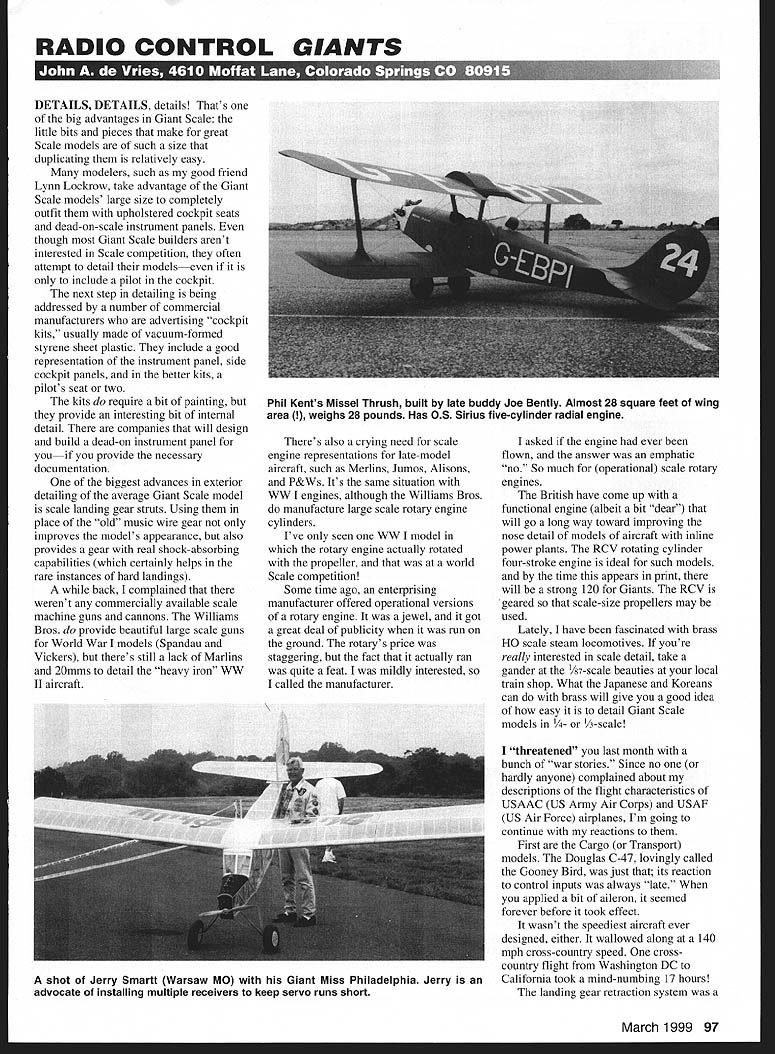
DETAILS, DETAILS, details! That's one of the big advantages in Giant Scale: the little bits and pieces that make for great scale models are of such a size that duplicating them is relatively easy.
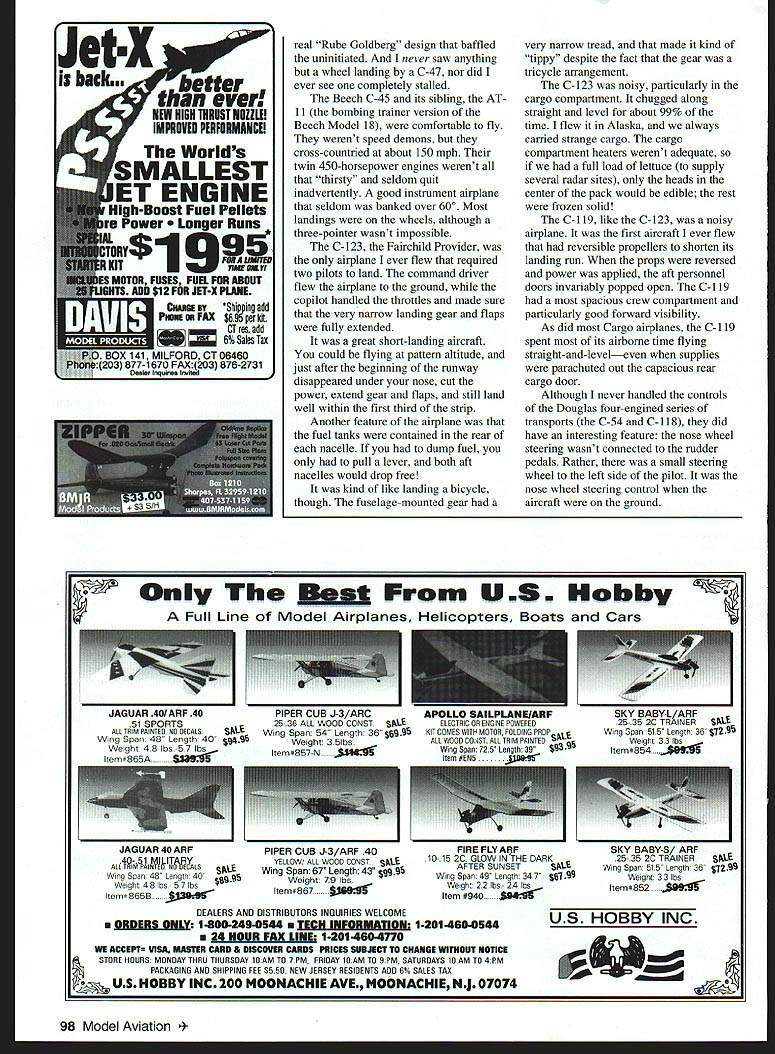
Many modelers, such as my good friend Lynn Lockrow, take advantage of Giant Scale models' large size to completely outfit them with upholstered cockpit seats and dead-on scale instrument panels. Even though most Giant Scale builders aren't interested in scale competition, they often attempt to detail their models—even if it is only to include a pilot in the cockpit.
Cockpit kits and instrument panels
The next step in detailing is being addressed by a number of commercial manufacturers who are advertising "cockpit kits," usually made of vacuum-formed styrene sheet plastic. They include a good representation of the instrument panel, side cockpit panels, and in the better kits, a pilot's seat or two.
The kits do require a bit of painting, but they provide an interesting bit of internal detail. There are companies that will design and build a dead-on instrument panel for you—if you provide the necessary documentation.
Scale landing gear and armament
One of the biggest advances in exterior detailing of the average Giant Scale model is scale landing gear struts. Using them in place of the "old" music wire gear not only improves the model's appearance, but also provides a gear with real shock-absorbing capabilities (which certainly helps in the rare instances of hard landings).
A while back, I complained that there weren't any commercially available scale machine guns and cannons. The Williams Bros. do provide beautiful large-scale guns for World War I models (Spandau and Vickers), but there's still a lack of Marlins and 20 mm guns to detail the "heavy iron" WWII aircraft.
There's also a crying need for scale engine representations for late-model aircraft, such as Merlins, Jumo engines, Alisons, and Pratt & Whitneys. It's the same situation with WWI engines, although the Williams Bros. do manufacture large-scale rotary engine cylinders.
I've only seen one WWI model in which the rotary engine actually rotated with the propeller, and that was at a world-scale competition!
Scale engines: operational examples
Some time ago, an enterprising manufacturer offered an operational version of a rotary engine. It was a jewel, and it got a great deal of publicity when it was run on the ground. The rotary's price was staggering, but the fact that it actually ran was quite a feat. I was mildly interested, so I called the manufacturer.
I asked if the engine had ever been flown, and the answer was an emphatic "no." So much for (operational) scale rotary engines.
The British have come up with a functional engine (albeit a bit expensive) that will go a long way toward improving the nose detail of models of aircraft with inline power plants. The RCV rotating-cylinder four-stroke engine is ideal for such models, and by the time this appears in print, there will be a Stag 120 for Giants. The RCV is geared so that scale-size propellers may be used.
Brass locomotives and scale inspiration
Lately, I have been fascinated with brass HO-scale steam locomotives. If you're really interested in scale detail, take a gander at the 1/8-scale beauties at your local train shop. What the Japanese and Koreans can do with brass will give you a good idea of how easy it is to detail Giant Scale models in 1/4- or 1/3-scale!
War stories
I "threatened" you last month with a bunch of "war stories." Since no one (or hardly anyone) complained about my descriptions of the flight characteristics of USAAC (US Army Air Corps) and USAF (US Air Force) airplanes, I'm going to continue with my reactions to them.
Cargo (Transport) models
First are the Cargo (or Transport) models.
#### Douglas C-47 "Gooney Bird"
The Douglas C-47, lovingly called the Gooney Bird, was just that; its reaction to control inputs was always "late." When you applied a bit of aileron, it seemed forever before it took effect.
It wasn't the speediest aircraft ever designed, either. It wallowed along at a 140-mph cross-country speed. One cross-country flight from Washington DC to California took a mind-numbing 17 hours!
The landing gear retraction system was a real "Rube Goldberg" design that baffled the uninitiated. And I never saw anything but a wheel landing by a C-47, nor did I ever see one completely stalled.
#### Beech C-45 and AT-11
The Beech C-45 and its sibling, the AT-11 (the bombing trainer version of the Beech Model 18), were comfortable to fly. They weren't speed demons, but they cross-countryed at about 150 mph. Their twin 450-horsepower engines weren't all that "thirsty" and seldom quit inadvertently. A good instrument airplane that seldom was banked over 60°. Most landings were on the wheels, although a three-pointer wasn't impossible.
#### Fairchild C-123 Provider
The C-123, the Fairchild Provider, was the only airplane I ever flew that required two pilots to land. The pilot in command flew the airplane to the ground, while the copilot handled the throttles and made sure that the very narrow landing gear and flaps were fully extended.
It was a great short-landing aircraft. You could be flying at pattern altitude, and just after the beginning of the runway it disappeared under your nose, cut the power, extend gear and flaps, and still land well within the first third of the strip.
Another feature of the airplane was that the fuel tanks were contained in the rear of each nacelle. If you had to dump fuel, you only had to pull a lever, and both fuel nacelles would drop free!
It was kind of like landing a bicycle, though. The fuselage-mounted gear had a very narrow tread, and that made it kind of "tippy" despite the fact that the gear was a tricycle arrangement.
The C-123 was noisy, particularly in the cargo compartment. It chugged along straight and level for about 99% of the time. I flew it in Alaska, and we always carried strange cargo. The cargo compartment heaters weren't adequate, so if we had a full load of lettuce (to supply several radar sites), only the heads in the center of the pack would be edible; the rest were frozen solid!
#### Fairchild C-119
The C-119, like the C-123, was a noisy airplane. It was the first aircraft I ever flew that had reversible propellers to shorten its landing run. When the props were reversed and power was applied, the aft personnel doors invariably popped open. The C-119 had a most spacious crew compartment and particularly good forward visibility.
As did most Cargo airplanes, the C-119 spent most of its time flying straight-and-level—even when supplies were parachuted out the capacious rear cargo door.
#### Douglas C-54 and C-118
Although I never handled the controls of the Douglas four-engined series of transports (the C-54 and C-118), they did have an interesting feature: the nose wheel steering wasn't connected to the rudder pedals. Rather, there was a small steering wheel to the left side of the pilot. It was the nose wheel steering control when the aircraft were on the ground. That might mean that a scale model of the big Douglases might require a separate ground-steering servo to be true scale.
Bombers and other types
In addition to the B-25 Mitchell that I detailed last month, I flew four other bomber types, and three were Boeing products:
- B-17 Flying Fortress
- B-29 Superfortress
- B-50 Superfortress
- (and the B-25 mentioned previously)
#### Boeing B-17 Flying Fortress
The only B-17 I flew really wasn't a bomber; it was configured as a reconnaissance aircraft (the F, for Photo), thus it was much lighter than the usual Fortress.
Not a speed demon (150 mph cruising speed), the B-17 was almost as bad a wallower as the C-47. After all, the aircraft was designed to be a steady bombing platform, and that's what it did—wonderfully. It took a husky pilot to wrestle it around the sky. It could be three-pointed, but if the runway was adequately long it was usually "wheeled in."
#### B-29 and B-50 Superfortresses
The Superfortresses were much more comfortable to fly. The crew space was fully pressurized so that heat and ventilation were far superior to that of the earlier Boeing bombers. The visibility was outstanding from all crew stations, and boosted controls were a big help.
The B-50 was a bit slicker than the B-29, with its more-powerful engines and taller vertical control surfaces. On takeoff, the B-29 had to be flown straight-and-level for a while to cool off the engines before a climb to altitude could begin. Not so with the B-50, with its better-designed cowling.
#### Douglas B-26
I had only one ride in a Douglas B-26, but it sure was impressive. Faster than a Mustang below 10,000 feet, it was almost as maneuverable. It was tricky to land, however; you had to maintain the approach attitude almost to the ground because the B-26 stalled immediately if the nose was raised above the horizon at approach speeds. The Douglas B-26 was a most sanitary and swift airplane!
Trainers: Vultee BT-13 and Lockheed T-33
I failed to mention two trainers last month: the Vultee BT-13 and the Lockheed T-33. The BT-13 really earned its name: Old Shakey.
When it was stalled, the clatter of the various canopy sections was almost deafening. Rumor had it that all three of the tail surfaces were interchangeable—both stabilizer halves and the fin/rudder.
Old Shakey was easy to land, what with its widely spaced main gear. The only onerous part to flying it was the fact that the flaps had to be wound up and down manually. That took considerable time and effort, even as you were trying to fly the aircraft. The BT-13, with all 450 horses up front, was the airplane that the fledgling pilot first used to fly formation.
The Lockheed T-33 retained all the ancient state-of-the-art of its single-seat predecessor: the P-80. The nose gear wasn't steerable, and differential braking was used to guide the airplane on the ground. That was fun on Alaska's iced-over runways, despite the effect of the steel wire coils that were imbedded in the main gear's tires.
Certainly not the most powerful jet airplane ever designed, the T-33's takeoff procedure was almost a given. After lining up on the runway, the brakes were locked and the engine was run up to 100%. The brakes were released slowly and equally, and the aircraft eased forward.
Even on the smoothest of runways, the T-33 rattled almost as loudly as the BT-13, but things quieted to a whisper once it broke ground.
A good straight-and-level instrument and cross-country airplane, the T-33 was not the best formation airplane ever invented. The lack of ready power made anticipating throttle movements necessary. The same was true on landing; it took so long for the engine to spool up that a decision to go around had to be made well back from the runway portal.
Aerobatics in the T-33 were smooth and easy; most of them were accomplished with your feet flat on the cockpit floor.
So much for war stories. There are more, but they'll have to wait until next month. In the interim, please don't roll or loop your model B-17s, or try any sharp turns in your model Gooney Bird. Keep your wings level, even after touchdown, in your miniature C-123, and glue the crew doors shut on your C-119. See ya next month.
Transcribed from original scans by AI. Minor OCR errors may remain.

