
Radio Control: Giants
John A. de Vries
4610 Moffat Lane Colorado Springs, CO 80915
Tail-wheel steering
Last month, tail skids; this month, tail wheels. If you were with us in the August issue, you'll remember that, beginning in the 1930s, tail wheels began to replace tail skids as grass airports gave way to paved runways. Concurrent with the use of wheels at the back end of tail-draggers, mechanisms were developed to steer airplanes as they taxied. Certainly aircraft became substantially more controllable on the ground—and wingwalkers became an endangered species.
Although tail wheels were a vast improvement over the skids they replaced, they were not without their own problems. The same difficulties, particularly during takeoff and landing, are found in scale models of "birds" (aircraft) from the Golden Age of aviation. Steerable tail wheels were (and are) mechanically connected to the rudder. However, when both wheel and rudder are given the same degree of movement, ground steering is often too sensitive for good directional control. Aircraft engineers solved the problem in two ways that may be used by Giant Scale model builders.
- Engineers restricted the movement of the tail wheel. The rear roller of a P-51 Mustang, for example, was limited to six degrees right and left under normal taxiing conditions.
- Engineers designed either manual or semiautomatic tail wheel locks. When a manual tail wheel lock was used, the pilot flipped a lever that centered the tail wheel and locked it in place. It was applied when the craft was lined up with the runway for takeoff and left locked for the expected landing runout. The C-47 (Gooney Bird) had a manual tail wheel lock.
Semiautomatic tail wheel locks were connected to the control system by any of several different methods. For example, as long as the P-51's control stick was in neutral or aft of neutral, tail wheel movement was restricted. Pushing the stick forward of neutral unlocked the tail wheel and made it full-swiveling for maneuvering at very slow taxi speeds. In the AT-6, the tail wheel was restricted until full rudder was applied and the brake tapped.
The moral of this story: to ensure good ground handling of your Giant model, consider building a tail wheel control system that restricts tail wheel movement to less than that required by the rudder. Two techniques have been used to accomplish this purpose. Either reduce tail wheel travel by using slightly larger control horns on the steering mechanism than you do for the rudder, or use separate rudder and tail wheel servos that are "Y'd" from the rudder servo plug on your receiver. If you take this precaution, your takeoffs will be straighter—as will your landing runs.
Books for beginners
It's difficult for yours truly to envision the problems that beset a beginner entering the Giant Scale hobby. After 50-some years hacking balsa and chewing glue off my fingers, I have to remind myself continually that not everybody started out with 10-cent Comet rubber-powered kits or Hawk solid models.
Few of today's modelers have built Gas Free-Flights or progressed through UControl to single-channel radios with escapement-actuated controls. Happily, there are two "Giants" who have considered the complexities facing present-day RC beginners and have written definitive books to help neophytes along.
- Dr. D.B. "Doc" Mathews — Getting Started, R/C Kit Builder's Guide for Ace R/C (116 W. 19th St., P.O. Box 511, Higginsville, MO 64037). It is included in Ace's Whiz 40 kit and is available separately for $5.95. The book is a comprehensive compendium of the tools, materials, and techniques for building and flying R/C models. A raw R/C beginner who reads and follows Doc's instructions will be rewarded with a flyable trainer.
- Dick Phillips — Building Big Is Beautiful, aimed specifically at the Giant Scale builder/flier. Available from ViP Publishers, P.O. Box 16103, Colorado Springs, CO 80935, for $9.95 plus $2.50 postage and handling. Building Big assumes that the beginner has built and flown a couple of R/C kit models—the situation someone would be in after absorbing Doc Mathews's volume.
If you're new to R/C and Giant Scale modeling, acquiring both Getting Started and Building Big Is Beautiful will not only answer many of your basic modeling questions but also put you on the right track for successful model building and flying.
Hostetler Cessna 150 plans
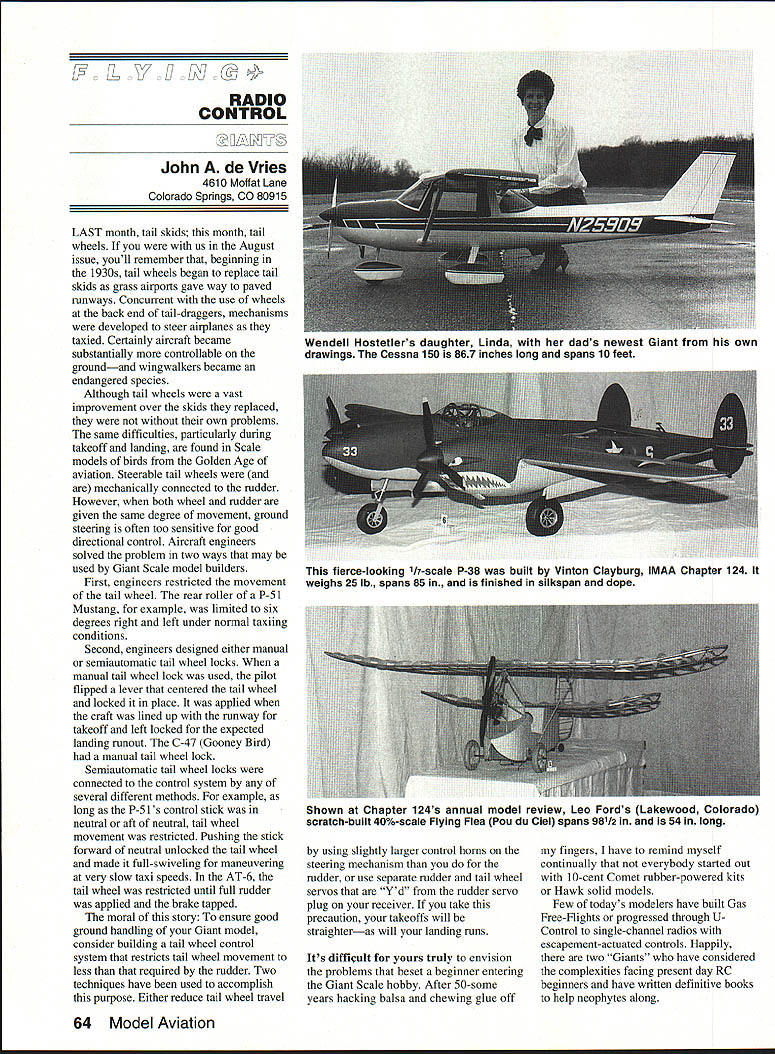
Wendell's at it again—the Hostetler drawing board, that is. He's come up with a doozy of a Giant Scale model: the ubiquitous Cessna 150, which can be found at practically any airport in the country.
Wendell's drawings include details for the 152 and the Cessna Aerobat as well—a three-in-one set of plans. The 30%-scale model spans 10 feet, is 6 ft. 7 in. long, and should weigh between 24 and 26 lb., ready to fly. A two- to four-hp engine should power the high-winger in realistic fashion.
To order:
- Contact Wendell at 1041 Heatherwood Lane, Orrville, OH 44667 (for orders only, call 1-800-232-3573).
- The Hostetler Cessna 150 plans cost $29.50 plus $3.50 postage and handling.
- Fiberglass components and aluminum gear are available for the 150.
Modeler's Choice paint
I received a fascinating page sheet from Modeler's Choice. Dick Elew is the president of this outfit, which produces acrylic enamel paints for models. The basic line includes 16 solid colors, eight metallics, plus silver and gold metal flake. Many of these match available film coverings. The color chips are gorgeous.
Modeler's Choice can produce a paint to match any color. The company has a computer mix facility and can duplicate any hue precisely—important to the discriminating Scale modeler.
The paint is a two-part formula: one ounce of activator to eight ounces of paint plus 20% thinner, and you're ready to spray. Modeler's Choice paint has a 15-minute tack time and can be taped for a second color in eight hours. It can be sanded in 10 hours and is completely cured in 72 hours.
Contact Modeler's Choice at:
- 665 Barbara Place, Mandeville, LA 70448
- Telephone: (504) 624-4804
QSAA fly-in
Roger Taylor, president of the QSAA, wrote to announce the 1992 fly-in schedule. The dates are October 15 through 18. The static display (October 15) will be located at the Nevada Palace (a new venue—in Las Vegas, Nevada), as will be the awards banquet on the 17th. Roger noted that the earlier-than-usual time frame was chosen to accommodate other RC events in the Vegas area.
Radio cradles
There are radio cradles, and then there are radio cradles. It takes real genius to develop one that is as simple as well as utilitarian. A.J. Products has come up with one that supports an RC transmitter in both vertical and horizontal positions on the ground while you're cranking your Giant bird.
Andy and Jeff (of A.J.) have included a capability in their plastic-covered, aluminum cradle that makes their cradle unique: a couple of integral hooks, together with your transmitter neck strap, turn the cradle into an almost weightless (two-ounce) transmitter tray. You can have fingertip control without having to hang onto the transmitter box to stabilize it.
Ordering information:
- A.J. Products, P.O. Box 54025, Cincinnati, OH 45254-0025
- Price: $9.95 plus postage and handling
- Information: Andy Fehrenbach at (513) 271-8429
Remember—flying safely is the name of the game!
Transcribed from original scans by AI. Minor OCR errors may remain.

