
Radio Control: Giants
By John A. de Vries
4610 Moffat Lane, Colorado Springs, CO 80915
Last month I spent most of my type space discussing the detailing of Giant Scale models. Exterior and interior detailing must have some basis in fact, which comes from collected documentation.
Drawings and photographs are the primary documentation sources, as are specialty books. There are books about almost any prototype you can imagine, and a good source of such volumes is Specialty Press (11481 Kost Dam Rd., North Branch, MN 55056). Its 24-hour order line is (800) 895-4585.
Of particular interest to modelers is the Warbird Tech series; it currently has 21 volumes, each devoted to an aircraft. The books contain good text, but my real reason for recommending them is that each volume is full of reprinted drawings from pilots' and maintenance manuals.
I purchased the book on the Bell P-39, and was stunned by the completeness of the detail—external and internal. Complete color information is provided for both areas, and the location of special construction features is included.
I was surprised by the P-39's starter system. It was operated by a large rocker switch mounted on the cockpit floor: push on it with your heel and the starter spooled up to speed; press with the front of your foot to engage the Allison engine's starter. Fascinating.
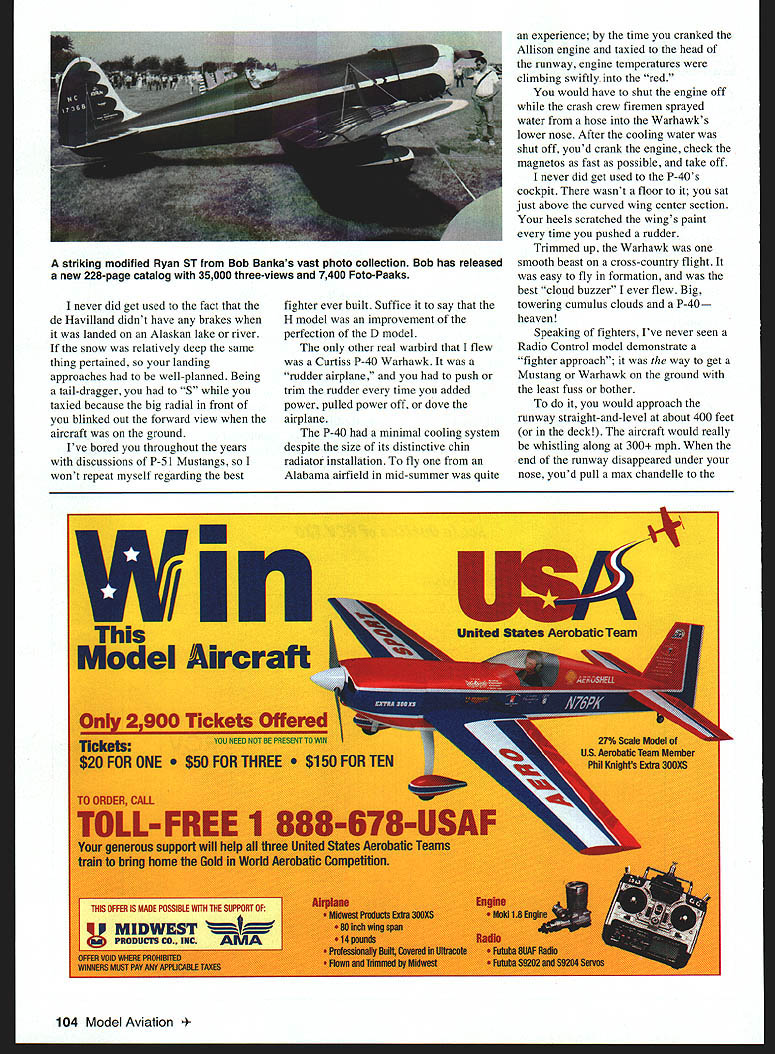
Bob Banka has published his 1999 catalog—a 228-page book that lists all 35,000 three-views in Bob's inventory and his 7,400 Foto-Paaks. The catalog is a most reasonable $8, and it includes definitive articles written by acknowledged scale-model experts.
Contact Bob Banka's Aircraft Documentation, 3114 Yukon Ave., Costa Mesa, CA 92628. He accepts Visa and MasterCard orders ($20 minimum), and his phone number is (714) 979-8058. Getting his catalog is a great scale-model investment!
Flight impressions — "L" aircraft and fighters
Probably the easiest warbird to check out was the Stinson L-5. The instructor pilot made the first landing, then let me make a couple. After he got out of the airplane, I took it up and over Mt. Fujiyama. One of the Stinson's features was "drooping ailerons." For really short landings you could crank down the ailerons to help with the flaps. The droop was necessary when you had to land on the 800-foot strip in the middle of downtown Yokohama, Japan! Cruising at about 100 mph, the L-5 was a friendly airplane to fly.
The Cessna L-19 flew similarly to its more numerous civilian counterparts: great visibility and no particular checkout problems. It flew like an aluminum L-5.
The de Havilland L-20 was entirely different; it was as strong as a tank. With its radial engine it was much faster than other L airplanes. It was stable as a rock, and I had the opportunity to fly it off floats, skis, and wheels—the latter configuration combined wheels projecting through the snow skis.
I never did get used to the fact that the de Havilland L-20 didn't have brakes. Landing on an Alaskan lake or river with relatively deep snow required well-planned approaches. Being a taildragger, you taxied carefully because the big radial blocked your forward view on the ground.
I've bored you throughout the years with discussions of P-51 Mustangs, so I won't repeat myself regarding the best fighter ever built. Suffice it to say the H model was an improvement on the D model's perfection.
The other real warbird I flew was the Curtiss P-40 Warhawk. It was a rudder airplane—trim with the rudder. Add power and it tended to climb; reduce power and it dove. The P-40 had a minimal cooling system despite its size—its distinctive chin radiator installation. Flying at an Alabama airfield in mid-summer provided quite an experience. One time I cranked the Allison engine, taxied to head for the runway, and engine temperatures climbed swiftly into the red; I would have shut the engine off. The crash crew and firemen sprayed the Warhawk with a water hose. After the cooling water was shut off, you'd crank the engine, check magnetos, and as fast as possible take off.
The P-40's cockpit sat just above the curved wing center section; my heels scratched the wing paint when I pushed the rudder. Trimmed up, the Warhawk was a smooth beast on cross‑country flights, easy to fly in formation. Big towering cumulus clouds—P-40 heaven.
Speaking of fighters, I've never seen a radio-control model demonstrate the fighter approach the way you'd get with a Mustang or Warhawk. The least fuss and bother would be to approach the runway straight-and-level about 400 feet deck; the aircraft would be really whistling along at 300 mph. At the end of the runway, when it disappeared under the nose, you'd pull a max chandelle; after about a 180° turn you'd dump landing gear and full flaps and begin descent.
The aircraft I neglected previously was the U-3 Cessna twin (the military version of the 310 model). It was called "The Blue Canoe" because it was painted blue. Its only idiosyncrasy was that you had to drain the wing tank sumps before flight. To do that you used a special hollow screwdriver that allowed any accumulated water to drain out onto the ramp. As did the militarized Aero Commander, the U-3 provided the comforts of home—leather seats and all. The U-3 had tip tanks that gave it a "warbird air," but the tricycle gear belied its civilian roots. The aircraft was strictly a straight-and-level cross-country airplane, and it handled the task perfectly.
A unique Giant Scale engine
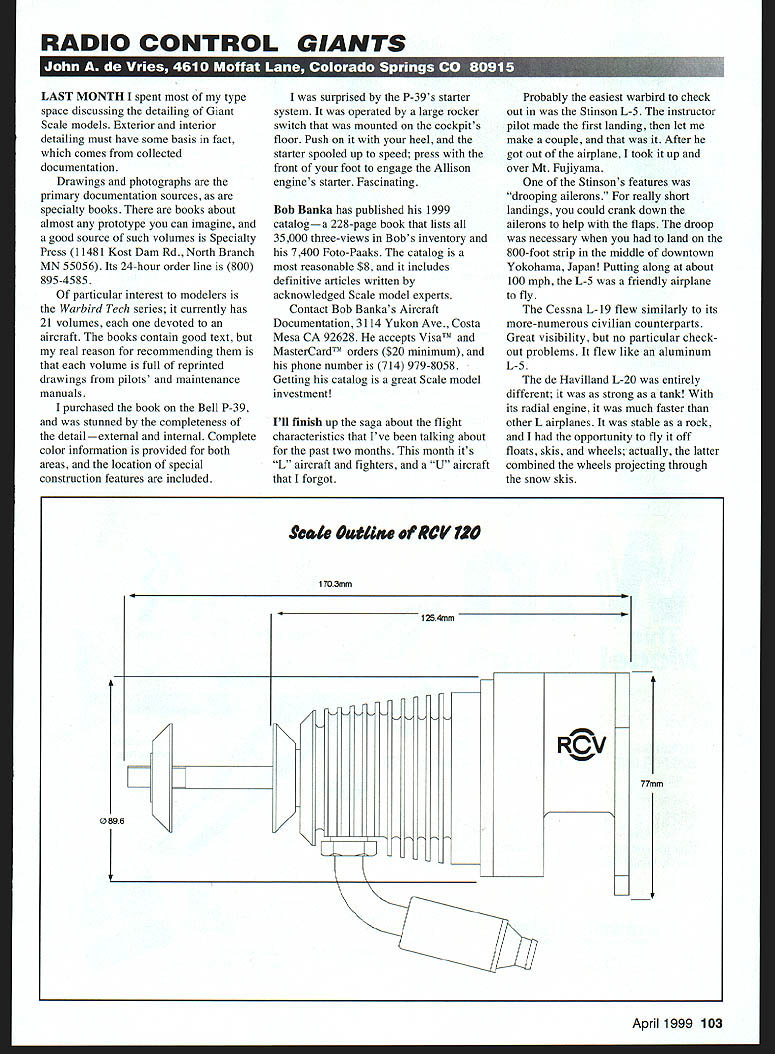
The British have come up with a Giant Scale engine that defies convention: the RCV 120. The propeller drive shaft is connected to the cylinder—the cylinder rotates. It's also geared so that the propeller turns half as fast as the engine. Using a special starter adapter, it is started from behind.
The best part is that all of the ironmongery is in a straight line; there's no cylinder projecting beyond the cowling on scale models of aircraft that had inline, liquid-cooled engines.
I've ordered one of the RCV 120s and hope to have it soon. According to the information at hand, the engine is as powerful as any other 120 four-stroker and, because of the gearing, is capable of turning scale-sized propellers. I've included a drawing of this unique power plant, and hope to have good photos of it for next month's column.
If you can't wait until next month, get information from RCV's web page: www.rcvengines.com. If you aren't on the Internet, send snail-mail requests for information to RCV Engines Ltd., 6 Haviland Road, Ferndown Industrial Estate, Wimborne, Dorset, England, BH21 7RF. Be sure to include an International Reply Coupon.
Back at you next month with more information on the RCV. Don't forget the big Toledo show coming up in early April.
Resources
- Specialty Press: 11481 Kost Dam Rd., North Branch, MN 55056 — 24-hour order line: (800) 895-4585.
- Warbird Tech series: 21 volumes with reprinted pilot and maintenance manual drawings.
- Bob Banka's Aircraft Documentation: 3114 Yukon Ave., Costa Mesa, CA 92628 — catalog $8; accepts Visa and MasterCard (minimum $20); phone: (714) 979-8058.
- RCV Engines Ltd.: www.rcvengines.com or 6 Haviland Road, Ferndown Industrial Estate, Wimborne, Dorset, England, BH21 7RF. Include an International Reply Coupon if mailing.
Transcribed from original scans by AI. Minor OCR errors may remain.

