

Radio Control: Giants
John A. de Vries
4610 Moffat Lane, Colorado Springs, CO 80915
Getting Started
Many, many years ago I got hooked on model airplanes. My interest was sparked by a 25¢ WACO Cabin biplane kit from the Scientific Model Co., typical for the era. Made with balsa sticks and Japanese tissue, the fuselage was red with a black stripe; the wings and tail feathers were yellow. I assembled it with Du Pont Duco glue and tightened the paper covering by blowing through a water siphon.
The propeller had been sanded from a rough balsa form; the wheels were also balsa, held on the wire axle with a drop of cement. A hay field across the road provided a perfect "tall grass testing area." The model glided well, so I gave the unlubricated rubber motor about 100 turns—and it flew in broad sweeping turns.
That red-and-yellow biplane got me hooked. It was followed by an all-balsa hand-launched glider that flew beautifully and a Denny Condor that won a $5 prize at the local polo field. The difference between then and now is that rubber bands are now often used to hold wings on Radio Control (RC) trainers. Things are bigger, noisier, and more expensive, but the thrill of watching your creation take to the air hasn't changed. Aerodynamic laws still work, and the same old thrill comes when a model flies as it's supposed to.
RCV Rotating-Cylinder Engines
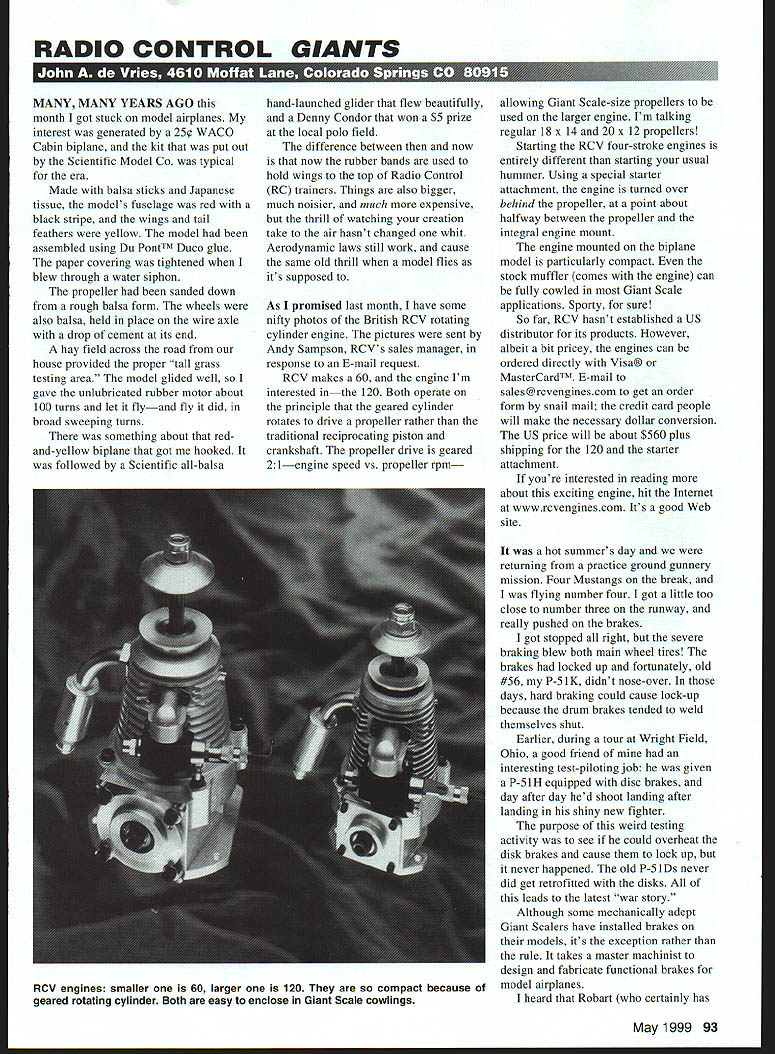
As promised last month, I received some great photos of the British RCV rotating-cylinder engine from Andy Sampson, RCV's sales manager.
RCV makes two sizes: a 60 and a 120. Both operate on the principle of a geared rotating cylinder that drives the propeller rather than a traditional reciprocating piston/crankshaft. The propeller is driven at a 2:1 reduction (engine speed vs. propeller rpm), which allows the use of Giant-Scale propellers such as 18 x 14 and 20 x 12.
Highlights:
- Models: RCV 60 and RCV 120.
- Propellers: supports typical Giant-Scale sizes (18 x 14, 20 x 12).
- Starting: uses a special starter attachment; the engine is turned over behind the propeller at a point about halfway between the prop and the integral engine mount.
- Installation: the engine is compact and can be fully cowled in many Giant-Scale applications; the stock muffler is included.
Ordering and price:
- RCV has not established a U.S. distributor yet. Engines can be ordered directly (Visa or MasterCard).
- Email sales@rcvengines.com to request an order form by mail; credit-card people will handle dollar conversion.
- Estimated U.S. price for the 120 plus the starter attachment is about $560, plus shipping.
- More information: www.rcvengines.com.
War Story: Brakes and Mustangs
It was a hot summer's day returning from a practice-ground gunnery mission. Four Mustangs were on the break; I was flying number four and got a little too close to number three on the runway. I really pushed on the brakes and stopped—but severe braking blew both main-wheel tires. The brakes had locked up; fortunately, old #56, my P-51K, didn't nose over. In those days, hard braking could cause lockup because drum brakes tended to weld themselves shut.
Earlier, during a tour at Wright Field, Ohio, a friend had an interesting test-piloting job: he was given a P-51H equipped with disc brakes and repeatedly shot landing after landing to see if he could overheat the discs and cause lockup. It never happened. The old P-51Ds never got retrofitted with discs. That history leads to the latest "war story."
Model Brakes
Although some mechanically adept Giant-Scale modelers have installed brakes on their models, it's the exception rather than the rule. It takes a master machinist to design and fabricate functional brakes for models.
I heard that Robart has developed a testing brake system for models. I emailed the company for information and they promised photos and technical details. Imagine a flight that starts with a remote-controlled engine run-up, taxis to the runway and, with radio control, applies brakes—everything controlled by radio. It boggles the mind.
Simulator Add-On
Tower Hobbies has finally shipped the second "Add-On" for its RC simulator. It includes many new models—electrics, ducted fans, turbines—and five new flying fields.
One big reason I ordered the second Add-On is that it includes a Fokker Triplane. The three-decker is a sensitive aircraft; my first three takeoffs resulted in nose-overs. Once airborne, though, it's as acrobatic as the original Disc's Ultra and a lot of fun.
The Sopwith Camel is probably the most stable of Add-On number two's models.
Back with you in the merry month of June, with any luck at all.
Transcribed from original scans by AI. Minor OCR errors may remain.

