
RADIO CONTROL GIANTS
John A. de Vries, 4610 Moffat Lane, Colorado Springs, CO 80915
I received an interesting letter from Fred Beeson, a retired U.S. Air Force maintenance crew chief and flight engineer. He flew in most of the full-scale aircraft and has a host of stories to tell, including a fascinating incident in a Mitchell B-25.
Fred was cruising along in the Mitchell when a hot rod pulled up on his wing in a Douglas B-26. The B-26 pilot dropped gear and flaps and feathered one engine. He gave the remaining R-2800 engine a bit of a push and pulled away from the B-25 with little difficulty.
Despite the super-swiftness of the B-26, my favorite cross-country propeller-driven airplane is a Mitchell. It had only one major problem: noise. Each of the B-25's cylinders had its own exhaust pipe; no collector ring was installed. The "crack" of the exhaust was deafening. Earphones helped, but after a long Mitchell trip, it took quite a while before your hearing returned to normal.
Featured Giants
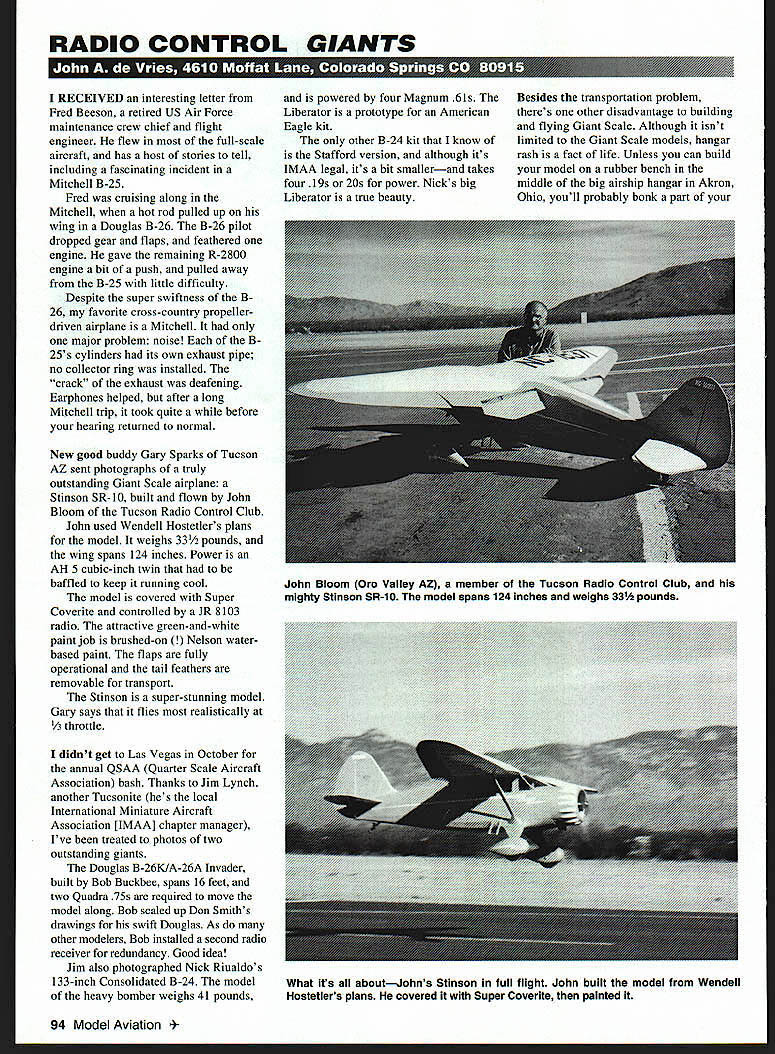
New good buddy Gary Sparks of Tucson, AZ sent photographs of a truly outstanding Giant Scale airplane: a Stinson SR-10, built and flown by John Bloom of the Tucson Radio Control Club.
- Model: Stinson SR-10, built from Wendell Hostetler's plans
- Weight: 33.5 pounds
- Wingspan: 124 inches
- Power: 0.5 cubic-inch twin engine (required baffling to keep it cool)
- Covering and radio: Super Coverite covering, JR 8103 radio
- Finish: Green-and-white paint brushed on with Nelson water-based paint
- Features: Fully operational flaps; removable tail feathers for transport
- Flight note: Flies most realistically at 1/3 throttle
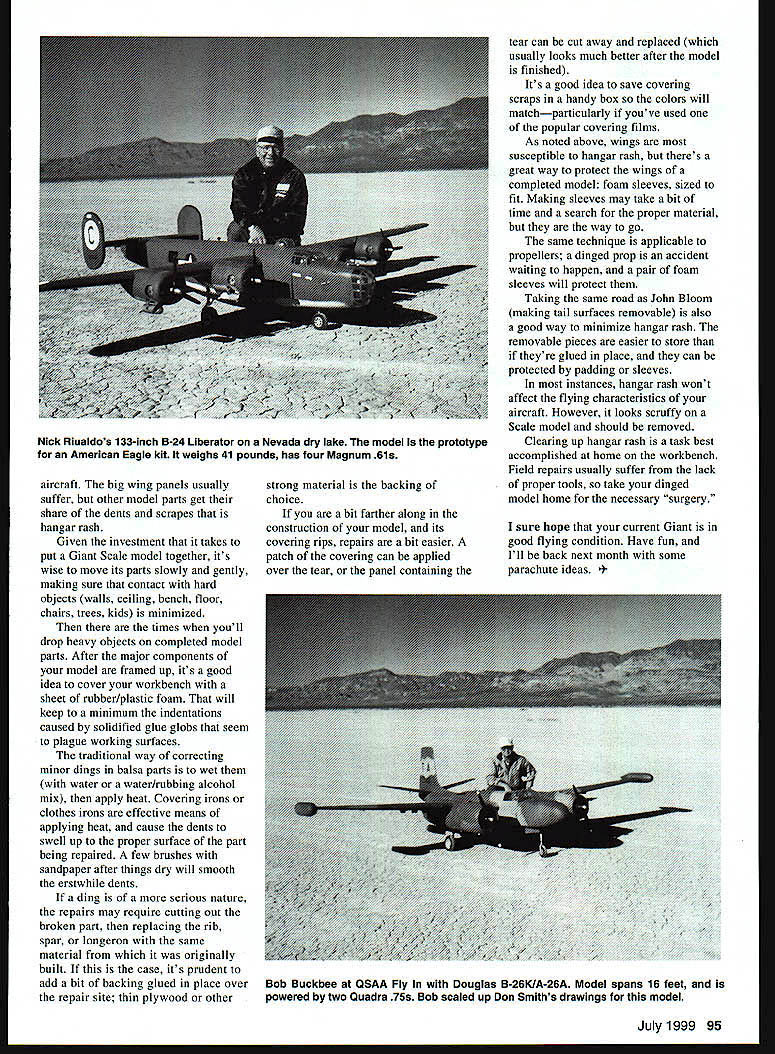
I didn't get to Las Vegas in October for the annual QSAA (Quarter Scale Aircraft Association) bash. Thanks to Jim Lynch, another Tucsonite (he's the local International Miniature Aircraft Association [IMAA] chapter manager), I've been treated to photos of two outstanding giants:
- Douglas B-26K/A-26A Invader, built by Bob Buckbee
- Wingspan: 16 feet
- Power: Two Quadra .75 engines
- Notes: Scaled-up from Don Smith's drawings; Bob installed a second radio receiver for redundancy
- Consolidated B-24, built by Nick Riualdo
- Wingspan: 133 inches
- Weight: 41 pounds
- Power: Four Magnum .61 engines
- Notes: Prototype for an American Eagle kit
The only other B-24 kit I know of is the Stafford version. Although it is IMAA legal, it's a bit smaller and takes four .19 or .20 engines for power. Nick's big Liberator is a true beauty.
Hangar Rash and Repairs
Besides the transportation problem, there's another disadvantage to building and flying Giant Scale models: hangar rash. Although not limited to Giant Scale, hangar rash is a fact of life. Unless you can build your model on a rubber bench in the middle of a big airship hangar in Akron, Ohio, you'll probably bonk a part of your model.
Given the investment required to build a Giant Scale model, it's wise to protect its parts and to slowly and gently minimize contact with hard objects (walls, ceiling, bench, floor, chairs, trees, kids) when you must handle or move components. When heavy objects fall onto completed model parts, damage can be extensive.
After major components are framed up, cover the workbench with a sheet of rubber or plastic foam. This will minimize indentations caused by solidified glue globs and other hazards on working surfaces.
Minor dents in balsa can often be corrected by wetting the part with water or a water/rubbing-alcohol mix and then applying heat. Covering irons or clothes irons are effective; heat causes dents to swell up. After the part dries, a few strokes of sandpaper will smooth the repaired area.
A serious ding may require cutting out the broken part and replacing a rib, spar, or longeron with the same material originally used. In that case, add a bit of backing glued in place over the repair site—thin plywood or other strong material is a good choice.
When the model is covered, repairs are easier. You can apply a patch of covering over a tear or cut away a panel containing the tear and replace it. It usually looks much better after finishing. Save covering scraps in a handy box so colors will match—particularly if you've used popular covering films.
Wings are especially susceptible to hangar rash. There's a great way to protect them: completed-model foam sleeves sized to fit. Making sleeves may take some time and a search for proper material, but they are worth it.
The same technique applies to propellers; a dinged prop is an accident waiting to happen, and a pair of foam sleeves will protect them.
Making tail surfaces removable, as John Bloom did, is another good way to minimize hangar rash. Removable pieces are easier to store and can be protected by padding or sleeves.
In most instances, hangar rash won't affect the flying characteristics of your aircraft. However, it looks scruffy on a scale model and should be corrected. Field repairs usually suffer from lack of proper tools, so take your dinged model home for the necessary "surgery."
I hope your current Giant is in good flying condition. Have fun, and I'll be back next month with some parachute ideas.
Transcribed from original scans by AI. Minor OCR errors may remain.

