
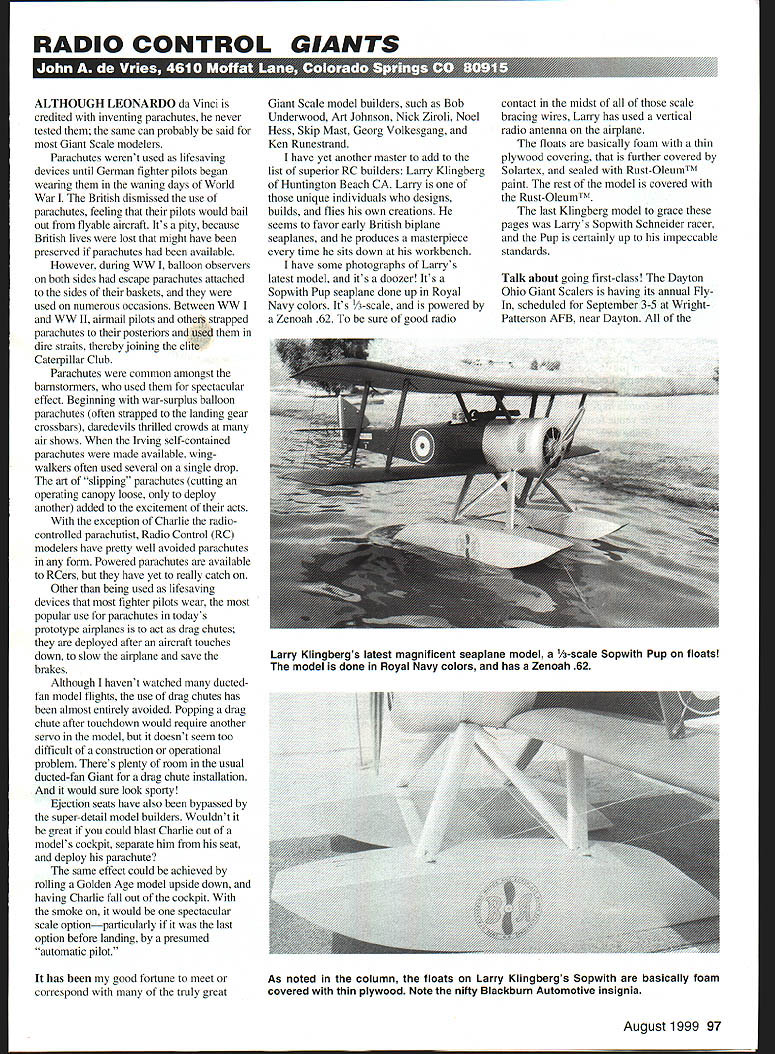
RADIO CONTROL GIANTS
Author
John A. de Vries 4610 Moffat Lane, Colorado Springs, CO 80915
Parachutes in aviation and modeling
Although Leonardo da Vinci is credited with inventing parachutes, he never tested them; the same can probably be said for most Giant Scale modelers.
Parachutes weren't used as lifesaving devices until German fighter pilots began wearing them in the waning days of World War I. The British dismissed the use of parachutes, feeling that their pilots would bail out from flyable aircraft. It's a pity, because British lives were lost that might have been preserved if parachutes had been available.
During WW I, balloon observers on both sides had escape parachutes attached to the sides of their baskets, and they were used on numerous occasions. Between WW I and WW II, airmail pilots and others strapped parachutes to their posteriors and used them in dire straits, thereby joining the elite Caterpillar Club.
Parachutes were common among the barnstormers, who used them for spectacular effect. Beginning with war-surplus balloon parachutes (often strapped to the landing gear crossbars), daredevils thrilled crowds at many air shows. When the Irvin self-contained parachutes were made available, wingwalkers often used several on a single drop. The art of "slipping" parachutes (cutting an operating canopy loose, only to deploy another) added to the excitement of their acts.
With the exception of Charlie the radio-controlled parachutist, radio control (RC) modelers have pretty well avoided parachutes in any form. Powered parachutes are available to RCers, but they have yet to really catch on.
Other than being used as lifesaving devices that most fighter pilots wear, the most popular use for parachutes in today's prototype airplanes is to act as drag chutes; they are deployed after an aircraft touches down to slow the airplane and save the brakes.
Although I haven't watched many ducted-fan model flights, the use of drag chutes has been almost entirely avoided. Popping a drag chute after touchdown would require another servo in the model, but it doesn't seem too difficult of a construction or operational problem. There's plenty of room in the usual ducted-fan Giant for a drag chute installation, and it would sure look sporty!
Ejection seats have also been bypassed by the super-detail model builders. Wouldn't it be great if you could blast Charlie out of a model's cockpit, separate him from his seat, and deploy his parachute?
The same effect could be achieved by rolling a Golden Age model upside down and having Charlie fall out of the cockpit. With the smoke on, it would be one spectacular scale option—particularly if it was the last option before landing, by a presumed "automatic pilot."
Giant Scale builders and Larry Klingberg
It has been my good fortune to meet or correspond with many of the truly great Giant Scale model builders, such as Bob Underwood, Art Johnson, Nick Ziroli, Noel Hess, Skip Mast, Georg Volkesgang, and Ken Runestrand.
I have yet another master to add to the list of superior RC builders: Larry Klingberg of Huntington Beach, CA. Larry is one of those unique individuals who designs, builds, and flies his own creations. He seems to favor early British biplane seaplanes, and he produces a masterpiece every time he sits down at his workbench.
I have some photographs of Larry's latest model, and it's a doozie! It's a Sopwith Pup seaplane done up in Royal Navy colors. It's 1/3-scale and is powered by a Zenoah .62. To be sure of good radio contact in the midst of all of those scale bracing wires, Larry has used a vertical radio antenna on the airplane.
The floats are basically foam with a thin plywood covering; that is further covered by Solartex and sealed with Rust-Oleum paint. The rest of the model is covered with Solartex and Rust-Oleum.
The last Klingberg model to grace these pages was Larry's Sopwith Schneider racer, and the Pup is certainly up to his impeccable standards.
Dayton Ohio Giant Scalers Fly-In
Talk about going first-class! The Dayton Ohio Giant Scalers is having its annual Fly-In, scheduled for September 3–5 at Wright-Patterson AFB, near Dayton. The huge full-scale runway venue features an unobstructed flying area, will include a special evening tour of the Air Force Museum Saturday night, and will include a showing in the IMAX theater. The club has scheduled an antiques tour for non-participants Saturday afternoon.
Pre-registration is $15. Make out checks to Dayton Ohio Giant Scalers, Box 14026, Dayton, OH 45413. For details, a meet brochure — a full-color advertising folder — can probably be obtained from event director Frank Noll Jr., 6042 Norwell Dr., Dayton, OH 45449. Tel. 937-435-9232.
I sure wish Ohio wasn't far.
Jim Messer and retirement projects
Colorado surprised me—I heard from old friend Jim Messer. Jim is a member of the STARS club in Olean, NY, and is retired in Sebring, Florida. We learned we have much in common about big RC model airplanes. My column describing difficulties landing the C-123 brought back some vivid memories.
He was an engineer on the first flight of the "X" (prototype) aircraft, and took down all of the data that would ultimately show up in the Pilot's Notes. Jim was working for the Chase Aircraft Co. at the time (the design was later sold to Fairchild, which produced the C-123 in numbers).
I was surprised to learn from Jim that not only were the fuel tanks jettisonable (they formed the rear of the engine's nacelles), but the engines were jettisonable as well!
Jim, who was one of the great pioneers in the Giant Scale business, noted how his "retirement" was going. While he was still active in the STARS, he designed, built, and flew two outstanding Giant Scale models. He kitted the Brodie and the Piper Tomahawk, and they flew great.
Jim found it a bit difficult to get an "in" with the hobbyists in Florida until he designed a 1/3-scale version of the Piper J-4. The 12-foot model was powered by a G-62, and Jim volunteered to cut a kit for anyone who wanted to build one.
Three guys he didn't even know took him up on his offer, and one of them was the local hobby shop owner, Jim Hofer. Although Jim Messer built his model at home, Jim Hofer offered space in the back of his shop to the other Piper builders. That "broke the local ice," and Jim Messer was accepted by the locals.
One of the club members asked Jim Messer to help him design a clipped-wing Taylorcraft. They designed a 1/4-scale version of the monoplane for a G-23 or YS 120. Four builders constructed five of the Taylorcrafts, and, as were the J-4s, they were excellent fliers.
While all of this was going on, Jim designed and built a 40% (approx. 1/3-scale) Kitten and a 1/4-scale Ercoupe. According to him, the latter flies like a P-51! The local fliers were so impressed with the Ercoupe that 10 of them requested kits. Jim obliged, and seven more Ercoupes were soon airborne.
Jim's latest "retirement project" was a 1/4-scale version of the old E-2 Piper Cub. Power for the model was the Quadra 35/41. Thirteen eager modelers signed up for E-2 kits.
Jim was operating from a vast store of balsa that he acquired a long time ago; for $750, he ended up with a garage full of balsa that he purchased as "war surplus." Before he retired, he sold his model business to Dave Reid of Phelps, NY, who still markets kits that Jim designed.
I suspect that when Jim retired, he looked forward to the Florida trip with great delight and didn't have the least intention of going back into the kitmaking business, however informal it may be. But everything that Jim Messer designs flies like a bird, and his designs are marvelously simple. He has the "touch" for certain, and a very busy retirement!
Closing
With any luck at all, I'll be back with you next month. Till then, have a most pleasant summer, and keep 'em flying!
Transcribed from original scans by AI. Minor OCR errors may remain.

