
Radio Control: Giants
John A. de Vries — 4610 Moffat Lane, Colorado Springs CO 80915
We're going to play catch-up this month on a few items we've written about this year. A couple of items may be of interest.
Jerry Smartt — Giant-scale Sopwith and shop
You probably remember Jerry Smartt, the giant-scale builder from Warsaw, MO. He's the fellow building the 1/2-scale Sopwith; we published a photo of him standing inside the framed-up fuselage of his monster biplane.
Jerry's other claim to fame is his use of multiple RC receivers to cut down on long cable runs. The latest word is that Jerry has decided to use four RC receivers in his biplane:
- one receiver in each wing,
- one to control the tail surfaces,
- and a fourth to control his electronic throttle.
He’s talking four sets of batteries and the attendant charging receptacles and switches. It's mind-boggling!
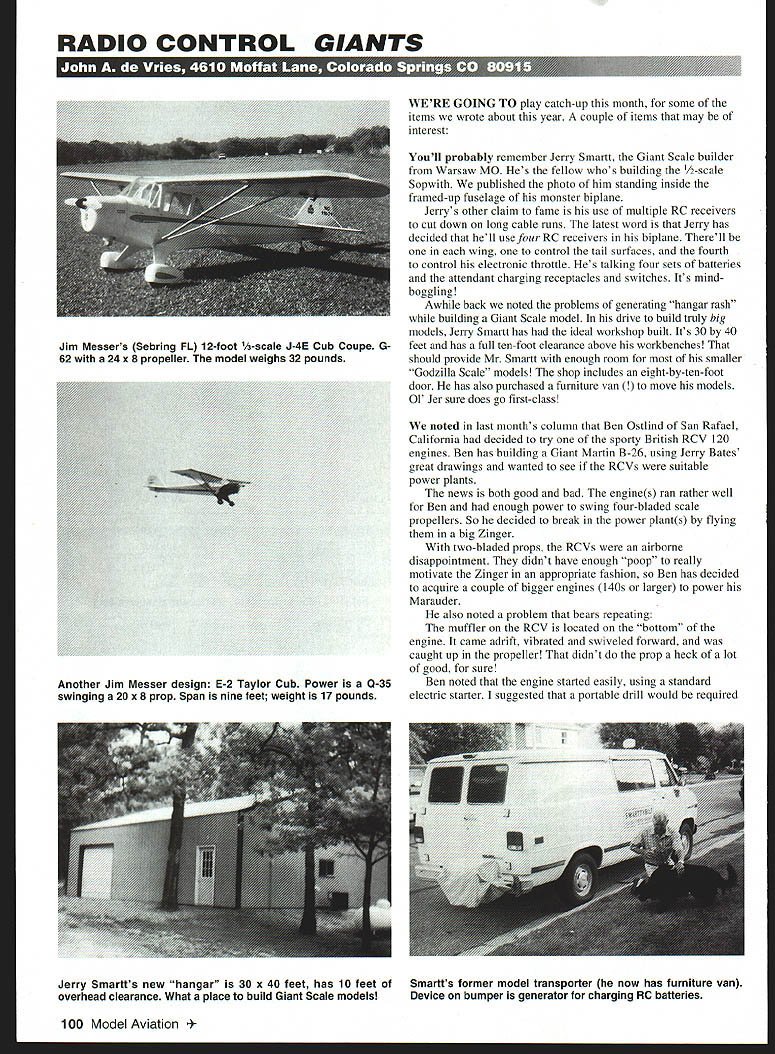
In his drive to build truly big models, Jerry has had the ideal workshop built. It's 30 by 40 feet with a full ten-foot clearance above his workbenches — plenty of room for most of his smaller "Godzilla scale" models. The shop includes an 8-by-10-foot door. He has also purchased a furniture van to move his models. Ol' Jer sure goes first-class!
Ben Ostlind and the British RCV 120 engines
Last month we noted that Ben Ostlind of San Rafael, California, had decided to try one of the sporty British RCV 120 engines. Ben has been building a giant Martin B-26 using Jerry Bates' great drawings and wanted to see if the RCVs were suitable power plants.
The news is both good and bad:
- The engines ran rather well and had enough power to swing four-bladed scale propellers.
- Ben broke in the engines by flying them in a big Zinger. With two-bladed props, however, the RCVs were an airborne disappointment — they didn't have enough grunt to motivate the Zinger properly. Ben has decided to acquire a couple of bigger engines (.40s or larger) to power his Marauder.
- He also encountered a serious muffler problem: the muffler on the RCV is located on the bottom of the engine. It came adrift, vibrated, swiveled forward, and was caught up in the propeller, which badly damaged the prop.
- The engine started easily using a standard electric starter. I had suggested that a portable drill might be required to turn the RCV over; Ben didn't have any problems with the normal starter once he'd set up the RCV starting attachment.
Kill switch harness for gasoline engines
While surfing the Net I came across a nifty accessory for folks who power giant-scale models with gasoline engines. R/C Online’s "new items" column included a Great Planes product I hadn't seen advertised: an engine-kill switch harness that provides stopping a gas engine manually and by servo action.
The harness includes:
- a manual switch and an attractive externally mounted switch plate,
- a microswitch system that requires a separate servo for the remote-kill function.
The remote-kill function shouldn't require a particularly strong servo. Price: about $9.95 — a nifty system at a reasonable cost for big models.
Scale details — war bonnets, struts, gear and cockpits
A large pastel portrait of an Indian chief hangs above my desk. At a quick glance it looks real enough, but closer inspection reveals the artist didn't know diddley-squat about eagle-feather war bonnets. In the genuine article, each feather has a thin leather loop bound to its quill used to hold the feather to an interior skull cap. In most cases that binding is covered by a felt cylindrical tube and finally wrapped with two or three wraps of contrasting-color yarn. In the portrait the feathers were wrapped only in yarn.
A very similar situation often applies to giant-scale model airplanes: they may "look" scale, but closer examination often shows the builder wasn't aware of how the full-size airplane was constructed.
Common scale inaccuracies:
- Strut positioning: On full-scale multiwing aircraft, cabane and interplane struts are connected to the wing spars through metal fittings. Because it's easier on models, struts are frequently mounted to flat bits of plywood and are positioned fore or aft of the true spar locations. They hold the model together but are not scale.
- Flying and landing wire attachments: End fittings on full-scale aircraft are frequently located inside the wing and tail covering. Replicating that on a scale model creates covering and assembly problems at the flying field; digging through reinforced holes in the covering to assemble a model is difficult for most of us.
- Landing gear location: Wheels and gear struts are frequently shifted forward from their scale position to improve ground handling, especially on fixed-gear taildraggers. This is often undetectable at first glance.
- Retractable gear and spars: Because of model wing construction, retracts are often placed so they won't interfere with the main spars. Installing retracts in a Messerschmitt Bf 109 or a Spitfire can be a real headache; cutting into a main spar near the fuselage is a no-no, so the whole installation is usually moved back, harming scale accuracy.
- Cockpit padding: Open-cockpit aircraft often had leather padding laced to the cockpit rim with thin leather thongs to protect the airman from sharp edges. On models the padding is often present but glued in place with Elmer's or epoxy rather than laced.
- Music-wire struts: With very few exceptions, full-scale airplanes do not use music wire for landing gear struts. Scale struts with forged wheel attachments are available for many late-war and transport airplanes; they look great but are pricier. Yet many fielded models still show bare music-wire struts and simple wheel covers. With full-scale strut and wheel covers, the gear only looks right when retracted and the model is flying.
Happily, detailed cockpit "kits" are beginning to appear on the market. These beautiful (usually vacuum-formed) commercial cockpits save a lot of research and skill when duplicating instruments, handles, and switches. So far they are largely limited to warbirds, so builders of other, less-popular scale subjects are still on their own. Just make sure you don't have more felt wrappings than feathers!
Back atcha in the January issue. Sure hope the Y2K bug doesn't bite you and that you've picked this winter's building project and are well on the way with it. +
Transcribed from original scans by AI. Minor OCR errors may remain.

